











AI’s Next Test: Strong Demand Meets Tighter Governance and a Debt-Funded Buildout
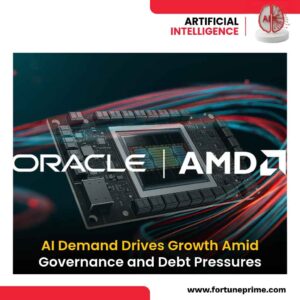
The latest wave of AI news captures the industry’s central tension: demand for chips, servers, and inference capacity remains exceptionally strong, while banks, investors, and credit markets are beginning to police how aggressively companies pursue it. AMD and Super Micro delivered above-consensus outlooks on AI infrastructure demand, Fal doubled its valuation to $16 billion, and Goldman Sachs restricted AI coding tools for most employees—just as Oracle, Meta, Microsoft, and Alphabet return to debt markets to finance the buildout.
Key Takeaways:
- AI infrastructure demand remains strong: AMD forecasts $17 billion in quarterly revenue, while Super Micro projects $19.5 billion–$21.5 billion, both above analyst expectations.
- Enterprise AI governance is tightening. Goldman Sachs restricted advanced AI coding tools to engineers following a review of productivity and risk concerns.
- Inference infrastructure continues attracting capital. Fal raised $1.3 billion at a $16 billion valuation, doubling its April valuation.
- Debt-funded AI expansion is increasing financial exposure as major technology companies tap capital markets. Oracle’s $10 billion bond sale illustrates the growing reliance on external funding.
- Return on investment is becoming a decisive test: investors want AI spending to produce sustainable revenue, margins, and cash flow, not simply higher infrastructure expenditure.
A demand story with financial strings attached
AI spending is no longer just a technology story; it has become a capital-markets story. The immediate evidence is in supplier guidance: AMD forecast fourth-quarter revenue of $17 billion, plus or minus 3%, above the average analyst estimate of $16.3 billion, citing continued strength in data-center processor demand.
Super Micro went further, guiding to December-quarter revenue of $19.5 billion to $21.5 billion and adjusted earnings of $1.66 to $1.90 per share—well above Bloomberg-compiled consensus of $16.5 billion in revenue and $1.08 in adjusted profit. The company attributed the outlook to demand for servers packed with AI chips.
| Company | Signal | Market implication |
|---|---|---|
| AMD | Q4 revenue guidance of $17 billion, above $16.3 billion consensus | AI accelerator demand remains broad enough to support a credible Nvidia challenger. |
| Super Micro | Q4 revenue guidance of $19.5 billion–$21.5 billion, versus $16.5 billion consensus | Server integrators are seeing direct, near-term AI infrastructure demand. |
| Fal | $1.3 billion raise at a $16 billion valuation, double its April valuation | Private-market capital is still chasing AI inference capacity. |
| Oracle | $10 billion bond sale alongside roughly $9.9 billion of equity | AI infrastructure is increasingly financed with external capital, not solely operating cash flow. bloomberg |
The connecting theme is that AI’s demand curve still looks steep—but the financing, governance, and return-on-investment questions are becoming harder to ignore.
Goldman’s guardrails show enterprise AI is maturing
Goldman Sachs has restricted use of advanced AI coding tools, including Anthropic’s Claude Code and Microsoft’s GitHub, to engineers after previously allowing bankers access. The bank made the change following a review of productivity and risk concerns, according to internal guidance seen by Bloomberg.
This matters because it punctures the assumption that AI adoption will be uniformly expansive across a large financial institution. For banks, coding agents can create benefits in software development but also introduce risks around data handling, model behavior, auditability, and operational resilience. Goldman’s move suggests a more segmented rollout: broad experimentation may give way to role-based access controls, especially in revenue-generating and control-sensitive functions.
For enterprise-software vendors, the implication is mixed. Demand for AI tools remains real, but financial firms may increasingly demand deployment models with stronger permissions, monitoring, data segregation, and compliance controls. That favors vendors able to offer enterprise-grade governance rather than simply raw model capability.
Chip and server strength confirm the infrastructure cycle
AMD’s guidance is notable because it suggests AI demand is not confined to one supplier. As a key challenger to Nvidia, AMD’s above-consensus outlook points to continued appetite for data-center processors and a market large enough to support multiple vendors.
Super Micro’s outlook adds the systems-layer confirmation. Its guidance implies that customers are not merely buying chips; they are buying complete AI server infrastructure at a scale that is lifting near-term revenue expectations materially above Street estimates.
The investment implication is that the AI trade remains anchored in physical capacity: accelerators, servers, networking, power, cooling, data centers, and energy. But it also raises the bar for later-stage validation. Investors will increasingly look for evidence that infrastructure spending converts into durable revenue, margins, and cash flow rather than merely more capex.
Fal’s valuation shows private capital still believes in inference
Fal, which hosts image, video, and audio models for developers and creators, raised $1.3 billion in October at a $16 billion valuation, doubling from the $8 billion valuation set in an April round led by Sequoia. Bessemer Venture Partners led the new round, with participation from Nvidia, Sound Ventures, HOF Capital, and T. Rowe Price.
The rapid valuation doubling highlights where investors see the next bottleneck: inference. Training models attracts headlines, but serving models reliably, cheaply, and at scale is becoming a recurring-revenue business tied directly to end-user adoption. Fal’s backing by Nvidia also underscores how strategic inference infrastructure has become across the AI stack.
Still, a $16 billion valuation for a young inference company is a reminder that private-market pricing can move faster than demonstrated earnings. The key question is whether inference demand grows quickly enough to justify the capital being committed to capacity, chips, and data centers.
The debt question: AI capex enters its financing phase
Oracle sold $10 billion of investment-grade dollar bonds on Monday while also raising about $9.9 billion in equity. Bloomberg reported that Meta Platforms is considering at least $20 billion of potential debt across multiple currencies, Microsoft sold $25 billion of bonds in its first US offering since 2017, and Alphabet raised debt in Europe for the second time this year.
That shift is significant. In the earlier phase of the AI boom, hyperscalers could fund data centers largely from enormous operating cash flows. Now, the scale and speed of the buildout are pulling in bond investors, equity issuance, and potentially more complex financing structures. Oracle’s simultaneous debt and equity raise is a particularly clear example of AI infrastructure becoming a capital-intensive, balance-sheet-heavy undertaking.
The debate is not whether AI demand exists—the supplier guidance suggests it does. It is whether the returns on that demand will arrive quickly enough to service the debt, justify the depreciation, and support current valuations.

What markets should watch
- Credit spreads and bond demand: Watch how investors price Oracle, Meta, Microsoft, and Alphabet debt. Tight spreads would signal confidence in cash-flow durability; widening spreads would signal concern about capex intensity and leverage.
- Server and chip guidance: AMD and Super Micro results provide a near-term read on whether AI infrastructure demand is accelerating, plateauing, or becoming more concentrated among a few buyers.
- Enterprise AI adoption policies: Goldman’s restrictions may presage more formal AI governance frameworks across banks, insurers, and other regulated industries.
- Inference economics: Fal’s valuation will be tested by whether inference providers can sustain pricing, utilization, and gross margins as competition increases.
- Power and data-center constraints: Bloomberg’s AI coverage highlights the sector’s growing need for data centers, power, water, land, and chips—constraints that could determine how quickly announced capacity becomes revenue-generating infrastructure.
Bottom line
AI demand is still strong enough to produce upside surprises at AMD and Super Micro, and private investors are still willing to pay up for inference infrastructure. But the market is entering a more demanding phase: enterprises are imposing controls, lenders are being asked to fund larger buildouts, and investors are beginning to distinguish between genuine demand and capital-cycle exuberance.
The next phase of the AI trade will likely be decided less by whether models improve and more by whether the industry can convert unprecedented infrastructure spending into measurable productivity, profitable revenue, and sustainable financing.
People Also Ask
What is driving demand for AI infrastructure?
Growing use of AI models requires more data-center processors, servers, and inference capacity. AMD’s and Super Micro’s above-consensus forecasts indicate continued demand for the hardware needed to run these workloads.
Why are financial institutions tightening AI governance?
Financial institutions must manage data security, auditability, and operational risk alongside potential productivity gains. Goldman Sachs’ restrictions illustrate a shift toward role-based access rather than unrestricted employee adoption.
Why is AI inference attracting investor interest?
AI inference involves running trained models to generate outputs for users. As adoption increases, providers that deliver reliable, cost-efficient model access can build recurring revenue, helping explain investor interest in companies such as Fal.
What risks come with debt-funded AI expansion?
Debt financing adds interest costs and repayment obligations before infrastructure necessarily generates sufficient returns. If demand or monetization falls short of expectations, companies could face pressure on cash flow and profitability.
What should investors watch during the AI buildout?
Investors should track whether capital expenditure translates into durable revenue, healthy margins, and stronger cash flow. Enterprise adoption, governance requirements, and infrastructure utilization also help assess whether expansion is sustainable.