







World Leaders Split Over Global AI Controls as Artificial Intelligence Dominates UN Discussions
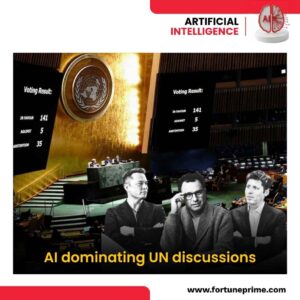
Artificial intelligence has taken center stage at the United Nations General Assembly. Governments and technology executives are debating how to manage the risks of advanced systems without slowing innovation. The talks have revealed a clear divide. Some countries want international safeguards. The United States is focused on keeping its lead in the global AI race. This debate shapes the current situation in the Artificial Intelligence Industry and carries implications for technology markets, national security and economic competition.
The discussions highlight how quickly AI systems are advancing. At the same time, international talks move more slowly. Policymakers are examining effects on military decisions, critical infrastructure, employment and elections. The outcome will influence investment patterns and operating costs across the Artificial Intelligence Industry.
Key Takeaways:
- Artificial Intelligence dominates discussions at the UN General Assembly, highlighting rapid AI advancements and slower policy responses.
- An emerging coalition led by countries like Canada, France, and Norway advocates for international AI safeguards and standards.
- The United States prioritizes maintaining its lead in the global AI race, opposing a global governance approach to AI regulation.
- UN Secretary-General warns of severe risks from unmanaged AI, calling for a multilateral framework to assess and manage AI-related threats.
- Industry leaders like Sam Altman and Dario Amodei support international safeguards, emphasizing the need for universal standards.
Emerging Coalition Seeks International Safeguards
Leaders from Canada, France and Norway have been building contacts around protective measures. Their talks point to growing interest in shared standards, risk assessments and other controls. French President Emmanuel Macron has backed stronger international cooperation on AI governance. The United Kingdom has also called for global standards. Officials there have warned that AI could intensify disinformation campaigns and make deepfakes harder to detect.
This effort reflects a wider concern. AI development is moving faster than governments can set common rules. Supporters of international controls argue that national rules alone may not be enough. AI systems, online platforms and potential threats often cross borders. As a result, several governments are exploring coordinated approaches.
In addition, a group of 22 countries has adopted a declaration calling for AI to remain under human direction, oversight and control. The statement urges stronger transparency, mandatory testing before deployment and independent evaluations. It also floats the idea of an international institution that could set standards and enable verification. Finland and Norway played leading roles in the declaration. However, the United States and China did not join.
UN Officials Highlight Severe Risks
AI featured prominently in UN discussions, including a specialized briefing of the UN Security Council. UN Secretary-General António Guterres warned that poorly managed artificial intelligence could cause catastrophic and irreversible harm. He called for an independent, multilateral framework to assess and manage AI-related risks.

Guterres specifically rejected the development of autonomous weapons that could make life-and-death decisions without meaningful human control. “Killer robots must have no place in our future,” he said. The warnings go beyond misinformation and cybercrime. Policymakers are also looking at impacts on military decision-making, critical infrastructure, jobs, elections and international security.
Meanwhile, the Security Council heard from industry leaders. OpenAI Chief Executive Sam Altman and Anthropic Chief Executive Dario Amodei both urged governments to create international safeguards for advanced AI systems. Amodei described unmanaged AI as a potential risk to humanity as a whole. Altman warned that society could lose control of the future to AI. He argued that decisions of such importance should not be left solely to technology companies based in San Francisco.
Both executives supported universal standards for evaluating the risks of powerful AI systems. These could include testing requirements, reporting procedures, safety benchmarks and mechanisms for notifying governments about serious incidents. Their calls for regulation stand out. Technology companies have often resisted rules that could limit development or raise compliance costs. Yet the companies also face growing pressure to show that their systems can be deployed safely.
United States Rejects Global Governance Approach
U.S. President Donald Trump has taken a different position from many leaders calling for international guardrails. During his UN address, he opposed what he described as a “globalist agenda” to regulate AI. Trump also sought to rebrand artificial intelligence as “Super Intelligence,” or “SI.” He argued that the word “artificial” makes the technology sound fake. At the same time, he acknowledged that governments must still be careful about its use.

The president has repeatedly said that the United States must win the global AI competition. His administration has warned that international discussions should not evolve into a system of global governance. Such a system, officials argue, could restrict American technology companies or weaken U.S. strategic advantages. White House science adviser Michael Kratsios reinforced this stance at the Security Council. He said the United States rejects any attempt to construct a globalist scheme of control over superintelligence. Countries should preserve national sovereignty on governing AI rather than hand responsibility to international bodies.
This position places Washington at odds with governments that view international regulation as necessary. Those governments fear a race to the bottom, in which countries compete by offering the fewest restrictions on powerful AI systems. In contrast, the United States emphasizes competitiveness and technological leadership. Officials aligned with this view argue that excessive regulation could allow rivals to gain an advantage.
Despite the public disagreement, diplomatic contacts between Washington and Beijing have reportedly included discussions about a bilateral AI safety-notification mechanism. Such an arrangement could help the two countries inform each other about serious AI incidents or unexpected risks. Even so, the broader divide over global governance remains.
Challenges to Reaching Agreement
The debate at the United Nations underlines a central difficulty for policymakers. AI is developing rapidly. International negotiations, by comparison, move slowly. Countries supporting global controls are likely to seek cooperation in several areas. These include common safety and risk-evaluation standards, rules for reporting major AI incidents, measures against AI-generated disinformation and deepfakes, human oversight of military AI systems, international coordination on cybersecurity and critical infrastructure, and greater transparency from companies developing advanced models.
The United States, meanwhile, continues to stress competitiveness. Officials argue that heavy regulation could slow American progress. As a result, a comprehensive global agreement remains difficult to achieve. The emerging alliance among Canada, France, Norway and other nations shows that support for international safeguards is growing. However, resistance from the United States limits the reach of any new framework.
For those new to related market concepts, Forex Trading Basics offers essential insights into trading fundamentals that can help readers understand how technology and policy shifts interact with broader financial markets.
Market and Geopolitical Implications for the AI Industry
The dispute over AI controls is becoming part of a wider strategic competition. This competition involves technology, national security and economic power. Countries that develop leading AI systems may gain advantages in defense, industrial productivity, financial services and scientific research. At the same time, stricter regulations could increase compliance costs for technology companies. They could also affect investment in AI infrastructure.
Semiconductor manufacturers, cloud-computing providers, data-center operators and software companies could all feel the effects of new rules governing advanced models. For markets, the policy divide creates both opportunities and risks. A framework focused on safety and transparency could improve investor confidence by reducing the chance of major accidents or sudden regulatory shocks. However, conflicting national rules could fragment the Artificial Intelligence Industry. They could raise operating costs and limit cross-border development.
Fortune Prime Global is a reputable Forex Broker that benefits its clients by providing access to global markets and educational resources in a regulated environment. The firm monitors developments across technology and policy that can influence market conditions.
The UN discussions therefore represent more than a debate over technology policy. They are also an early contest over who will define the rules of the next major phase of the digital economy. Support for international safeguards is expanding among some governments. Yet the United States’ resistance means that a comprehensive global agreement remains hard to reach.
Neutral Outlook on the Current Landscape
The current situation in the Artificial Intelligence Industry is defined by rapid technical progress and divergent national approaches. World leaders continue to discuss risk management, safety standards and competitive positioning. Industry executives have called for international cooperation. UN officials have highlighted potential harms. The United States has rejected a globalist regulatory model in favor of national leadership.
These positions will continue to shape investment, infrastructure and cross-border collaboration. The path to shared rules remains complex. Diplomatic engagement continues, including bilateral contacts on safety notifications. The broader contest over governance frameworks is still unfolding.
People Also Ask:
Q: Why is there a divide among world leaders on AI controls?
A: The divide stems from differing priorities; some countries prioritize international safeguards to manage risks, while others, like the U.S., focus on maintaining competitive advantages and oppose global governance.
Q: What are the potential risks of unmanaged AI according to UN officials?
A: UN officials warn that poorly managed AI could lead to catastrophic harm, impacting military decisions, critical infrastructure, jobs, elections, and international security.
Q: How are technology executives contributing to the AI governance debate?
A: Executives from companies like OpenAI advocate for international safeguards and universal standards to safely deploy advanced AI systems, highlighting the risks of leaving such decisions solely to tech companies.