











AI Jitters and Geopolitical Threats Mark Start of Busy Week in Markets
U.S. stocks opened the week lower on Monday as AI jitters and geopolitical threats weighed on major indexes. Semiconductor and technology shares led the decline. The Nasdaq Composite and S&P 500 finished lower while the Dow Jones Industrial Average posted a modest gain. Investors focused on chip makers and AI-related names amid concerns over spending and valuations. Fresh tensions involving Iran and trade talks with Canada added to the cautious tone.
This early-week move set the stage for a busy calendar. Key earnings reports and inflation data remain ahead. Market participants monitored developments that could shape the AI investment narrative and interest-rate outlook.
Key Takeaways:
- U.S. stock markets opened lower due to AI jitters and geopolitical tensions, with tech and semiconductor stocks leading declines.
- Major indexes like the Nasdaq Composite and S&P 500 fell, while the Dow Jones posted a modest gain.
- Investor focus on AI spending and valuations drove caution, especially in chip maker stocks.
- Geopolitical factors, including tensions with Iran and trade issues with Canada, added to market uncertainty.
- Upcoming events, including earnings reports and inflation data, are crucial for shaping AI investment narratives and interest-rate expectations.
Tech and Chip Shares Lead the Decline
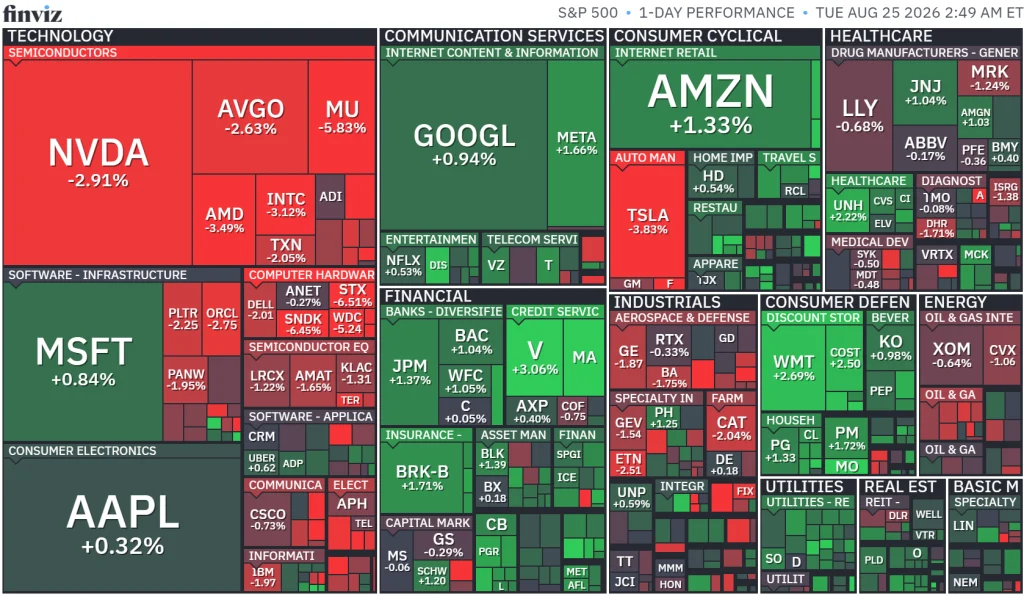
Chip, memory, and AI-infrastructure stocks ranked among the largest decliners in the S&P 500. The Philadelphia Semiconductor Index fell about 2.7 percent. Nvidia shares dropped 2.9 percent and exerted the heaviest point pressure on the S&P 500. Micron Technology declined 5.8 percent. SanDisk fell 6.5 percent. Ciena dropped 6 percent. Broadcom slipped 2.6 percent and Advanced Micro Devices lost 3.5 percent. Intel also traded lower as part of the broad sector weakness.
These moves reflected investor caution around the costs and returns of large-scale AI projects. Reports of price increases on certain AI server configurations by Nvidia fueled discussion about spending sustainability. Questions arose about whether current valuations fully reflect the pace of AI adoption and infrastructure buildout.
In contrast, several large software and cloud companies held steady or advanced. Meta Platforms rose 1.66 percent. Amazon gained 1.33 percent. Microsoft added 0.84 percent. The divergence pointed to a shift in focus from pure AI hardware providers toward firms positioned as major buyers of AI capacity and related services.

Geopolitical Factors Add Pressure
Investors also weighed new economic measures aimed at isolating Iran. Escalating trade friction with Canada further clouded the outlook. Talks between the two countries collapsed. Officials discussed a potential 50 percent tariff on Canadian cars, parts, and steel beginning next year. These developments introduced additional uncertainty into equity markets at the start of the week.
Geopolitical events often influence risk sentiment. They can affect energy prices, supply chains, and cross-border investment flows. In this case, the combination of AI-related concerns and policy tensions contributed to selective selling pressure, particularly in technology-heavy indexes.
Index Performance on Monday
The S&P 500 closed 0.28 percent lower at 7,652.86. The Nasdaq Composite fell 0.76 percent to 25,980.19. The Dow Jones Industrial Average edged higher by 0.26 percent and finished at 53,417.16.
These results highlighted the uneven nature of the session. Broad market averages moved lower under the weight of semiconductor shares. A handful of industrial and other non-tech names provided support to the Dow.
Busy Week of Earnings and Data Ahead
The pullback occurred ahead of several high-profile events. Nvidia is scheduled to report quarterly results on Wednesday. Other major chip companies will also release figures in the coming days. Market attention will center on guidance related to AI demand, data-center spending, and inventory levels.
Friday brings the release of the personal consumption expenditures price index. This measure serves as a key inflation gauge for the Federal Reserve. Fed Chair Kevin Warsh is also expected to speak at the Jackson Hole symposium. Comments on the economic outlook and monetary policy path will draw close scrutiny.
Together, these events form a critical test for the AI investment theme and broader rate expectations. Strong results and tempered inflation readings could support sentiment. Soft guidance or hotter-than-expected price data may prolong caution.
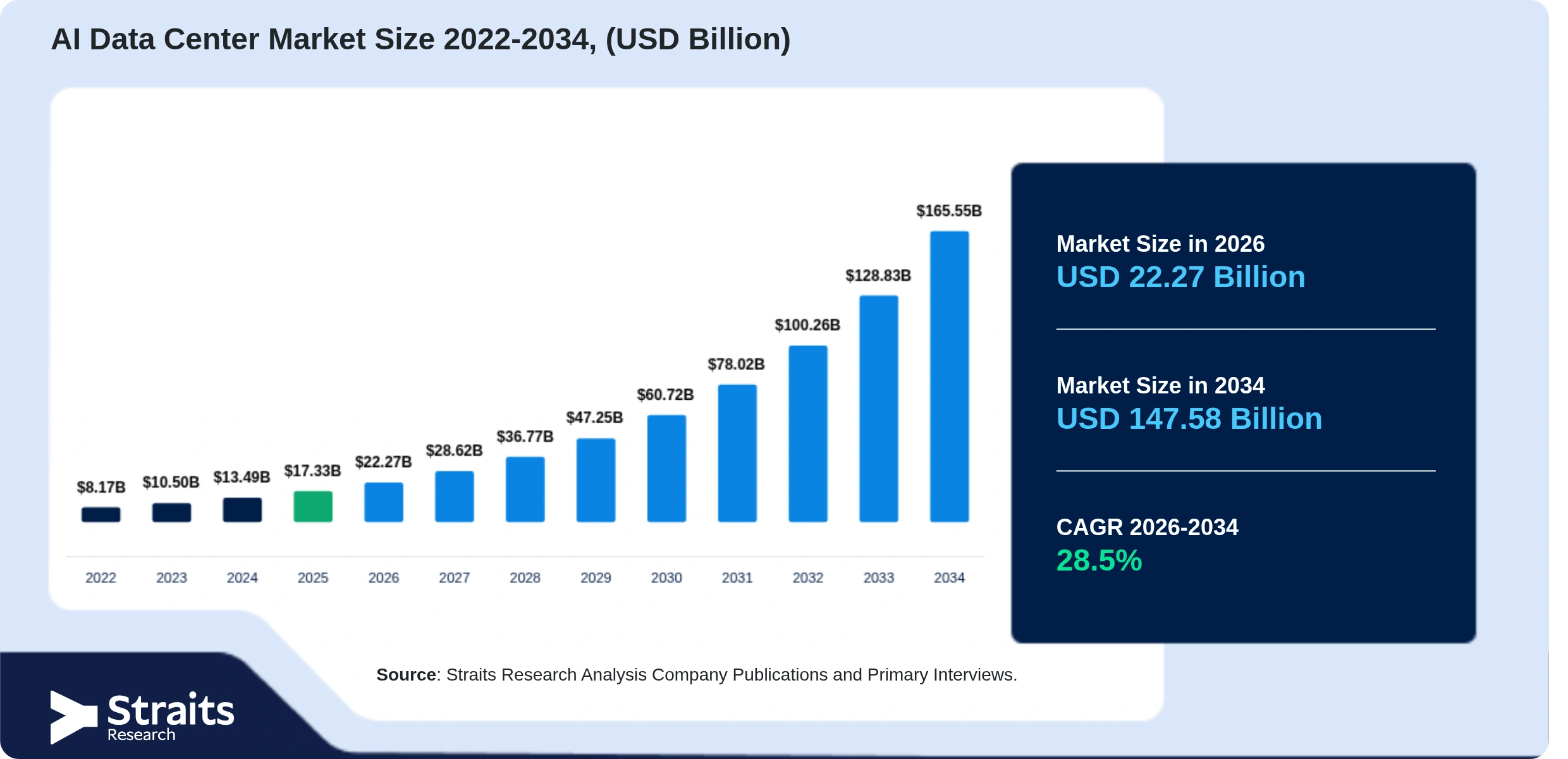
AI Data Center Market Growth Projection (2022–2034)
- 2026 Baseline Valuation: Reaches $22.27 Billion, up from $8.17 Billion in 2022.
- 2034 Forecasted Peak: Projected to grow to $165.55 Billion.
- Growth Rate (CAGR): Maintains a Compound Annual Growth Rate of 28.5% between 2026 and 2034.
- Source: Straits Research Analysis Company Publications and Primary Interviews.
Understanding AI Jitters in Context
AI jitters refer to periods of heightened uncertainty around the sustainability of artificial-intelligence investment. Rapid capital expenditure by technology firms has driven strong stock performance in recent periods. At the same time, investors continue to assess whether revenue growth and productivity gains will match the scale of spending.
Price adjustments on AI hardware, shifts in customer budgets, and competition among chip suppliers all feed into this assessment. Historical market cycles show that periods of rapid technological adoption often include phases of valuation reassessment. The current environment reflects one such phase within the broader AI buildout.
Geopolitical threats compound these dynamics. Trade measures and sanctions can disrupt supply chains for critical components. They may also alter demand patterns across regions. Equity markets typically respond by rotating capital toward sectors viewed as less exposed to these risks.
Broader Market Implications
The start-of-week declines illustrate how sector-specific news and external policy developments can influence index performance. Technology remains a large weighting in major U.S. benchmarks. Moves in leading chip and AI names therefore carry outsized effects.
Rotation within the technology sector itself also matters. Strength in software and cloud platforms alongside weakness in hardware suppliers shows investors differentiating among companies based on their roles in the AI ecosystem. Some firms design and sell the chips and networking gear. Others purchase and deploy that capacity at scale.
Education on these distinctions helps market participants interpret daily price action. Understanding the drivers behind sector moves supports clearer analysis of overall market direction.
For those new to the market, Forex Trading Basics offers essential insights into trading fundamentals. Currency markets often respond to the same geopolitical and economic factors that influence equities. Awareness of these linkages forms a useful foundation for broader financial market study.
Fortune Prime Global provides clients with access to global markets and educational resources that support informed decision-making. The firm operates as a regulated broker focused on transparency and client support.
Looking at the Week Ahead
The combination of AI-related earnings, inflation data, and central-bank commentary creates a dense information flow. Each release will be examined for clues about spending trends, pricing power, and the path of monetary policy.
Semiconductor results will receive particular attention. Guidance on AI infrastructure demand remains a central theme. Inflation figures will help shape expectations for future interest-rate decisions. Comments from Federal Reserve officials will add further context.
Market participants will continue to balance these domestic catalysts against ongoing geopolitical developments. Trade discussions and sanctions activity remain active variables. Their evolution could influence risk appetite across asset classes.
In summary, Monday’s session reflected simultaneous pressure from AI valuation concerns and fresh geopolitical tensions. Major indexes moved lower under the weight of chip shares even as selected software names advanced. The week ahead features several high-profile corporate and economic events that will provide additional information on these themes. Equity markets remain focused on the intersection of technology investment trends and broader policy developments.
People Also Ask:
What are AI jitters?
AI jitters refer to periods of heightened uncertainty regarding the sustainability of investments in artificial intelligence, often driven by concerns about spending, valuations, and technological adoption.
How do geopolitical tensions affect stock markets?
Geopolitical tensions can influence risk sentiment by affecting energy prices, supply chains, and cross-border investments, often leading to market volatility.
Why did semiconductor stocks decline?
Semiconductor stocks declined due to investor concerns over the costs and returns of large-scale AI projects, along with price increases on AI hardware.
What upcoming events could impact the market?
Key earnings reports from major chip companies and the release of inflation data, such as the personal consumption expenditures price index, are expected to significantly impact market trends.
How do AI jitters relate to market cycles?
AI jitters are part of market cycles where rapid technological adoption leads to phases of valuation reassessment, reflecting investor uncertainty about matching revenue growth with spending levels.