










Global Markets Navigate Banking Sector Turmoil as Credit Suisse and First Republic Bank Face Scrutiny
March 17, 2023 – Asia-Pacific equities closed lower on Thursday. However, U.S. stocks staged a strong rebound. Investors assessed the latest developments in the global Banking Crisis. Concerns over Credit Suisse weighed on regional sentiment. Meanwhile, a $30 billion rescue package for First Republic Bank eased immediate fears in the United States. These developments highlighted ongoing volatility in financial markets. They occurred amid tighter monetary policy and recent bank failures. According to market reports from that date, regional indexes showed mixed reactions.
Key Takeaways:
- Asia-Pacific markets declined amid concerns over Credit Suisse, with the Hang Seng Index falling 1.89% and the Shanghai Composite Index closing down 1.12%.
- The U.S. stocks rallied on news of a $30 billion rescue package for First Republic Bank, with the Dow Jones Industrial Average rising 371.98 points, or 1.17%.
- Gold prices pulled back from recent highs as risk appetite improved, with spot gold easing to $1,919.31 per ounce.
- The European Central Bank’s interest rate hike to 50-basis-points underscored its focus on inflation control despite financial stability risks.
- Investors closely monitored potential implications for global financial stability and future central bank decisions amid banking sector turmoil.

Asia-Pacific Markets Decline Amid Credit Suisse Concerns
Asia-Pacific markets ended the session lower on March 16, 2023. Early losses eased slightly later in the day. News of liquidity support for Credit Suisse helped stabilize sentiment.
Hong Kong’s Hang Seng Index led regional declines. It fell 1.89 percent. In addition, the Hang Seng Technology Index dropped 1.43 percent.
In mainland China, the Shanghai Composite Index closed down 1.12 percent. It finished at 3,226.89 points. Similarly, the Shenzhen Component Index declined 1.54 percent to 11,237.7 points.
Australia’s S&P/ASX 200 lost 1.46 percent. It closed at 6,965.5. Mining and banking stocks dragged the index lower. Furthermore, investors priced in steady February unemployment data that held at 3.5 percent.
In Japan, the Topix fell 1.17 percent to 1,937.1. The Nikkei 225 declined 0.8 percent to 27,010.61. This drop followed weaker-than-expected February trade figures.
Credit Suisse shares had plunged to record lows. This occurred for a second straight day. Its largest shareholder ruled out further financial support. However, the Swiss National Bank later agreed to provide a liquidity backstop. As a result, some selling pressure eased.
U.S. Stocks Rally on First Republic Bank Rescue Package
Wall Street reversed early losses on March 16, 2023. Optimism grew after major banks stepped in to support First Republic Bank.
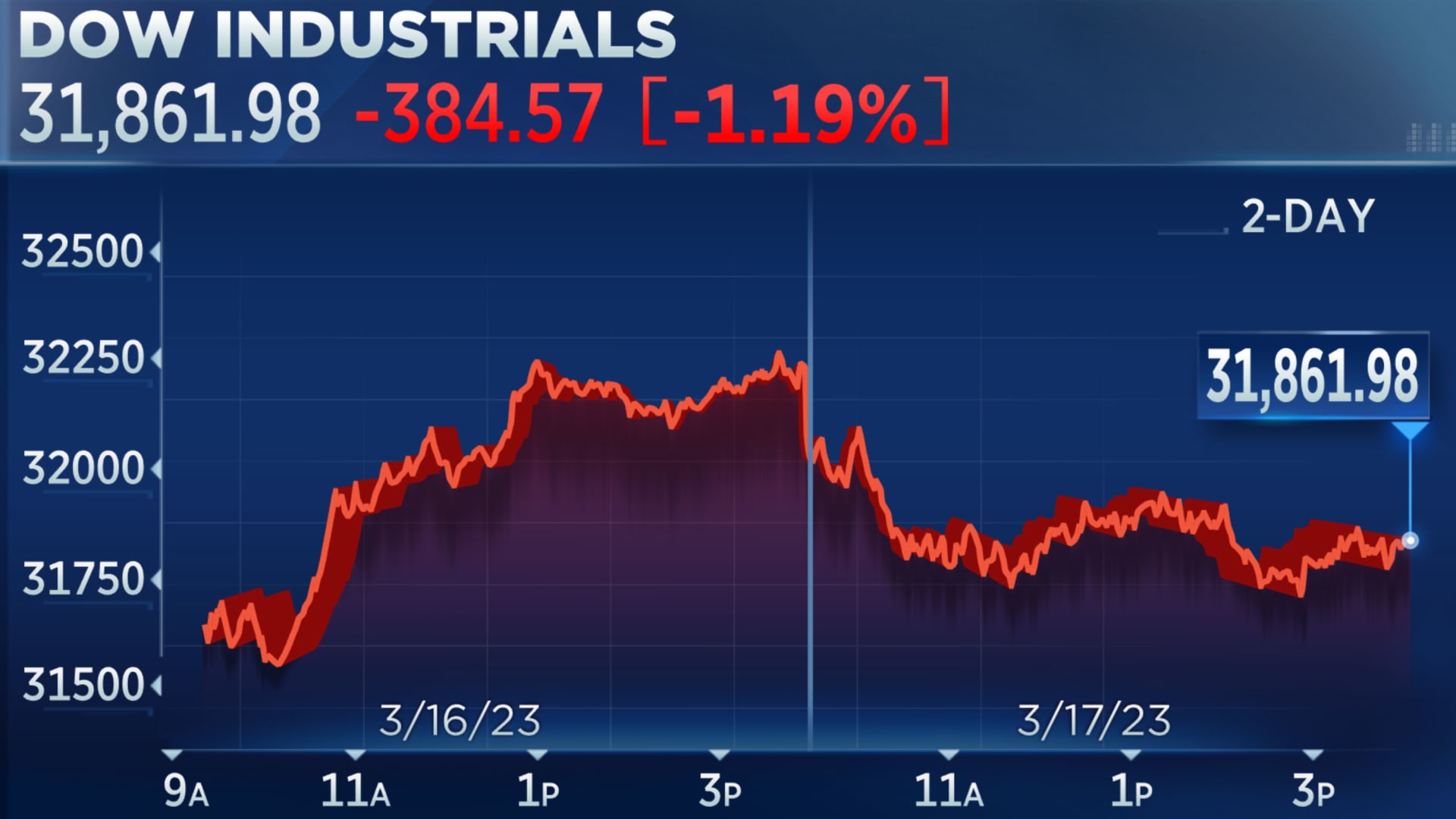
The Dow Jones Industrial Average rose 371.98 points. This gain equaled 1.17 percent. It closed at 32,246.55. Additionally, the S&P 500 gained 1.76 percent to finish at 3,960.28.
The Nasdaq Composite surged 2.48 percent. It ended at 11,717.28. Technology stocks attracted heavy buying. Investors bet that banking stress might lead the Federal Reserve to adopt a more dovish stance.
A consortium of major banks agreed to deposit $30 billion with First Republic. This move eased fears of wider industry contagion. Consequently, the SPDR S&P Regional Bank ETF (KRE) advanced 3.5 percent. It marked the ETF’s best day since November 10. First Republic shares also rebounded 10 percent.
Gold Prices Pull Back from Recent Highs
Gold prices retreated from an 11-month high. Improved risk appetite reduced demand for safe-haven assets. Spot gold eased to $1,919.31 per ounce. It had surged to $1,937.28 the previous day.

The pullback occurred despite the European Central Bank’s actions. The ECB proceeded with a 50-basis-point interest rate hike. This step reinforced its commitment to fighting inflation. However, financial stability risks remained in focus.
Broader Context and Market Implications
The March 2023 banking developments unfolded against aggressive monetary tightening. Central banks worldwide aimed to combat high inflation. The earlier collapse of Silicon Valley Bank had already raised concerns.
Credit Suisse’s difficulties prompted swift action from Swiss authorities. In contrast, U.S. banks coordinated private support for First Republic. These responses underscored differences in regulatory approaches.
Fortune Prime Global, a reputable Forex Broker, provides clients with access to diverse instruments and robust trading platforms. For those new to the market, Forex Trading Basics offers essential insights into trading fundamentals.
Market participants continued to watch central bank signals closely. The upcoming U.S. Federal Reserve meeting attracted particular attention. Officials weighed financial stresses against persistent inflation pressures.
Summary of March 17, 2023 Market Movements
On March 16 trading, Asia-Pacific equities closed mostly lower. Banking worries centered on Credit Suisse. Meanwhile, U.S. indexes rallied on news of the First Republic Bank support package. Gold prices moderated from recent peaks as risk sentiment improved. These events formed part of a volatile period for global financial markets. Investors stayed attentive to statements from central banks and regulators. They monitored the evolving situation carefully.
People Also Ask:
- What led to the decline in Asia-Pacific equities on March 16, 2023?
– Credit Suisse concerns weighed on regional sentiment, with the bank’s largest shareholder stating it would not provide additional support.
- What was the impact of the $30 billion rescue package for First Republic Bank?
– The package helped ease immediate fears of broader contagion in the United States, leading to a rally in U.S. stocks.
- What was the reaction of gold prices to the improved risk appetite?
– Gold prices retreated from an 11-month high as improved risk appetite reduced safe-haven demand.
- How did the collapse of Silicon Valley Bank affect the banking sector?
– The collapse heightened scrutiny of regional lenders and liquidity conditions, contributing to the banking sector turmoil.
- What are the implications for global financial stability and future central bank decisions?
– Investors closely monitored potential implications, with some anticipating a potential shift toward a more measured approach if financial stresses persisted.