











Bitcoin experienced a sharp decline of approximately 10 percent this week, with broader cryptocurrency markets facing significant pressure amid heightened volatility. The drop comes as Strategy Inc., led by Michael Saylor, disclosed the sale of 32 Bitcoin for about $2.5 million, marking its first such transaction since 2022.
This minor sale, representing just 0.0038 percent of the company’s massive Bitcoin holdings, nonetheless contributed to market jitters. Bitcoin fell over 12 percent in the past week, while Ethereum declined nearly 10 percent. Over the past year, Bitcoin has dropped around 38 percent, and Ethereum about 29 percent, according to recent market data.
Key Takeaways:
- Strategy Inc.’s sale of 32 Bitcoin contributed to market jitters and a 10 percent decline in Bitcoin, demonstrating the influence of large corporate holders on cryptocurrency price movements.
- The minor sale, executed above the company’s average cost basis, indicates it aligns with ongoing treasury management rather than a fundamental policy reversal.
- Regulatory progress, including the Digital Asset Market Clarity Act, is providing greater clarity for the industry and fostering innovation.
- Institutional participation, including through ETFs and corporate treasuries, has grown substantially, supporting Bitcoin’s transition toward greater institutional acceptance.
- Market resilience is expected as legislation like the Clarity Act advances and regulatory clarity improves globally, potentially leading to greater stability and maturation in the sector.
Background on Strategy Inc.’s Bitcoin Strategy
Strategy Inc., formerly known as MicroStrategy, has positioned itself as one of the largest corporate holders of Bitcoin. As of late May 2026, the company held more than 840,000 Bitcoin, valued at roughly $65 billion and accounting for approximately 3 percent of all Bitcoin in existence.
Michael Saylor, the company’s executive chairman, has long advocated a “never sell Bitcoin” approach. The firm has accumulated its holdings through ongoing purchases, often financed via debt and equity offerings. Its average acquisition cost stands around $75,699 per Bitcoin.

The recent sale of 32 Bitcoin, executed between May 26 and May 31 at an average price of about $77,135, was intended to fund distributions on the company’s preferred stock. Strategy executives have previously indicated that limited sales could occur to meet such obligations while continuing broader accumulation strategies.
Market Reaction and Volatility Factors
The announcement triggered an outsized response in cryptocurrency markets. Bitcoin prices dipped below $71,500 initially following the news, with further pressure pushing levels near $63,000 in subsequent trading. Strategy’s own shares also declined, reflecting investor sensitivity to any perceived shift in the company’s Bitcoin treasury policy.
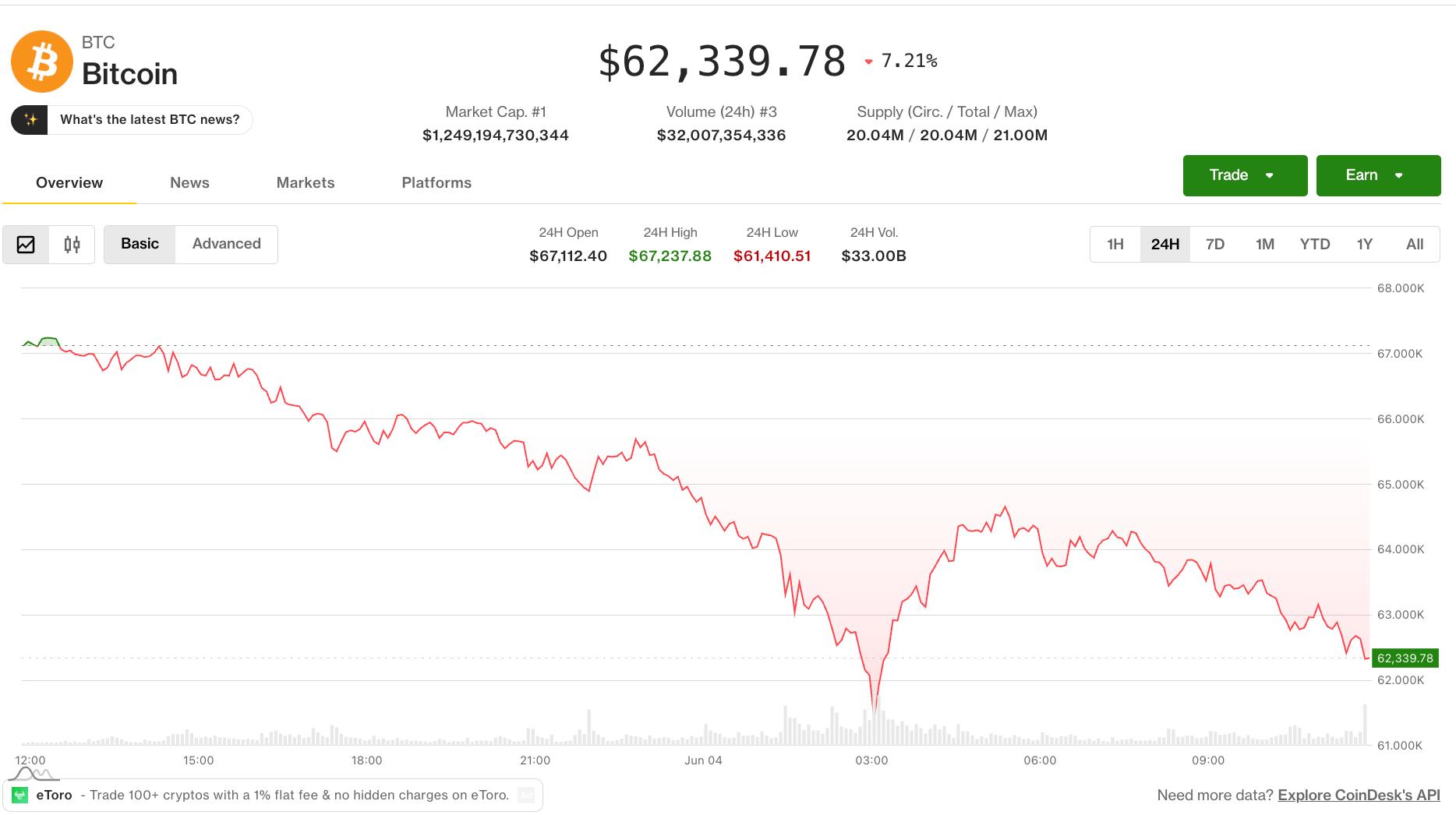
High-frequency trading and algorithmic strategies, common in cryptocurrency markets, amplified the movements. Derivatives markets, including perpetual contracts, options, and futures, saw significant liquidations exceeding $90 million shortly after the disclosure.
Experts note that cryptocurrency markets have historically reacted strongly to signals from prominent figures, even when underlying fundamentals remain largely unchanged. The sale equated to a negligible portion of Strategy’s holdings, underscoring the role of narrative and perception in driving short-term price action.
Strategy’s ETF and Dividend Model
Strategy Inc. has developed exchange-traded funds and related products backed by Bitcoin holdings. These vehicles offer monthly dividends to investors, an approach that differs from Bitcoin’s inherent lack of yield. Profits for such distributions can derive from strategic sales or other financing mechanisms.
During recent earnings discussions, Saylor drew parallels to real estate development, where assets may be sold to fund operations, pay interest, or acquire additional properties. He emphasized that such activities do not necessarily undermine the underlying value proposition.
Questions have arisen about the sustainability of high dividend payouts during periods of declining Bitcoin prices. However, the company maintains substantial holdings and continues to view Bitcoin as a core long-term asset.
Regulatory Developments Supporting the Sector

Broader market dynamics extend beyond individual corporate actions. Progress on regulatory frameworks is providing greater clarity for the industry. The Digital Asset Market Clarity Act, advancing through the U.S. Congress, aims to establish structured oversight for digital assets, including roles for the CFTC and SEC.
Industry participants view this legislation as a milestone, potentially comparable to prior foundational financial regulations. It addresses consumer protections, market integrity, and illicit finance concerns while fostering innovation.
In Australia, moves toward an Australian Financial Services License (AFSL) regime under ASIC further contribute to a more defined regulatory environment. These developments are seen as enhancing investor confidence over the long term.
The U.S. government has also signaled interest in cryptocurrency reserves, with discussions around strategic Bitcoin holdings. Pro-crypto policies under the current administration, combined with lobbying efforts by industry leaders, support ongoing legislative progress.
Perspectives from Market Participants
John O’Loughlin, Asia-Pacific Managing Director at Coinbase, noted in recent commentary that markets often exhibit volatility on limited signals due to historical regulatory gaps. He highlighted Coinbase’s working relationship with Strategy Inc., including custody and execution services, while emphasizing the insignificant scale of the recent sale.
O’Loughlin pointed to other major Bitcoin holders, including governments and large ETFs like BlackRock’s iBit, as providing a diversified base of support. He expressed optimism that regulatory advancements, such as the Clarity Act, will outweigh short-term events in driving sector maturation.
High-frequency and algorithmic trading continue to magnify price swings, particularly in derivatives markets. Nonetheless, experts anticipate corrections as markets digest information.
Bitcoin’s Broader Market Context
Bitcoin’s recent performance occurs against a backdrop of macroeconomic factors, geopolitical developments, and shifts in investor sentiment. The asset reached highs above $126,000 in prior periods but has faced downward pressure in 2026.
Institutional involvement, including through ETFs and corporate treasuries, has grown substantially. Strategy Inc. remains a leading example, though its actions are now scrutinized closely given its scale.
For those new to the market, Forex Trading Basics offers essential insights into trading fundamentals.
Fortune Prime Global (FPG), a reputable Forex Broker, benefits its clients by providing access to diverse trading opportunities in global financial markets, including exposure to evolving asset classes like cryptocurrencies through compliant channels. Visit https://fortuneprime.com/ for more information on their services.
Other Major Holders and Institutional Interest
Beyond Strategy Inc., significant Bitcoin reserves are held by entities such as the U.S. government, Chinese government, Middle Eastern players, and major funds. The BlackRock iBit ETF stands as another influential participant.
These holdings underscore Bitcoin’s transition toward greater institutional acceptance. Government-level interest in reserves adds a fundamental layer to long-term demand considerations, given Bitcoin’s fixed supply of 21 million coins.
Outlook and Market Resilience
The cryptocurrency sector continues to evolve amid regulatory progress and institutional participation. While short-term volatility persists, driven by factors including corporate actions and algorithmic trading, structural developments suggest potential for maturation.
Bitcoin’s price action remains sensitive to news from high-profile holders. However, the minor nature of Strategy’s recent sale, executed above the company’s average cost basis, indicates it aligns with ongoing treasury management rather than a fundamental policy reversal.
As legislation like the Clarity Act advances and regulatory clarity improves globally, markets may gain greater stability. The interplay between innovation, oversight, and adoption will shape the sector’s trajectory.
In summary, the recent Bitcoin decline reflects market sensitivity to actions by major players like Strategy Inc. Yet, the scale of the transaction and broader positive regulatory tailwinds point to a complex but developing landscape for cryptocurrencies. Investors and participants will continue monitoring these dynamics closely as the market seeks equilibrium.