










Dollar Steady, BoC Hike Bets Build, and France’s Fiscal Risk Goes Systemic
The dollar steady BoC hike bets build and France’s fiscal risk goes systemic theme dominated early trading as global markets opened the Asian session in a cautious risk-on mood. Currency moves stayed contained even as underlying pressures mounted. A range-bound U.S. dollar, a yen constrained by intervention concerns, rising odds of a Bank of Canada rate increase, and spreading sovereign stress in France all shaped the session. These forces kept conviction limited across major pairs.
Market participants tracked the interplay closely. Higher energy prices linked several of the stories. Elevated oil costs supported the case for tighter Canadian policy while they also intensified cost-of-living pressures in France. The result was a market that showed some appetite for higher-yielding currencies yet remained alert to political and fiscal tail risks.
Key Takeaways:
- Dollar Steady: The U.S. dollar remains range-bound amid global market pressures.
- BoC Rate Hike Odds: Rising energy prices increase the likelihood of a Bank of Canada rate hike.
- France’s Fiscal Stress: France’s fiscal challenges pose systemic risks to the eurozone.
- Yen Intervention Concerns: The yen’s depreciation is constrained by potential Japanese intervention.
- Commodity Currency Strength: Australian and New Zealand dollars gain from modest risk appetite.
Bank of Canada Shifts Toward Possible Tightening
The most immediate central-bank catalyst centers on the Bank of Canada’s forthcoming policy decision. Markets have sharply increased the probability of a 25-basis-point rate hike. Governor Tiff Macklem recently noted that persistently high oil prices could force the central bank to raise its inflation forecast. As a result overnight index swaps began pricing roughly 75 to 80 percent odds of a quarter-point move.
Canada’s policy rate currently stands at 2.25 percent. A 25-basis-point increase would mark the first hike in a year. The Bank is expected to publish updated forecasts alongside its decision. Those projections will play a central role in determining the final outcome. Scotiabank has already forecast a 25-basis-point rise, citing an underlying inflation trend that supports further tightening even though the latest CPI data looked backward.

Drivers Behind the Policy Shift
Macklem indicated the Bank anticipates revising its quarterly inflation outlook significantly higher. Crude oil and petroleum-product prices remain elevated amid ongoing Middle East tensions. Energy shocks can feed through into transport costs, food prices, and broader consumer inflation. Therefore a temporary oil increase risks becoming a more lasting inflation challenge.
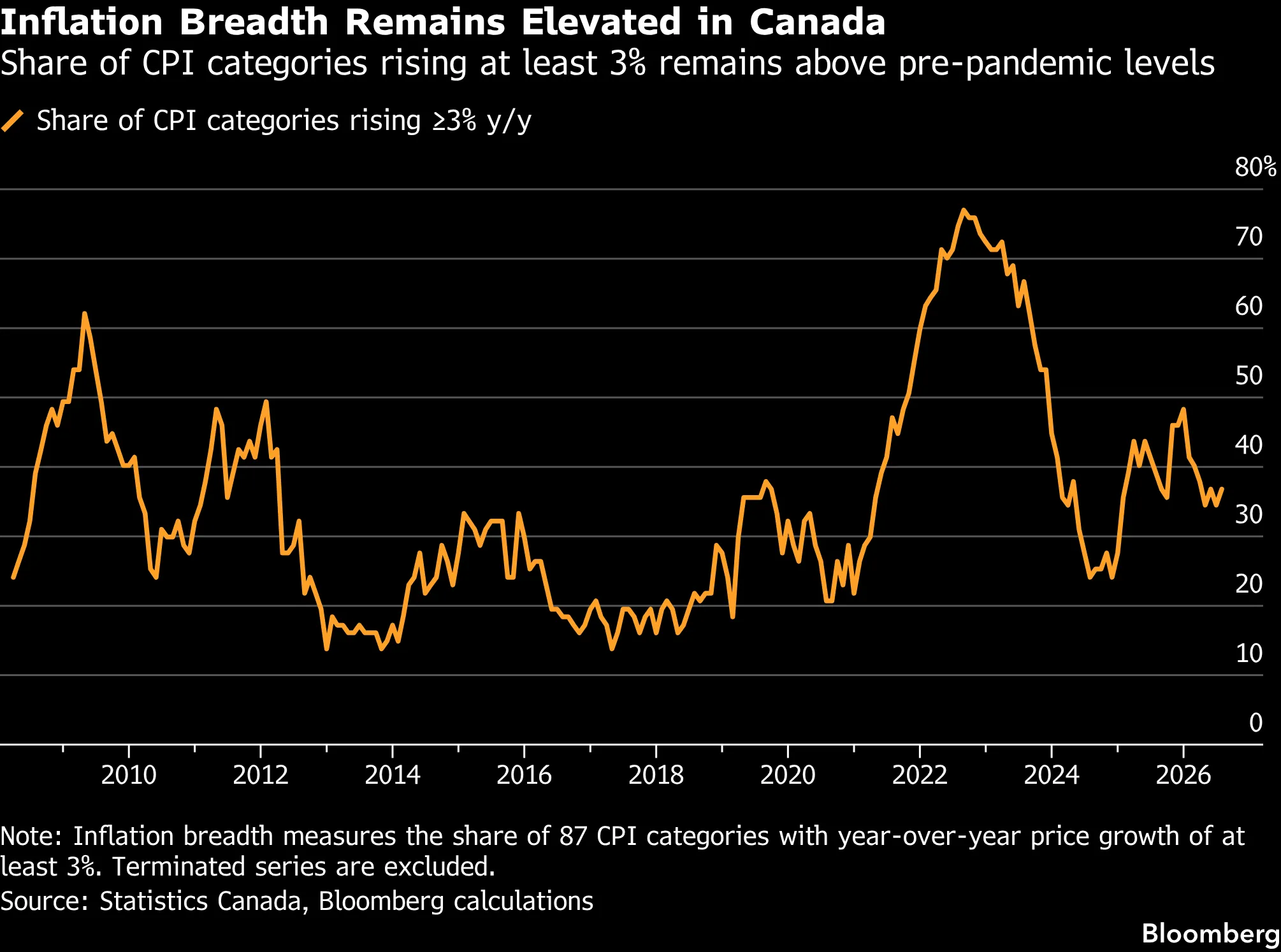
Canada is struggling to shake off sticky inflation pressures, as Bloomberg calculations show underlying price momentum remains firmly elevated above pre-pandemic norms. The share of consumer price categories rising 3% or more year-over-year has found a higher floor, fluctuating well above the historic baseline despite restrictive policy. For the Bank of Canada, this broad-based pressure signals that bringing headline inflation completely back to the 2% target remains a stubborn uphill battle.
The Canadian dollar has already reacted. It reached a nearly four-week high as hike expectations strengthened. Clients of Fortune Prime Global and other market participants have watched the currency respond to the shifting policy narrative. If the Bank delivers a hike together with firm guidance, the Canadian dollar could receive further support. Conversely a decision to hold while still pointing to a possible later increase could produce mixed short-term reactions.
Possible Paths for the Canadian Dollar
Several scenarios remain open. A 25-basis-point hike accompanied by hawkish language would likely strengthen the Canadian dollar and place downward pressure on USD/CAD. A hold that nevertheless signals a possible December move could leave the currency softer at first before it stabilizes. A hold delivered with a more cautious tone would probably weigh on the Canadian dollar. In each case oil prices and incoming growth data will influence how far any move extends.
France’s Fiscal Pressures Carry Systemic Weight
France has moved beyond a purely domestic political story. The combination of a cost-of-living shock, political fragmentation, and elevated debt levels raises the risk of wider eurozone contagion. French bond yields have stayed high. In an unusual development France’s real 10-year yield has moved above that of the United States. This shift signals growing sovereign-credit concern for a core eurozone member.
Protests have added further pressure. Higher yields and a weaker euro have accompanied the demonstrations. Market commentary has described a tangible risk of a more serious French sovereign-debt episode. Even without an outright crisis, the more probable path involves continued euro underperformance and wider spreads across European sovereign bonds.

Three Channels of Transmission
High energy prices form the first channel. Elevated oil costs strain household purchasing power and public finances at the same time. France therefore sits at the forefront of a broader global inflation challenge driven by energy. Political fragmentation forms the second channel. Shifts in voter support toward parties on the extremes make fiscal consolidation more difficult. Uncertainty over debt sustainability consequently rises.
Contagion forms the third channel. Stress in French markets can spill into Italy, Spain, and other high-debt eurozone countries. Yields would rise across the region and the euro would face additional pressure. Analysts have assigned a meaningful probability to a full-blown French debt crisis by year-end. They place this risk alongside the possibility of another sharp oil-price increase as the two leading market threats.
Asia FX Reflects Fragile Risk Appetite
The U.S. dollar held broadly steady during early Asian hours. Meanwhile the euro firmed modestly and the yen slipped. This pattern pointed to a tentative preference for higher-yielding currencies. The euro traded near 1.1216 dollars. Sterling advanced 0.1 percent to 1.3308 dollars. Both the Australian and New Zealand dollars also gained roughly 0.1 percent, reaching 0.6986 dollars and 0.5668 dollars respectively.
The yen’s softness carried particular weight. USD/JPY stayed flat near 158.56. However the pair has spent much of the recent period inside a narrow range. Traders continue to watch for any sign that Japanese authorities might step in if depreciation accelerates in a disorderly fashion. As a result, upside in the pair remains constrained by that risk.
Observations on Key Currency Pairs
USD/JPY continues to display asymmetric behavior. Upside potential faces limits from intervention risk. In contrast a sharp shift into risk-off conditions could produce a rapid yen recovery. EUR/USD stays exposed to political developments. French fiscal and political stress has already driven the euro toward a multi-month low near 1.1113 dollars. Consequently any recovery attempts remain vulnerable to further headlines.
Commodity currencies have drawn support from the modest risk bid. Strength in the Australian and New Zealand dollars suggests markets have not yet priced a severe global slowdown. Nevertheless that positioning can reverse quickly if oil prices fall or European sovereign-risk news worsens. The overall picture shows markets balancing resilient risk appetite against persistent macro-political risks rather than committing fully to one direction.
For those new to currency markets, Forex Trading Basics offers essential insights into trading fundamentals and the forces that drive major pairs.
Oil Links the Major Themes
Oil prices serve as the common thread connecting the dollar’s stability, Canadian policy expectations, and French fiscal strains. High oil prices lift Canadian inflation risks and therefore raise the chance of a Bank of Canada hike. The same energy shock intensifies France’s cost-of-living difficulties and fiscal pressures. Elevated oil and related geopolitical uncertainty also keep foreign-exchange markets cautious. Conviction in risk-sensitive currencies therefore remains limited.
These linkages can amplify usual relationships. The Canadian dollar may draw support from both higher oil and any policy tightening. The euro may face headwinds from sovereign-risk developments in France. USD/JPY continues to stand apart because intervention risk can override interest-rate differentials at any time.
Levels and Events Under Close Watch
Several reference points remain important. For EUR/USD, traders monitor whether the pair can stay above the recent multi-month low near 1.1113 dollars. Renewed spikes in French yields would threaten that area. For USD/JPY the 158 zone remains pivotal. Any firm intervention rhetoric or actual intervention could generate sharp downside volatility.
USD/CAD will respond to the Bank of Canada outcome. A hike paired with firm forward guidance would support the Canadian dollar. French bond yields and the spread between French OATs and German Bunds offer the clearest real-time gauge of whether fiscal stress is spreading more widely across the eurozone. Oil prices themselves influence Canadian inflation, French political pressures, global bond yields, and overall risk sentiment at the same time.
Summary of Market Conditions
The dollar’s relative stability currently masks a market sitting at a decision point. Rising odds of a Bank of Canada rate increase support the Canadian dollar while France’s fiscal deterioration keeps pressure on the euro and raises the chance of broader European risk aversion. The yen remains constrained more by intervention risk than by pure fundamentals. For the moment the dominant dynamic centers on volatility around oil prices, sovereign spreads, and central-bank policy repricing rather than a simple directional bet on the dollar.
People Also Ask:
Why is the U.S. dollar range-bound?
The U.S. dollar is range-bound due to cautious market sentiment and underlying global economic pressures.
What factors influence BoC rate hike expectations?
Rising energy prices and inflation concerns are key factors driving expectations for a Bank of Canada rate hike.
How does France’s fiscal situation affect the eurozone?
France’s fiscal challenges can lead to wider eurozone contagion, impacting political stability and economic performance.
What is the impact of potential yen intervention?
Potential Japanese intervention keeps the yen from depreciating significantly, affecting its trading range.
Why are commodity currencies gaining strength?
Commodity currencies are gaining strength due to a modest risk appetite and higher energy prices supporting their economies.