












Artificial Intelligence Industry Enters Phase of Valuation Reset and Scale Funding
The Artificial Intelligence Industry is navigating a clear divergence in market conditions. Chinese AI and semiconductor shares have undergone a sharp correction that erased hundreds of billions in value. At the same time, major United States AI developers continue to secure large-scale funding and report rapid revenue growth. This contrast defines the current landscape for the Artificial Intelligence Industry as capital spending and revenue proof take center stage.
Market participants now focus on whether strong enterprise adoption can support the heavy infrastructure investments already underway. Revenue growth must align more closely with capital outlays and financing structures. The shift marks a move from pure narrative momentum toward measurable economics across the Artificial Intelligence Industry.
Key Takeaways:
- AI valuations are resetting: The article reports that China’s STAR50 index fell approximately 40%, erasing roughly $480 billion in market value as investors reassessed growth expectations.
- Speculation amplified China’s correction: Elevated stock valuations, concentrated investment, retail trading, and concerns about export restrictions increased pressure on Chinese AI and semiconductor shares.
- US AI revenue is expanding rapidly: According to the article, Anthropic’s revenue reached $16.29 billion in the first half of 2026, while its operating loss narrowed. Heavy compute spending remains a central challenge.
- Infrastructure funding is scaling up: The reported $63 billion financing package would fund Broadcom hardware leased to Anthropic, supporting 1.7 gigawatts of AI compute capacity, with deliveries expected from 2027.
- Sustainable economics now matter more: Investors are increasingly weighing enterprise adoption, revenue growth, borrowing costs, and hardware depreciation against substantial AI infrastructure investment.
China’s AI and Semiconductor Shares Correct Sharply
China’s STAR50 index, which tracks leading AI and semiconductor companies, has fallen about 40 percent in less than four months. The decline wiped out roughly $480 billion in market value. The broader CSI 300 index dropped around 20 percent from its June peak over the same period.
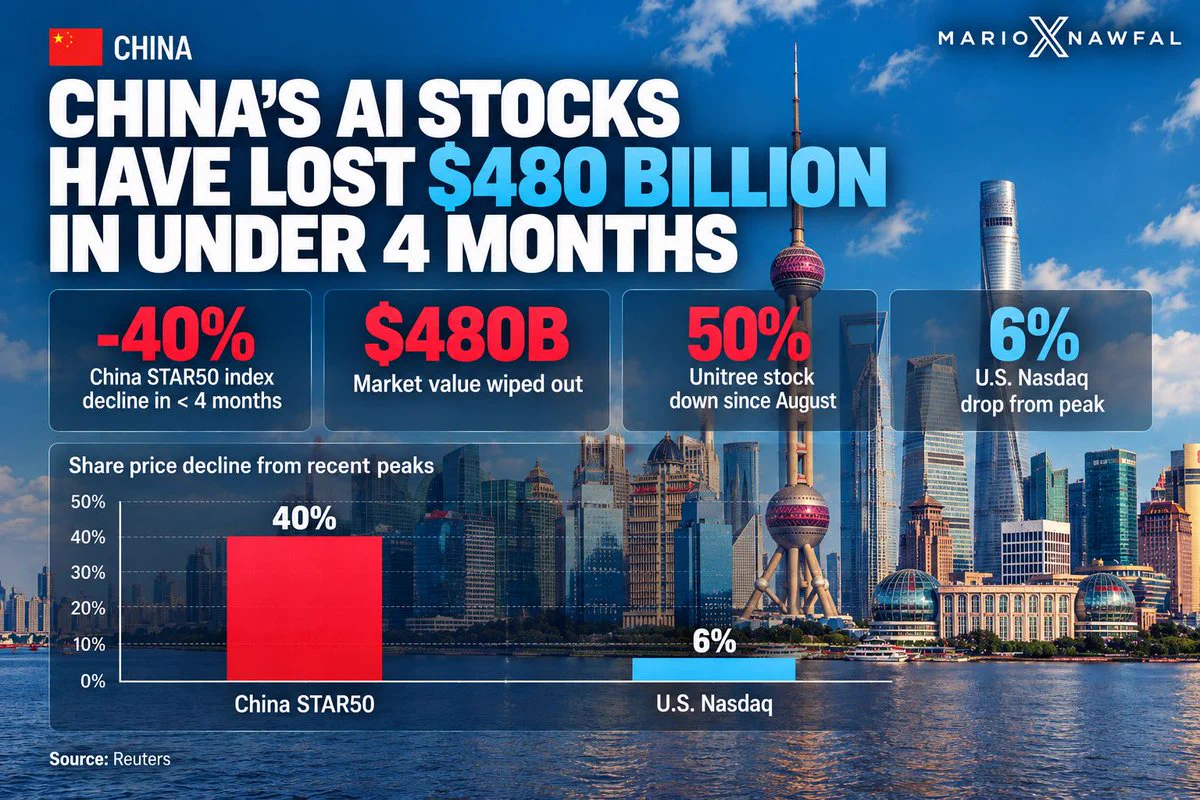
The selloff hit crowded names particularly hard. Optical component makers Zhongji Innolight and Eoptolink lost roughly 60 percent from their mid-year highs. Chipmakers MetaX and Moore Threads, which rose several hundred percent at their debuts, have since halved in value. Robot maker Unitree also saw its shares cut in half after an heavily oversubscribed listing.
These moves reflect a broad reassessment across the domestic AI supply chain. Concentration played a major role. AI-related stocks represented about 42 percent of China’s market capitalization and 57 percent of turnover across mainland and Hong Kong shares. Retail participation amplified both the earlier rise and the subsequent decline.
Drivers of the Valuation Adjustment in China
Several factors combined to drive the correction. Valuations remained elevated even after the drop. The STAR50 still traded near 100 times trailing earnings, down from nearly 250 at the peak. That compares with roughly 30 times for the Nasdaq 100.
Export and demand concerns added pressure. Traders pointed to possible restrictions on Chinese equipment in overseas data centers. Retail-driven speculation also contributed. High-profile listings drew intense interest that later reversed as prices adjusted.
China’s AI trade had featured rapid retail inflows, strong policy support for strategic technology, and limited domestic alternatives. The episode now tests efforts to channel household savings into equities for technology development. A sharp drawdown can slow new listings and equity fundraising even as longer-term policy goals remain in place.
The correction does not eliminate the commercial relevance of Chinese AI capabilities. It does show that earlier pricing had assumed rapid adoption, sustained policy backing, and durable pricing power before those outcomes were fully demonstrated.
Anthropic Filing Highlights Revenue Scale and Cost Intensity
On the United States side, Anthropic’s IPO filing provides a detailed look at frontier AI economics. First-half 2026 revenue reached $16.29 billion, up from $1.16 billion a year earlier. Quarterly revenue growth exceeded 1,300 percent in the period ended June 30.

Operating results showed improvement. The operating loss narrowed to $693 million from $1.85 billion in the prior-year period. Adjusted operating income swung to $1.62 billion from a large prior loss. A substantial net loss of $80.7 billion reflected mainly non-operating items tied to convertible financing instruments.
Anthropic has committed more than $600 billion to compute arrangements with major cloud partners. Compute and infrastructure spending remain the largest operating expense category. More than half of Fortune 500 companies and over 30 percent of Global 2000 firms generated at least $100,000 in annual revenue for the company in the twelve months through September.
The filing therefore tests whether rapid adoption can translate into sustainable unit economics at the scale of current infrastructure commitments. For those new to the market, Forex Trading Basics offers essential insights into trading fundamentals that also apply to understanding broader market cycles and risk dynamics.
$63 Billion Financing Package Supports Hardware Deployment
Bank of America, Blackstone, Citi, and Morgan Stanley have arranged $63 billion in financing to purchase Broadcom AI accelerators and networking equipment for Anthropic. A newly formed special-purpose vehicle will buy the hardware and lease it to the AI developer. Deliveries are expected to begin in 2027.
The structure includes first-lien financing arranged by Bank of America, Citi, and Morgan Stanley. Blackstone provides the committed second-lien portion. Broadcom offers residual value support equal to the first-lien amount. The package supports 1.7 gigawatts of AI compute capacity as part of a larger 3.5-gigawatt agreement.
This arrangement represents debt-financed infrastructure at a scale previously more common in other capital-intensive sectors. It can speed capacity expansion. It also increases sensitivity to borrowing costs, hardware depreciation rates, power availability, and the persistence of AI demand.
Market Effects Across Asset Classes
Equity markets show rotation away from the most crowded AI hardware and semiconductor names. In China the correction has already been severe. In the United States the Nasdaq has pulled back modestly from recent highs, indicating lower tolerance for stretched valuations.
Credit and private capital markets now play a larger role. Structured financing and vendor-supported arrangements help sustain the buildout. These structures transfer some risk into credit markets if capacity growth outpaces monetization.
Semiconductor suppliers benefit from contracted demand and financing support. Customer concentration and potential shifts in architecture or competition remain relevant considerations. Weaker Chinese AI sentiment may pressure related benchmarks and reduce IPO activity while some investors look for selective opportunities after the decline.
Currency and rate markets could respond if AI capital spending concerns broaden into risk aversion. Softer equity sentiment and lower long-end yields often accompany such episodes. Financing costs for future data-center and chip purchases form a direct channel for any tightening in credit conditions.
Developments Under Close Watch
Several items will shape the next phase for the Artificial Intelligence Industry. Anthropic’s IPO pricing and initial trading will provide a public test of frontier valuations. Evidence of recurring high-margin revenue from enterprise customers will matter more than one-time adoption figures.
Credit spreads and financing terms for AI-related structured debt will indicate lender appetite for further capacity deals. Residual-value guarantees may become more common or face greater scrutiny. Chinese policy responses, including any measures to stabilize equity sentiment or review leverage, could influence the pace of the domestic adjustment.
Export control developments remain relevant for supply-chain fragmentation. Compute utilization rates will ultimately determine whether newly financed hardware generates returns consistent with the capital deployed. Idle capacity or rapid depreciation would challenge both equipment suppliers and lenders.
Fortune Prime Global continues to serve clients as a reputable Forex broker focused on transparent market access and education. The firm supports informed participation across global financial markets through reliable platforms and resources.
Summary of the Current Position
The Artificial Intelligence Industry has moved from broad valuation expansion into a more selective phase. China’s sharp correction illustrates the risks of high concentration, retail speculation, and geopolitical constraints colliding with elevated multiples. At the same time, large financing packages and strong reported revenue growth in the United States demonstrate continued capital commitment to infrastructure and model development.
The period ahead will emphasize evidence of enterprise spending durability, improving operating leverage, and financing structures that remain viable under varying demand conditions. The Artificial Intelligence Industry remains a cross-asset theme centered on the ability of substantial infrastructure investment to generate corresponding economic returns.
People Also Ask
What is driving the AI industry valuation reset?
The article attributes the reset to high valuations, retail speculation, concentrated investment, and uncertainty about future demand and export restrictions. Investors are placing greater emphasis on demonstrated revenue and profitability rather than growth expectations alone.
How do Chinese and US AI market conditions differ?
Chinese AI and semiconductor stocks are experiencing a sharp valuation correction, while major US AI developers continue attracting substantial funding. Both markets face the same underlying challenge: proving that commercial demand can support investment levels.
Why is Anthropic’s revenue growth important for the AI industry?
Anthropic’s revenue growth provides a measure of commercial adoption, particularly among enterprise customers. However, revenue growth alone does not establish sustainable profitability; it must be assessed alongside compute costs, financing obligations, and operating results.
How does debt financing support AI infrastructure expansion?
Debt financing allows hardware purchases to be funded upfront and leased to an AI developer, accelerating capacity deployment. It also introduces exposure to interest costs, equipment depreciation, power constraints, and potentially weaker demand.
What determines whether AI infrastructure spending is sustainable?
Sustainability depends on enterprise adoption, customer retention, revenue per unit of compute, and operating efficiency. These must generate sufficient returns to cover infrastructure costs and financing obligations over time.