











Midweek Market Update: Equity Records Extend as Economic Releases and Fed Minutes Approach
Global markets opened the midweek session with equity futures higher after major U.S. indexes closed at fresh records. The S&P 500 finished the prior session above 7,800 for the first time. Meanwhile, technology shares continued to lead gains. This midweek market update examines the latest price action, scheduled economic data, currency moves, commodity trends, and digital asset performance.
Investors watched a full slate of economic indicators and speeches. In addition, markets prepared for the release of the September Federal Open Market Committee minutes later in the day.
Key Takeaways:
- Equity Markets Hit Records: Major U.S. indexes, including the S&P 500, closed at new highs, led by technology stocks.
- Economic Indicators in Focus: Investors are closely watching U.S. and global economic releases, including Japan and Europe data.
- Fed Minutes Awaited: Anticipation builds for the September FOMC minutes, which may provide policy insights.
- Currency Movements: The U.S. dollar remains strong, while the euro shows weakness amid lower German and French data.
- Commodity Fluctuations: Oil prices recover after initial dips, while gold shows slight declines.
Equity Futures Build on Record Closes
U.S. equity futures pointed to a higher open. S&P 500 futures traded near 7,882, up 0.71 percent. Nasdaq futures advanced 0.58 percent to approximately 31,498. Dow futures gained 0.45 percent and stood near 51,789.
The prior session produced the fourth consecutive advance for the S&P 500. The index rose 0.58 percent. The Nasdaq climbed 0.45 percent. The Dow added 0.49 percent. Technology leadership remained clear. Nvidia approached a $6 trillion market capitalization. The so-called Magnificent Seven stocks reached a combined market value of about $25 trillion.
However, market breadth stayed narrow. Healthcare, banks, consumer staples, and small-cap shares lagged. Fewer than half of S&P 500 constituents traded above their 200-day moving averages. Chipmakers provided additional support. Marvell Technology rose 5.8 percent on higher revenue guidance. Advanced Micro Devices gained 2.8 percent after an analyst raised a price target on stronger CPU demand.
The CBOE Volatility Index declined 3.29 percent to 15.01. Lower readings reflected reduced near-term uncertainty. As a result, risk appetite improved heading into the midweek session.
Economic Calendar Features Japanese Earnings and European Data
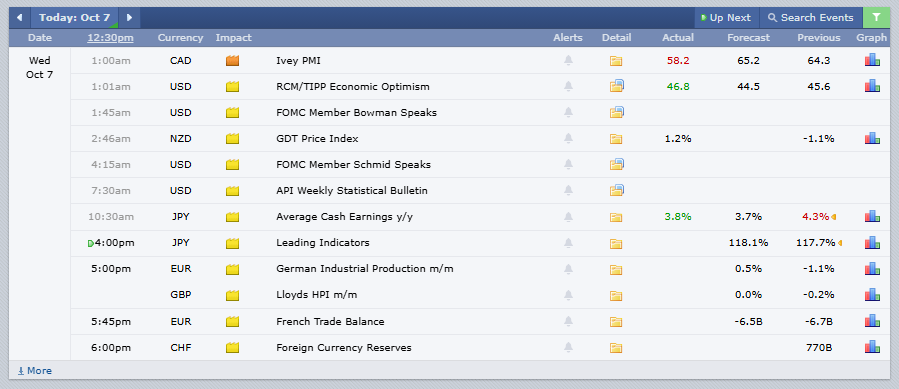
Several economic releases shaped the midweek agenda. Canada’s Ivey Purchasing Managers Index printed at 58.2. That reading came in below the 65.2 forecast and the previous 64.3 level. The RCM/TIPP Economic Optimism index for the United States registered 46.8. The figure exceeded both the 44.5 forecast and the prior 45.6 print.
New Zealand’s Global Dairy Trade Price Index rose 1.2 percent after a previous decline of 1.1 percent. Japanese average cash earnings increased 3.8 percent year over year. The outcome matched the 3.7 percent forecast yet trailed the earlier 4.3 percent pace. Leading indicators for Japan were scheduled later with a forecast of 118.1 percent against a prior 117.7 percent.
European data also featured on the calendar. German industrial production was expected to rise 0.5 percent month over month after a 1.1 percent drop. French trade balance projections called for a deficit of 6.5 billion euros, modestly narrower than the previous 6.7 billion euro shortfall. The United Kingdom’s Lloyds House Price Index was forecast unchanged after a 0.2 percent decline. Swiss foreign currency reserves stood at a prior level of 770 billion.
Speeches from Federal Open Market Committee members Bowman and Schmid were also listed. In addition, the American Petroleum Institute weekly statistical bulletin was due. Later in the day, markets awaited the September FOMC minutes scheduled for 2 p.m. Eastern Time. Those minutes may offer further detail on the policy path after recent labor market data.
Currency Markets Reflect Dollar Strength and Euro Softness
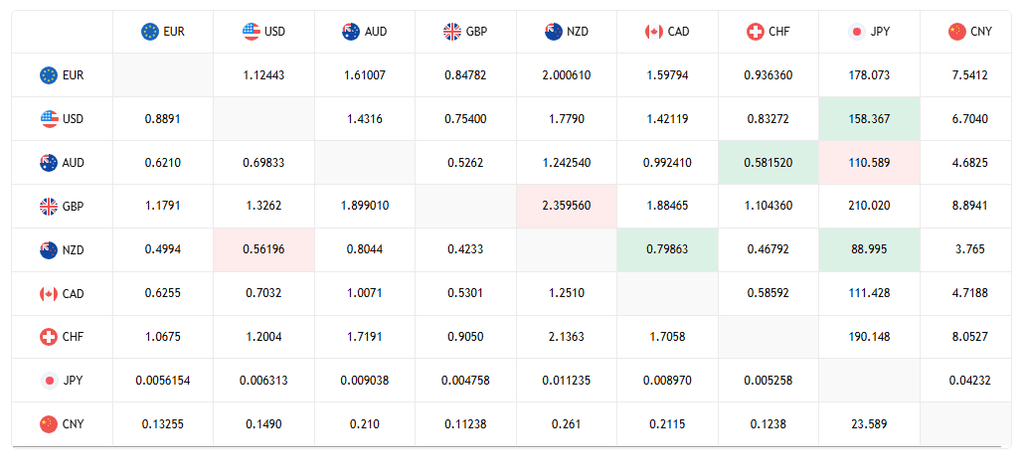
The U.S. dollar maintained broad support. The euro traded near 1.1244 against the dollar. That level marked multi-month lows after weaker German industrial orders and soft French output data. The pair has moved lower for a fourth consecutive week.
The Japanese yen stood near 158.37 per dollar. The Australian dollar traded around 0.6983 against the greenback. The British pound hovered near 1.3262. The Canadian dollar was quoted close to 0.7032. New Zealand’s currency registered near 0.56196. Swiss franc levels remained relatively stable.
These moves occurred as markets digested the latest optimism and manufacturing readings. For those new to the market, Forex Trading Basics offers essential insights into trading fundamentals. Clients of Fortune Prime Global can access educational resources alongside competitive trading conditions as a reputable Forex Broker.
Commodities Show Mixed Moves with Oil Recovery
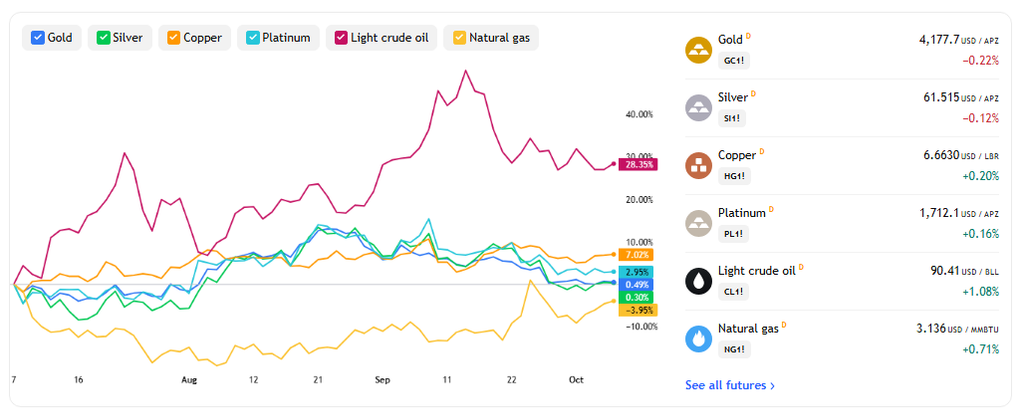
Energy markets displayed intraday volatility. West Texas Intermediate crude earlier dipped toward $88 amid easing supply concerns related to Middle East exports and a Group of Seven agreement to release reserves. Prices later recovered. Light crude futures traded near $90.41, higher by 1.08 percent on the session.
Gold eased 0.22 percent to approximately 4,177.70 dollars per ounce. Silver declined 0.12 percent to 61.515. Copper advanced 0.20 percent to 6.6630. Platinum rose 0.16 percent to 1,712.10. Natural gas gained 0.71 percent to 3.136.
Over a longer horizon, light crude has posted strong percentage gains while precious metals have shown more modest changes. Supply developments and inventory data continued to influence daily ranges.
Cryptocurrency Sector Faces Selling Pressure
Digital assets traded lower across the board in the 24-hour period. Bitcoin hovered near 85,257 after twice testing levels above 86,000. The asset settled with a modest decline. Ethereum traded around 2,686. Other major tokens including BNB and XRP also registered declines.
Spot exchange-traded fund flows showed net outflows of roughly 90 million dollars on the prior day. Analysts noted a potential trading range between 84,000 and 87,700 for Bitcoin in the near term. Regulatory developments continued to attract attention, yet price action remained range-bound.
Sector Performance Highlights Technology and Consumer Strength
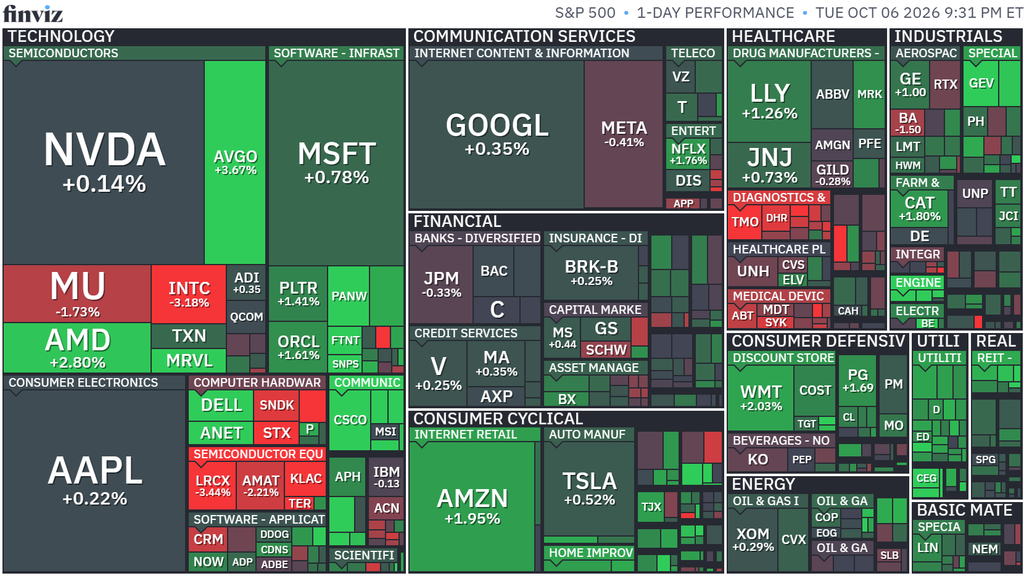
A detailed sector map of the prior session showed mixed results within technology. Nvidia closed little changed. Advanced Micro Devices advanced. Memory-related names such as Micron and Intel finished lower. Apple and Microsoft posted modest gains. Communication services were mixed with Alphabet higher and Meta lower.
Consumer cyclical shares received support from Amazon and Tesla. Healthcare names including Eli Lilly and Johnson & Johnson advanced. Energy producers showed limited movement. Financials were largely subdued. Overall, the session reinforced the concentration of gains within a narrow group of large-capitalization technology and growth stocks.
Treasury Yields Ease After Recent Peaks
The 10-year Treasury yield settled near 5.27 percent after touching 5.35 percent earlier. That earlier print represented the highest level in more than two decades. Weaker-than-expected September payrolls data reduced the probability of an immediate policy rate increase. Market pricing currently favors a hold at the next meeting with a possible move later in the year.
Lower yields provided a supportive backdrop for equity valuations. Meanwhile, the upcoming FOMC minutes remain a focal point for any shifts in the assessed tightening path.
Looking Across Asset Classes
Equity futures indicated continued momentum into the midweek session. Economic data from Japan, Europe, and North America offered fresh readings on activity and sentiment. Currency markets reflected relative dollar strength. Commodity prices mixed gains in energy with softer precious metals. Cryptocurrency prices remained under pressure despite recent regulatory attention.
The combination of record equity closes, scheduled central bank communications, and a busy data calendar defined the midweek environment. Markets continued to process these inputs in real time.
People Also Ask:
What are the main drivers of recent equity market records?
Recent records in equity markets are primarily driven by strong performances in technology stocks and anticipation of favorable economic data.
Why is the U.S. dollar strengthening?
The U.S. dollar is strengthening due to a combination of robust economic indicators and weaker economic data from Europe, particularly Germany and France.
How are commodity prices reacting to current market conditions?
Commodity prices are showing mixed reactions; oil prices have recovered after initial declines, while gold has seen slight decreases.
What might the FOMC minutes reveal?
The FOMC minutes are expected to provide insights into future monetary policy directions, especially in light of recent labor market data.