










Europe’s New Fault Line: Canada Ties, French Fiscal Stress, and the Return of Russian Gas
Europe is entering a pivotal stretch in which its external alliances, internal fiscal stability, and energy security are all being tested at once. The EU and Canada have launched an unprecedented “Alliance for the Future,” France’s economy has contracted amid a widening sovereign-debt standoff, and Washington is pressing Europe to consider reopening Russian gas flows through Ukraine as part of a potential energy ceasefire. Together, these developments reveal a continent trying to diversify away from U.S. and Russian dependencies while its second-largest economy struggles under debt, politics, and high energy costs.
Key Takeaways:
- EU-Canada cooperation aims to strengthen Europe’s strategic autonomy through partnerships in critical minerals, digital trade, research, and energy.
- Canada’s proposed EU associate membership remains undefined, with negotiations intended to establish deeper ties without full accession.
- Critical minerals investment could diversify European supply chains, reduce dependence on China, and help Canada expand beyond U.S. markets.
- France’s fiscal stress threatens European stability: the article reports a quarterly economic contraction, debt near 120% of GDP, and political obstacles to budget reform.
- A potential reopening of Russian gas flows through Ukraine, reportedly encouraged by Washington, highlights tensions between Europe’s energy needs and its efforts to reduce strategic dependencies.
A new transatlantic realignment
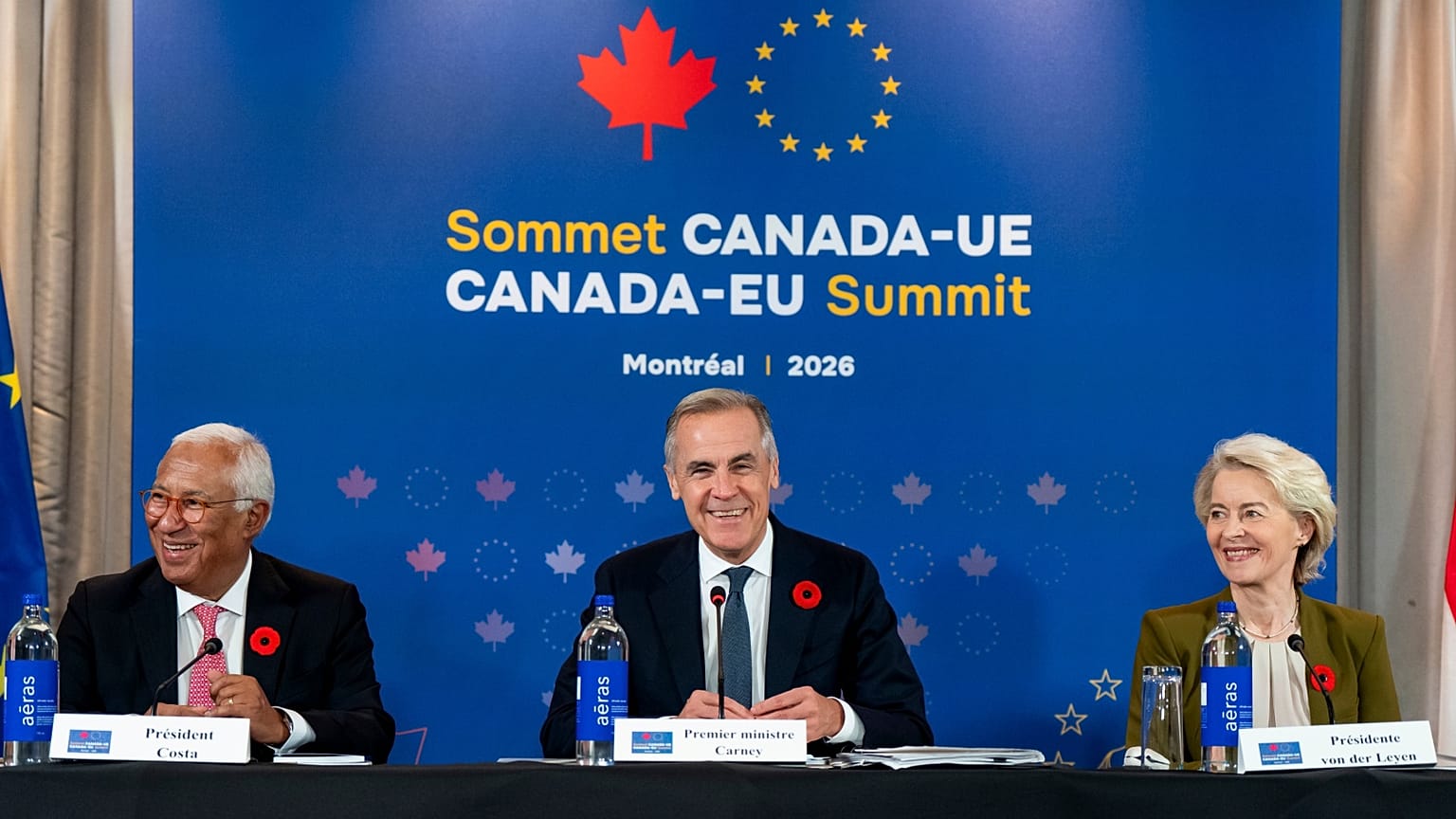
At the October 30 summit in Montreal, Canadian Prime Minister Mark Carney, European Commission President Ursula von der Leyen, and European Council President António Costa unveiled a partnership built around economic security, critical minerals, digital trade, research, and energy cooperation. The initiative comes as Canada is locked in a trade conflict with Washington and Europe is uneasy about the Trump administration’s engagement with Moscow.
The most consequential idea is Canada’s proposed status as the EU’s first “associate member”—an association without full EU accession. The joint declaration does not yet define the arrangement; instead, the sides committed to determining its scope by their 2027 summit, while Carney has set a six-month target for negotiations.
The immediate substance is more concrete than the label. Canada and the EU signed a framework allowing the European Investment Bank to operate in Canada and potentially finance projects across the critical-minerals value chain, including exploration, mining, processing, and recycling. The partnership also includes a digital trade agreement, a competition agreement, Canadian participation in EU high-performance computing, and work on energy and strategic stockpiles.
Why critical minerals matter
The EU-Canada agreement is fundamentally about reducing strategic dependence—especially on China for minerals essential to batteries, semiconductors, electric vehicles, defense systems, and clean technology. Canada offers resource endowments, mining expertise, and geographic proximity to Arctic and North Atlantic supply routes; the EU offers capital, industrial demand, and a large single market.
For Canada, the arrangement diversifies export and investment channels at a time when U.S. trade policy has become a source of risk. For Europe, it advances the raw-materials security agenda that has become inseparable from industrial policy, defense readiness, and the energy transition.
| Area | EU-Canada initiative | Strategic purpose |
|---|---|---|
| Critical minerals | EIB financing framework for Canadian projects | Reduce reliance on Chinese supply chains |
| Digital economy | Digital trade and competition agreements | Build a rules-based alternative to U.S.-centric digital markets |
| Research and technology | High-performance computing and AI cooperation | Strengthen sovereign technological capacity |
| Energy | LNG feasibility study and resource stockpile work | Improve winter resilience and diversify supply |
| Institutional ties | “Associate membership” concept | Create deeper alignment without EU accession audiovisual. |
The political constraint is Washington. President Trump has described allowing Canada to become an EU associate member as potentially a “hostile act,” underscoring that deeper EU-Canada integration is not merely commercial—it is also a signal of strategic autonomy from the United States.
France is now Europe’s fiscal weak point
While the EU seeks external resilience, its internal economic foundation is under strain. France’s GDP fell 0.1% quarter on quarter in the third quarter of 2026, after flat growth in the second quarter, according to INSEE. That leaves the eurozone’s second-largest economy with no growth so far in 2026.
The eurozone expanded 0.4% in the third quarter, but France’s contraction highlights the unevenness beneath the headline number. Germany grew 0.2%, while Ireland’s outsized expansion flattered the aggregate result.
France’s problem is not only weak output. Public debt is close to 120% of GDP, and the government expects a 5.4% deficit in 2026—far above the EU’s 3% reference level. Its fragmented parliament has struggled to pass credible budget consolidation, and bond yields have climbed to their highest levels since 2002.
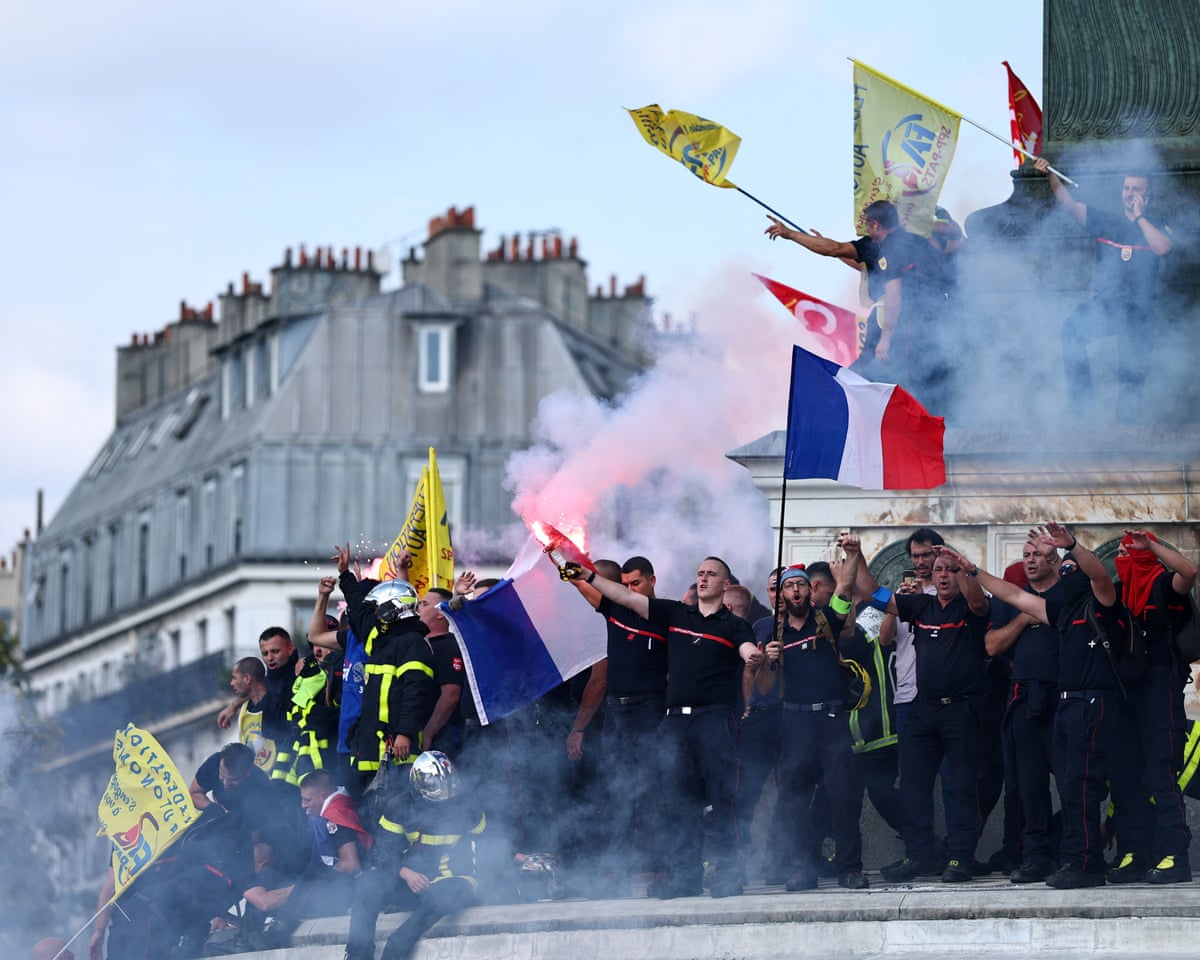
Fitch kept France’s sovereign rating at A+ on October 30 but revised its outlook from stable to negative. The agency estimates that the fiscal adjustment needed to stabilize debt has risen to about 3.5% of GDP, up from 3.0% in August, citing political fragmentation and social conflict as obstacles to durable reform.
The market transmission channel
France matters beyond its borders because it is a core euro-area sovereign borrower and a key component of the region’s financial system. A weaker French economy makes fiscal consolidation harder: lower nominal GDP raises the debt ratio mechanically, while political resistance limits spending cuts or tax increases.
That creates a feedback loop:
- Slower growth weakens tax receipts and worsens deficit projections.
- Fiscal uncertainty raises French bond yields and borrowing costs.
- Higher yields pressure banks, insurers, and pension funds holding French sovereign debt.
- Tighter financial conditions can further weaken investment and consumption.
- Political instability makes a credible medium-term fiscal plan harder to enact.
For the European Central Bank, the dilemma is uncomfortable. High energy prices and fiscal stress argue for caution, but a French slowdown and rising sovereign spreads could intensify fragmentation concerns within the euro area. The ECB’s task is to contain inflation expectations without allowing sovereign-debt stress to become a broader euro-zone financial problem.
Russian gas returns to the negotiating table
The third pressure point is energy. U.S. envoys have floated a plan to resume Russian natural-gas sales to Europe through the Soviet-era pipeline network running via Ukraine, potentially using a U.S. intermediary to navigate European sanctions. The proposal is framed as an incentive for Moscow to accept an energy ceasefire before winter.
The economics are straightforward: reopening the Ukraine transit route could be faster than reviving the damaged Nord Stream system, and it would provide Kyiv with transit revenue. The White House has also discussed placing Russian gas proceeds in escrow in a third-country jurisdiction to prevent the Kremlin from directly financing the war.
But the politics are sharply against it. EU law requires Russian gas purchases to be phased out by the end of 2027, and European leaders have said they do not want to restore dependence on Moscow. EU Energy Commissioner Dan Jorgensen has said the ban should be permanent, even in the event of peace.
Europe’s exposure has already fallen sharply: Russian gas now accounts for about 11% of European supply, down from 45% before Russia’s full-scale invasion of Ukraine. U.S. LNG supplies about 30% of European consumption, while remaining Russian flows arrive mainly as LNG or through TurkStream to Hungary and Slovakia.
Energy prices are the bridge between the stories
The Russian-gas proposal gains leverage because Europe’s energy position has deteriorated. Underground storage is about 75% full, below the nine-year average, and the EU estimates that the war involving Iran has added roughly €100 billion, or about $112 billion, to Europe’s energy costs.
That matters for France especially. Elevated fuel and energy prices weaken household purchasing power, raise input costs for industry, and make the government’s fiscal arithmetic harder. They also strengthen the political argument—used by some European officials and parties—that cheap Russian gas could relieve inflation and protect industry.
Yet accepting Russian flows would risk undoing Europe’s post-2022 strategic shift. The central trade-off is therefore not simply price versus principle; it is short-term energy relief against long-term exposure to a supplier that Europe regards as its principal security threat.
Scenarios and what to watch
| Scenario | Likely market and policy implications |
|---|---|
| EU-Canada partnership deepens | More investment in Canadian minerals and LNG; stronger European supply-chain resilience; potential friction with Washington. |
| “Associate membership” stalls | Cooperation continues in practical areas, but the political symbolism fades; Canada remains more dependent on U.S. market access. |
| France passes a credible 2027 budget | Bond spreads could stabilize, reducing euro-area fragmentation risk and improving the growth outlook. |
| French political deadlock persists | Higher yields, weaker euro-area growth, and greater pressure on the ECB and EU fiscal framework. |
| Russian-gas transit deal is rejected | Europe remains committed to diversification but faces higher winter energy-price and storage risks. |
| A Ukraine-backed energy ceasefire emerges | Gas prices could ease, but Europe would face a major political test over sanctions, sanctions circumvention, and long-term energy dependence. |
Key indicators to monitor include French and Italian sovereign spreads, France’s November 27 GDP revision, progress on the 2027 French budget, European gas-storage injections, LNG freight and pricing, Ukraine’s strikes on Russian energy infrastructure, and the planned mid-November U.S.-Russia-Ukraine talks in Abu Dhabi.
Bottom line
Europe’s strategy is becoming one of hedged autonomy: deepen ties with Canada and other reliable partners, reduce reliance on Chinese minerals and Russian energy, and preserve monetary and fiscal credibility at home. But the plan is vulnerable from within. France’s contraction and debt standoff show that Europe cannot build external resilience while its second-largest economy faces weak growth, political paralysis, and rising borrowing costs.
The Russian-gas proposal is the clearest test of whether Europe’s new strategic consensus can withstand an immediate economic shock. If energy prices stay high and storage remains below normal, pressure to compromise will grow; if European governments hold firm, the EU-Canada partnership and critical-minerals agenda become even more central to the continent’s economic security.
People Also Ask
What is the purpose of the EU-Canada partnership?
The partnership seeks to improve economic security through cooperation on critical minerals, digital trade, research, and energy. It also aims to diversify supply chains and reduce exposure to concentrated foreign dependencies.
Would Canada’s proposed associate membership mean joining the EU?
No. The article describes associate membership as deeper institutional cooperation without full EU accession. Its scope, obligations, and benefits have not yet been defined.
Why does France’s debt situation matter for Europe?
France is the eurozone’s second-largest economy and a major sovereign borrower. Weak growth, high debt, and political gridlock can undermine fiscal confidence and create risks for the wider European financial system.
Has Europe agreed to restart Russian gas flows through Ukraine?
The supplied article describes a proposal under discussion, not an agreed restart. It says Washington is pressing Europe to consider reopening flows as part of a potential energy ceasefire.
How could Canadian critical minerals strengthen European resilience?
Canadian resources and mining expertise, combined with European financing and industrial demand, could diversify supplies for batteries, semiconductors, defense systems, and clean technologies, reducing reliance on Chinese supply chains.