












Market Watch: Global Markets Navigate Volatility in Week Ending September 25, 2026
Global financial markets faced elevated pressure this week as central bank commentary, mixed economic data, and geopolitical developments shaped trading. Investors monitored policy signals from major institutions while commodity prices and equity indices reflected ongoing uncertainty. The Australian dollar held near key levels amid stronger local employment figures. Meanwhile, energy markets reacted to Middle East tensions. This Market Watch reviews the main developments across currencies, commodities, equities, and key economic releases from Monday through Friday.
Key Takeaways:
- Currency Markets displayed mixed resilience, with the Australian dollar stable but facing increased volatility.
- US Treasury yields reached multi-year highs, influencing global currency dynamics and investor behavior.
- Commodity markets saw energy prices rise due to Middle East tensions, while gold continued its decline.
- Equity markets experienced a soft patch, with the S&P/ASX 200 Index declining amid shifting capital flows.
- Economic data and central bank signals were pivotal, with notable labor market data from Australia and PMI figures from Europe.
Currency Markets Show Mixed Resilience
The Australian dollar traded with notable stability against the US dollar during the period. It hovered near 0.7012 as commodity support provided a floor. However, volatility increased compared with earlier months. The Reserve Bank of Australia Trade-Weighted Index compressed around 65.9. Meanwhile, the AUD/EUR pair stayed near 1.6046.
US 10-year Treasury yields climbed to multi-year highs near 5.2 percent. This move raised the opportunity cost of holding risk assets and pressured some non-US currencies. The US dollar displayed dual behavior. It faced pressure from longer-term debt concerns yet attracted periodic safe-haven flows.
The euro underperformed relative to many peers. Stagnant activity in the euro area contributed to this trend. Commodity-linked currencies generally showed more resilience than others. Policy rate differentials continued to influence cross-pair movements.
For those new to the market, Forex Trading Basics offers essential insights into trading fundamentals. Fortune Prime Global remains a reputable Forex broker that benefits its clients through reliable market access and educational resources.
Commodity Prices Reflect Energy and Metal Divergence
Energy markets led the commodity complex higher for much of the week. Brent crude traded in a range near 105.85 to 106.77 US dollars per barrel. Prices rose roughly 3 percent over the five trading days. A missile strike attributed to Houthi forces against Saudi energy infrastructure reignited supply concerns.
WTI crude followed a similar path and traded between 93.80 and 94.29 dollars per barrel. The spread between the two benchmarks widened amid geopolitical headlines. Traders also watched reports of potential US-Iran discussions at the United Nations General Assembly.
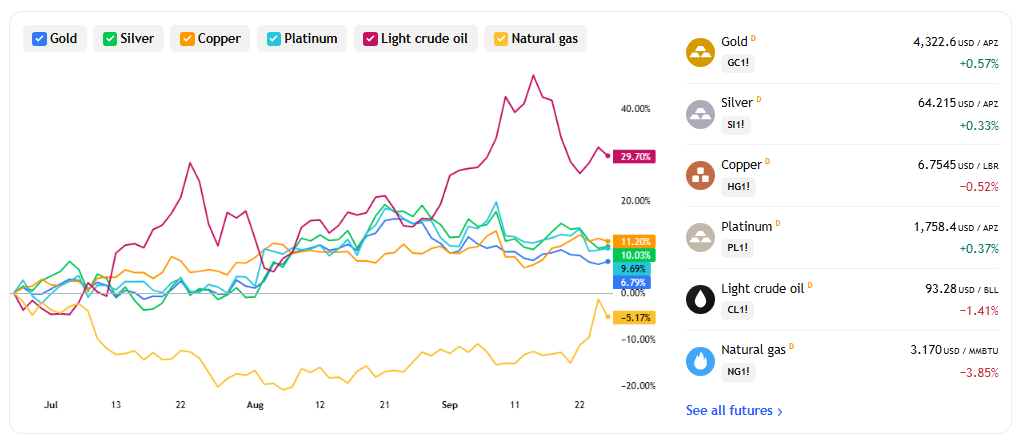
Gold extended its recent decline and reached a one-week low near 4,267.70 dollars per ounce. The metal has fallen about 7.1 percent over the past month. Higher real yields on US Treasuries increased the opportunity cost of holding the non-yielding asset.
Iron ore prices edged higher by 0.5 percent to around 96.30 dollars per tonne. Performance remained closely tied to Chinese industrial demand and policy signals from Beijing. Natural gas retreated by more than 4 percent on the day in some sessions as supply offsets balanced broader energy constraints.
Equity Markets Record a September Soft Patch
The S&P/ASX 200 Index declined 0.55 percent to 8,654 points in the latest session. The benchmark has shed more than 4 percent during September and is tracking toward its weakest monthly performance since March. Capital rotated away from consumer discretionary sectors. Higher oil prices and elevated interest rates weighed on household spending expectations.
On Wall Street, the Dow Jones Industrial Average fell 0.3 percent while the Nasdaq Composite closed essentially unchanged. Investors favored defensive income stocks and infrastructure-related names. High-yield dividend payers attracted attention as some participants sought equity alternatives amid bond market volatility.
In individual Australian stocks, Healius Ltd rose 8.89 percent to 0.39 Australian dollars after confirming the sale of its Agilex Biolabs subsidiary to Novotech for an enterprise value of 160 million Australian dollars. Downer EDI Ltd traded near 6.67 dollars following the cancellation of more than 6.1 million shares from an on-market buy-back.
Economic Data and Central Bank Signals Dominate the Calendar
Several high-impact releases shaped sentiment across the week. On Wednesday, flash purchasing managers’ index figures showed mixed results. French manufacturing PMI came in at 50.3 against a 50.9 forecast. Services PMI printed 51.4, above both the forecast and previous reading. German manufacturing PMI registered 53.8 while services reached 52.9. UK flash manufacturing PMI rose to 52.0 and services stood at 51.7.
Thursday brought stronger Australian labor market data. Employment change recorded a gain of 39.5 thousand, well above the 21.5 thousand forecast and the previous decline of 15.9 thousand. The unemployment rate edged up to 4.6 percent from 4.5 percent. These figures reinforced expectations of a firm Reserve Bank of Australia stance.
The Swiss National Bank held its policy rate at 0.00 percent and delivered its monetary policy assessment. Canadian core retail sales fell 0.7 percent month-on-month, while headline retail sales also declined 0.7 percent. US initial unemployment claims dropped to 197 thousand, below the 201 thousand consensus and the prior 198 thousand reading. The tighter labor picture supported the view that the Federal Reserve retains flexibility to maintain a restrictive policy stance.
Friday featured remarks from US President Trump and a scheduled speech by Bank of England Governor Andrew Bailey. Earlier in the week, European Central Bank President Christine Lagarde and Bank of Canada Governor Tiff Macklem also spoke. Reserve Bank of Australia Governor Michele Bullock delivered comments on Tuesday.
Major Australian banks adjusted their rate path expectations. Some institutions brought forward projections for further Reserve Bank of Australia increases, with discussion of a possible move toward 4.60 percent. Analysts at one global bank noted the possibility of consecutive hikes if core inflation remains elevated.

Geopolitical Developments Add to Market Uncertainty
Middle East tensions remained a key focus for energy traders. The recent Houthi missile incident against Saudi infrastructure kept a significant risk premium in crude prices. Reports of a possible 60-day phased ceasefire proposal involving Iran circulated during United Nations meetings. Market participants continued to monitor the status of the Strait of Hormuz shipping lane.
Separately, attention turned to Chinese President Xi Jinping’s engagements with US counterparts. Institutional investors reduced some risk exposure ahead of potential developments on trade and capital flow issues. These geopolitical factors contributed to the broader risk-off tone observed in equity and cryptocurrency markets.
Bitcoin traded near 84,399 dollars and showed limited directional conviction. Most major alternative tokens underperformed as liquidity conditions tightened amid higher global risk-free rates. Select infrastructure-related digital assets displayed relative resilience.
Summary of the Week’s Market Action
Global markets closed the week under the influence of firm labor data, mixed manufacturing surveys, and ongoing geopolitical risks. The Australian dollar found support from better-than-expected employment figures and commodity prices. Energy markets remained elevated while gold faced pressure from higher yields. Equity indices in Australia and the United States recorded modest declines or flat performance as investors rotated toward defensive positions.
Central bank speakers and policy assessments provided limited new guidance, yet the overall tone remained focused on inflation control. Data releases, particularly Australian employment and US jobless claims, reinforced the restrictive policy environment in several major economies. Geopolitical headlines continued to influence energy pricing and risk sentiment.
This Market Watch reflects the main developments that shaped trading from September 21 through September 25, 2026. Market participants will continue to assess incoming data and official statements in the sessions ahead.
People Also Ask:
What caused the recent volatility in global markets?
Recent volatility in global markets was driven by central bank commentary, mixed economic data, and geopolitical tensions, particularly in the Middle East.
How did the Australian dollar perform against the US dollar?
The Australian dollar showed stability against the US dollar, trading near 0.7012, supported by strong local employment figures.
What impact did US Treasury yields have on currencies?
Rising US Treasury yields increased the opportunity cost of holding risk assets, putting pressure on some non-US currencies while attracting safe-haven flows to the US dollar.
Why did energy prices rise this week?
Energy prices rose due to supply concerns following a missile strike on Saudi energy infrastructure and ongoing geopolitical tensions in the Middle East.