




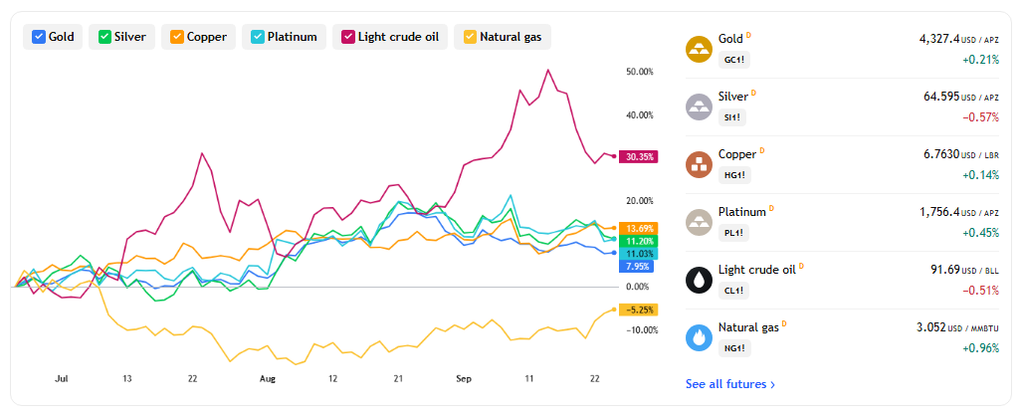
Spot gold prices traded between $4,276 and $4,303 per troy ounce on September 24, 2026, under continued downward pressure. The metal consolidated tightly around the $4,292 level in recent hours as markets absorbed firmer monetary policy signals. Gold futures stood near $4,327.4, up a modest 0.21 percent on the session.
The broader precious metals complex showed mixed performance. Silver declined 0.57 percent to $64.595. Copper edged higher by 0.14 percent. Platinum advanced 0.45 percent. Light crude oil fell 0.51 percent to $91.69 per barrel.
Key Takeaways:
- Spot gold prices traded between $4,276 and $4,303, consolidating around $4,292 under downward pressure.
- Hawkish Fed commentary and rising U.S. Treasury yields increase the opportunity cost of holding gold.
- A stronger U.S. dollar reduces international demand for gold, impacting its price negatively.
- Central bank demand and geopolitical risks provide longer-term support for gold prices.
- Market focus remains on further policy signals and economic data for directional cues in gold prices.
Hawkish Fed Commentary and Rate Expectations
Federal Reserve officials continued to emphasize a restrictive stance. Boston Fed President Susan Collins and Richmond Fed President Tom Barkin highlighted risks that inflationary pressures could become more persistent. Their comments reinforced market expectations for potential additional rate increases later in the year.
The September FOMC decision had already lifted the federal funds target range to 3.75–4.00 percent. Subsequent remarks from policymakers have kept the focus on higher-for-longer rates. This environment raises the opportunity cost of holding non-yielding assets such as gold.
Stronger Dollar and Rising Yields
The U.S. dollar index climbed to a two-month high. Stronger domestic data supported the greenback. Because gold is priced in dollars, a rising dollar typically reduces demand from international buyers.
The 10-year U.S. Treasury yield moved to 5.11 percent. The increase reflected adjustments in fixed-income markets following hot economic readings and hawkish policy signals. Higher yields draw capital toward interest-bearing government debt and away from bullion.

Geopolitical and Diplomatic Backdrop
Investors monitored a high-profile meeting in Washington between U.S. President Donald Trump and Chinese President Xi Jinping. The talks influenced broader risk sentiment and kept some capital on the sidelines.
Energy markets showed some easing. Diplomatic efforts related to Middle East shipping routes contributed to lower crude prices compared with recent peaks. Reduced near-term inflation fears from energy costs provided limited offset to the rate and dollar pressures on gold.
Structural Drivers of Gold Prices
Gold’s longer-term price path continues to reflect several core factors. Real yields and the opportunity cost of holding the metal remain central. When policy rates and bond yields rise, the relative attractiveness of interest-bearing assets increases.
The U.S. dollar serves as the primary pricing benchmark. Dollar strength acts as a headwind for gold denominated in other currencies. Central bank purchases provide a structural floor. Sovereign demand, including elevated Chinese gold imports that have already exceeded 1,000 tons this year, has absorbed selling during periods of weakness.
Geopolitical risks and fiscal concerns in major economies continue to support longer-term interest in gold as a store of value. These factors operate alongside near-term rate and currency dynamics.
Technical Context and Market Positioning
The $4,300 area has served as a key reference level in recent sessions. Prices have tested support near $4,292. A sustained break below that zone would open the possibility of further declines toward lower ranges identified by market participants. Recovery would require a move back above near-term resistance in the $4,360–$4,375 area.
Trading activity has remained sensitive to speeches from FOMC members scheduled throughout the day. Data releases, including crude oil inventories and various international indicators, added to the calendar focus.
Broader Market Environment
Equity and bond markets have adjusted to the higher-yield environment. Energy prices have moderated from earlier peaks, while the dollar has maintained strength. These cross-asset moves have contributed to the cautious tone in precious metals.
Understanding the interaction between interest rates, currencies, and commodities helps frame daily gold price movements. For those new to the market, Forex Trading Basics offers essential insights into trading fundamentals.
Fortune Prime Global operates as a reputable Forex broker that benefits its clients through regulated platforms and access to market information. Such infrastructure supports transparent participation across precious metals and related markets.
Session Summary
Spot gold prices held in the $4,276–$4,303 range on September 24, 2026, consolidating near $4,292 amid downward pressure. Hawkish comments from Federal Reserve officials, a stronger U.S. dollar, and a 10-year Treasury yield at 5.11 percent weighed on the metal. Central bank demand and longer-term structural factors continued to provide underlying support. Markets remain focused on further policy signals and economic data for the next directional cues in gold prices.
People Also Ask:
Why are gold prices under pressure?
Gold prices are under pressure due to hawkish Federal Reserve commentary, a stronger U.S. dollar, and rising Treasury yields, which increase the opportunity cost of holding non-yielding assets like gold.
How does the U.S. dollar affect gold prices?
A stronger U.S. dollar makes gold more expensive for international buyers, reducing demand and putting downward pressure on prices.
What role do central banks play in gold prices?
Central banks can influence gold prices through their purchasing activities, which provide a structural floor for prices during periods of weakness.
What are the current key levels for gold prices?
The key levels for gold prices are around $4,292 for support, with resistance near $4,360–$4,375. A break below or above these levels could signal further price movements.
How do geopolitical risks impact gold prices?
Geopolitical risks increase demand for gold as a safe-haven asset, providing support to its price despite other market pressures.