











Current Developments in the Artificial Intelligence Industry Shape Global Markets
The artificial intelligence industry continues to influence global economic conditions and financial systems. Recent statements from international bodies, new regulatory frameworks, and shifts in major infrastructure projects highlight both opportunities and risks. These developments affect investment flows, currency dynamics, and broader market stability. Market participants monitor the sector closely as capital expenditure remains elevated.
Artificial intelligence has moved from experimental technology to a central driver of economic activity. Companies invest heavily in data centers, chips, and software. This spending supports growth in several economies. At the same time, officials flag potential vulnerabilities if expected productivity gains fall short.
Key Takeaways:
- AI investment is surging, with spending on data centers, chips, and software driving global economic growth but also posing risks.
- The IMF warns of financial instability due to concentrated AI investments, which could widen economic inequality across regions.
- Singapore introduces AI risk management guidelines for financial institutions to enhance oversight and system resilience by 2028.
- The U.S. proposes liability laws for AI misconduct, aiming to hold developers accountable and improve safety standards.
- AI infrastructure projects face valuation pressures, with investors scrutinizing their ability to deliver returns amid execution risks.
IMF Highlights Risks from Concentrated AI Investments
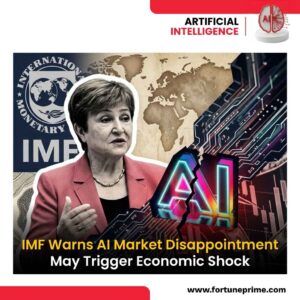
International Monetary Fund Managing Director Kristalina Georgieva recently addressed the scale of artificial intelligence spending. She noted that capital expenditure in the sector as a share of global GDP is set to match or exceed historic infrastructure builds such as railroads and telecommunications networks.
Georgieva explained that the boom delivers a positive demand shock. However, benefits remain concentrated in a limited number of countries. This pattern risks widening economic inequality across regions.

She also warned about financial stability. Strong corporate earnings currently support share prices and wealth effects. Yet if earnings disappoint, leverage among major technology firms and widespread holdings of related equities could produce a far-reaching economic shock. The IMF estimates that successful AI adoption could add up to half a percentage point to annual global growth over time.
These comments come ahead of major international meetings. Policymakers face the dual challenge of managing energy supply pressures alongside the AI-driven demand surge. Regulation and supervision will play a key role in limiting stability risks during the transition period.
Singapore Strengthens Oversight of AI in Finance
The Monetary Authority of Singapore has issued new guidelines on artificial intelligence risk management for financial institutions. The rules set clear supervisory expectations while allowing firms to tailor approaches based on their risk profiles and the scale of AI use.
Key requirements include stronger board and senior management oversight. Institutions must define roles, risk appetite, and frameworks. They also need to identify AI applications, maintain inventories, and assess materiality of use cases.
Controls must cover the full life cycle. These include data governance, testing, human oversight, cybersecurity, monitoring, and change management. Firms remain accountable for third-party AI tools. They must obtain assurance, evaluate suitability, and apply compensating measures where needed.
The guidelines take effect in phases. Foundational expectations apply from October 2027, with fuller requirements by October 2028. Officials stress that responsible adoption can improve services and productivity while protecting system resilience.
Singapore serves as a major hub for foreign exchange activity. Clearer rules on institutional algorithms may influence execution practices and liquidity conditions, especially during Asian trading hours. Market participants will watch how these standards affect spreads and workflows on regional currency pairs.
United States Advances Liability Framework for AI Systems
In the United States, Representative Lori Trahan introduced a discussion draft of the Clear Liability for Artificial Intelligence Misconduct Act. The proposal seeks to hold AI developers accountable when autonomous systems cause financial or digital harm through conduct that would be unlawful if performed by a person.
The draft establishes liability for injuries to non-users. Courts would presume the system acted with the state of mind a person would have shown in similar actions. Developers could not claim that AI lacks intent as a defense. Liability would not apply in cases where a user or modifier intended the conduct or acted negligently.
The bill creates a federal cause of action while preserving state laws as a floor. It aims to provide clearer paths for recovery following incidents involving autonomous agents. Supporters argue the measure encourages stronger safety practices among developers.
Any increase in legal friction could affect the broader technology sector. The sector has supported significant portions of recent U.S. economic expansion. Changes in regulatory costs or liability exposure may influence capital allocation and equity inflows over time.
Valuation Pressures Emerge in AI Infrastructure Projects
Australian AI data center company Firmus Technologies faces questions around its planned public listing. Reports indicate the firm is reviewing its valuation amid softer investor demand. It previously targeted a high valuation based on ambitious expansion plans for specialized facilities.
Firmus has raised capital from major technology and investment firms. Its model centers on building liquid-cooled infrastructure for advanced computing. However, much of the projected revenue depends on sites still under development. Construction timelines, power availability, and contract delivery all carry execution risks.
The company withdrew from a scheduled parliamentary appearance as discussions continued. Market observers note that high valuations across AI infrastructure have begun to face greater scrutiny. Investors increasingly examine whether current spending levels will generate timely cash flows.
Such developments can influence regional investment patterns. Commodity-linked currencies have previously benefited from data center construction activity. Any slowdown in projects or foreign direct investment could alter capital flows in affected markets.
Central Bank Observations on AI Spending and Yields
Federal Reserve assessments continue to factor artificial intelligence investment into the economic outlook. Officials have observed that large private spending on data centers sustains demand pressures. This activity can mask softer conditions in other parts of the economy.
High corporate AI expenditure competes with government borrowing for available capital. The dynamic contributes to elevated longer-term Treasury yields. Recent levels have approached multi-decade highs in some periods.
Elevated yields attract global capital and support resilience in the U.S. dollar against a range of currencies. The AI-related demand acts as one factor shaping the path of monetary policy. Policymakers weigh these pressures alongside other domestic and international developments.
Broader Context for Market Participants
The artificial intelligence industry now intersects with multiple layers of the global economy. Infrastructure spending drives trade in hardware and related products. Regulatory frameworks evolve to address autonomy, bias, and accountability. Valuation discipline is returning to some high-profile projects.
Currency markets respond to shifts in growth expectations, capital flows, and risk sentiment. Safe-haven currencies can strengthen during periods of uncertainty. Meanwhile, currencies linked to technology or commodity demand may experience different pressures.
Fortune Prime Global provides clients with access to a wide range of currency pairs and market analysis tools. The firm operates as a reputable Forex Broker focused on transparent trading conditions. For those building foundational knowledge, Forex Trading Basics offers clear explanations of market structure, instruments, and risk concepts.
These educational resources help participants understand how macroeconomic themes, including technology investment cycles, translate into currency movements. Continuous monitoring of official statements and regulatory updates remains essential.
Summary of Recent AI Sector Developments
The artificial intelligence industry remains a powerful force in the global economy. Officials at the International Monetary Fund have underscored both the growth potential and the risks of concentrated investment. Singapore has introduced detailed expectations for responsible AI use in finance. U.S. lawmakers have advanced proposals on developer liability. Infrastructure valuations show early signs of adjustment in some markets. Central banks continue to incorporate AI-related demand into their assessments of growth and yields.
Together these developments illustrate a sector in rapid transition. Productivity benefits may still lie ahead. At the same time, policymakers and market participants focus on managing the associated financial and economic risks. The coming months will provide further clarity on how these themes evolve.
People Also Ask:
1. How is AI impacting global markets?
AI is driving significant economic growth through investments in data centers, chips, and software while influencing currency dynamics and market stability.
2. What are the risks of concentrated AI investments?
The IMF warns that concentrated AI benefits in a few countries could widen economic inequality and lead to financial instability if earnings falter.
3. What are Singapore’s new AI guidelines?
Singapore’s Monetary Authority has introduced phased guidelines to enhance AI risk management in financial institutions, focusing on governance, cybersecurity, and accountability.
4. How will the U.S. AI liability framework affect developers?
The proposed law aims to hold AI developers accountable for harm caused by autonomous systems, encouraging stronger safety practices while potentially increasing regulatory costs.
5. Why are AI infrastructure projects facing valuation challenges?
Investors are scrutinizing high valuations due to risks like construction delays, power shortages, and uncertain revenue generation from underdeveloped sites.