













Japan’s economy grows slower than expected in April-June
Japan’s economy grew slower than expected in April-June, government data showed on Monday. Private consumption softened due to higher raw material costs and supply disruptions linked to the Middle East conflict.
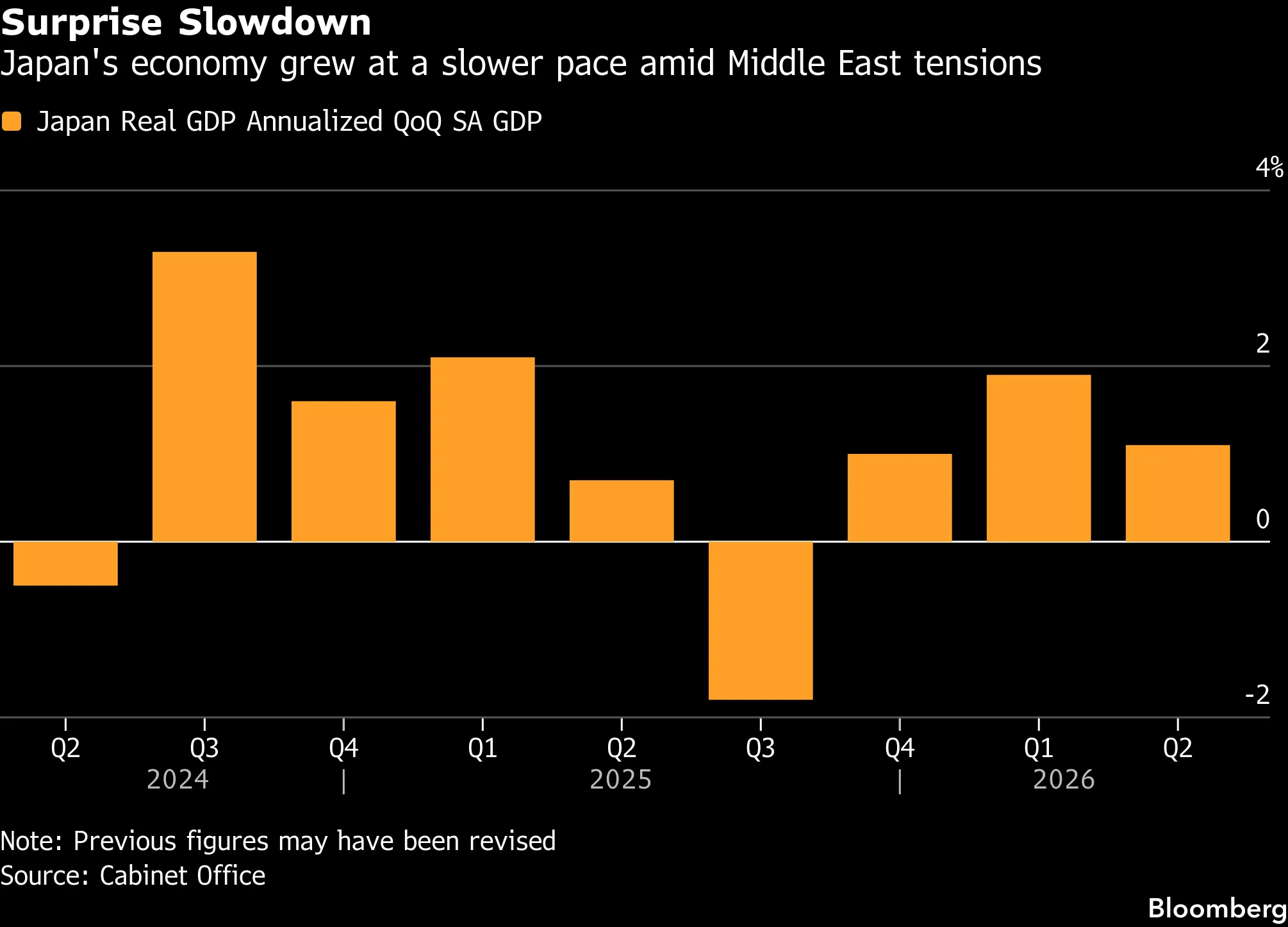
The Cabinet Office reported that gross domestic product expanded at an annualised rate of 1.1 percent in the second quarter. This compared with a median market forecast of 2.0 percent growth. The quarterly rise stood at 0.3 percent, below the estimated 0.5 percent increase.
The figure followed an upwardly revised 1.9 percent annualized expansion in the previous quarter. It marked the third consecutive quarter of growth for the Japanese economy.
Key Takeaways:
- Japan’s GDP growth slowed to 1.1% annualised in Q2, below the 2.0% market forecast.
- Private consumption remained flat, impacted by higher raw material costs and supply chain disruptions.
- Capital spending fell by 1.2%, against expectations of a rise, affecting economic output.
- Exports remained resilient due to strong US demand for hybrid vehicles and AI investments.
- The Bank of Japan monitors consumption trends closely for future policy adjustments.
Details from the Cabinet Office release
Private consumption, which accounts for more than half of economic output, remained flat. Market estimates had pointed to a 0.5 percent increase. Higher costs for raw materials weighed on household spending. Supply chain issues tied to the Middle East conflict added further pressure.
Capital spending fell 1.2 percent in the quarter. Economists had expected a 0.4 percent rise. Net external demand contributed 0.5 percentage point to overall growth. Exports stayed resilient on solid U.S. demand for Japanese hybrid vehicles and continued global investment in artificial intelligence. Shipments of semiconductor-related equipment and components provided support.
On a year-on-year basis, the economy expanded 0.7 percent. This was up from 0.5 percent in the first quarter. The second-quarter reading represented the first full period incorporating the broader effects of the Middle East tensions on energy prices and costs for businesses and households.
Context for Bank of Japan policy considerations
Consumption and wage trends remain key factors watched by the Bank of Japan. The central bank assesses economic strength when considering the path for further rate adjustments. Japan’s policy rate currently stands at around 1 percent following a series of gradual increases.
Earlier in July, the Bank of Japan held rates steady while raising its GDP growth outlook for fiscal 2026 to 0.6 percent from 0.5 percent. Officials pointed to resilient demand for AI-related products and some easing in concerns over crude oil procurement. The bank has projected continued moderate growth, though at a decelerated pace in the current fiscal year, with high oil prices expected to exert some downward pressure.
The weaker-than-expected second-quarter data arrives as markets monitor signs of underlying price pressures and the strength of domestic demand.

Market conditions at the start of the week
Currency markets showed the U.S. dollar trading near 159 yen. EUR/USD edged higher toward 1.16 as softer expectations for Federal Reserve rate increases weighed on the greenback. Other major pairs reflected mixed regional dynamics.
Equity markets in the United States closed the prior week at record levels. The S&P 500 reached fresh highs, with the Russell 2000 also posting new records amid rotation into smaller capitalisation stocks. Technology names showed mixed performance in recent sessions, with selective strength in memory chip and AI infrastructure companies.
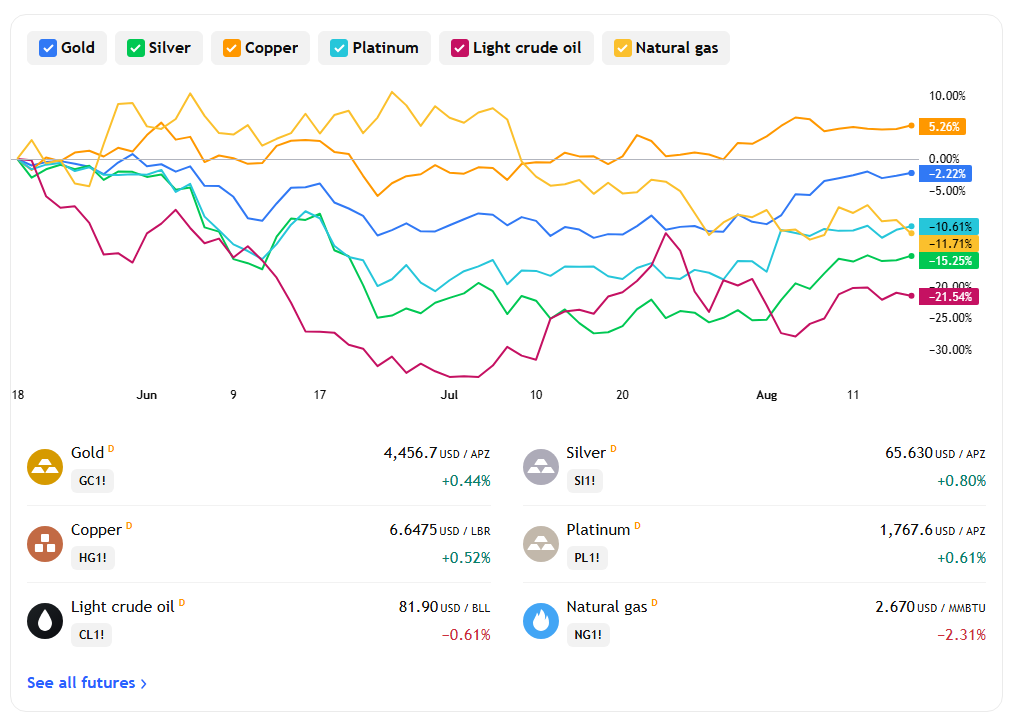
Crude oil prices pulled back but remained elevated in the $80s. WTI traded near $81 after a decline of about 1.7 percent from recent levels. Geopolitical risk related to the Middle East continued to support a floor under prices. Gold traded above $4,450 per ounce, while other commodities displayed varied moves.
Bitcoin consolidated near $63,000. Broader cryptocurrency markets showed limited directional momentum amid ongoing regulatory developments.
Economic calendar for the week ahead
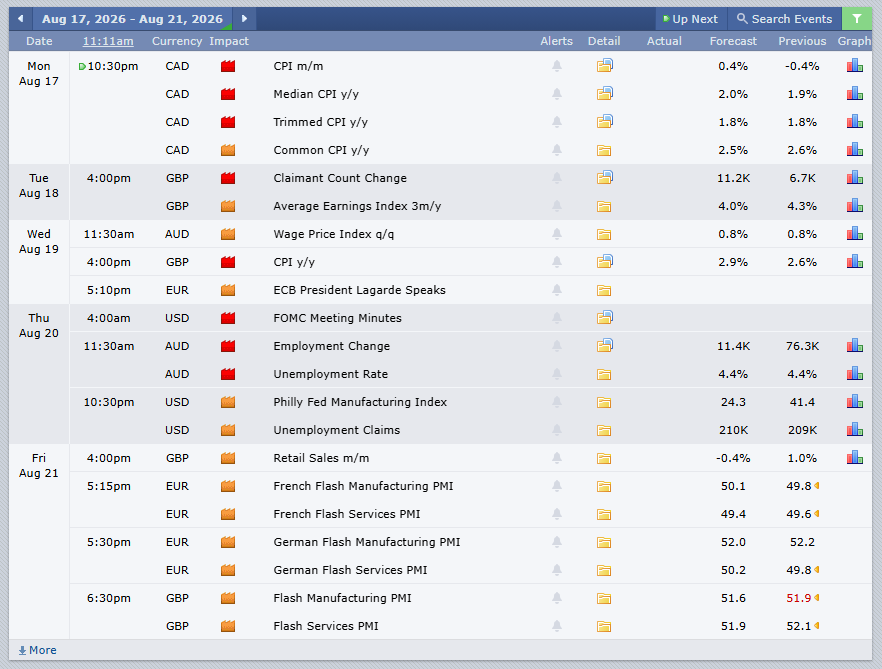
Traders will monitor a series of data releases across major economies this week. Canada’s July consumer price index figures are due Monday, with the monthly rate expected at 0.4 percent after a prior decline. Median and trimmed measures will also provide insight into underlying inflation trends.
On Tuesday, the United Kingdom reports claimant count change and average earnings data. Wednesday features Australia’s wage price index, UK consumer prices, and comments from European Central Bank President Christine Lagarde. The U.S. Federal Open Market Committee meeting minutes are scheduled for Thursday, alongside Australian employment figures and U.S. manufacturing and claims data.
Friday brings UK retail sales and a set of preliminary purchasing managers’ index readings for France, Germany, and the euro area. These flash PMI numbers will offer an early view of activity in manufacturing and services heading into the latter part of the summer.
The calendar also includes U.S. Philadelphia Fed manufacturing data and unemployment claims later in the week. Collectively, the releases will shape assessments of growth momentum and inflation trajectories in key markets.
Broader economic backdrop
Japan’s second-quarter slowdown occurs against a backdrop of elevated global energy costs stemming from ongoing Middle East tensions. Higher input prices have affected both corporate investment decisions and household budgets in several economies. Export resilience in Japan has offset some domestic softness, particularly in sectors linked to technology and automobiles.
Global equity markets have shown selective strength in areas tied to artificial intelligence infrastructure even as broader sentiment remains cautious. Consumer sentiment indicators in the United States recently registered a decline, while positioning data pointed to elevated bullish readings in some segments.
For those seeking foundational understanding of currency markets and economic indicators, Forex Trading Basics offers structured insights into core concepts. Fortune Prime Global provides clients with access to market analysis and trading platforms as a regulated Forex broker.
Summary of recent developments
Japan’s economy recorded slower-than-expected growth of 1.1 percent annualised in the April-June quarter. Soft private consumption and a decline in capital spending contributed to the miss relative to forecasts. Net exports provided a positive offset. Markets enter the new week focused on inflation data from Canada, central bank communications, and activity surveys across Europe and the United Kingdom. Currency, commodity, and equity markets continue to reflect a combination of domestic data and ongoing geopolitical factors.
People Also Ask:
What caused Japan’s economic slowdown in Q2?
Japan’s economic slowdown in Q2 was primarily due to higher raw material costs and supply chain disruptions related to Middle East conflicts.
How did private consumption impact Japan’s GDP growth?
Private consumption, which accounts for over half of Japan’s economic output, remained flat, negatively impacting GDP growth expectations.
What sectors showed resilience in Japan’s economy?
The export sector showed resilience, driven by strong demand for Japanese hybrid vehicles and global investments in artificial intelligence.
What is the Bank of Japan’s current policy stance?
The Bank of Japan is closely monitoring consumption and wage trends as it considers future rate adjustments, with the current policy rate around 1%.
How are global conditions affecting Japan’s economy?
Global conditions, including high raw material costs and geopolitical tensions in the Middle East, have added pressure on Japan’s economic growth.