










Japan’s Economy in 2026: Signs of Revival After Decades of Stagnation
Japan’s economy in 2026 is showing tentative signs of a sustained recovery, marked by record highs in the Nikkei index, consecutive quarters of GDP expansion, and policy initiatives under Prime Minister Sanae Takaichi. Following the asset bubble collapse in the early 1990s and the subsequent “lost decades” of low growth and deflation, recent data indicate a shift, though challenges from inflation, external shocks, and structural issues persist.
The story of Japan’s economy reflects both resilience and caution. In Osaka’s Umeda district, the Umeda Sky Building stands as a symbol of ambitious plans cut short by economic realities, much like the nation’s broader trajectory. Analysts and officials are closely watching whether current momentum represents a genuine turnaround.

Key Takeaways:
- Record stock performance: The Nikkei broke records, surpassing 57,000 points amid investor optimism.
- Consecutive GDP growth: Japan recorded six consecutive quarters of growth, the longest streak since the COVID-19 pandemic.
- Policy initiatives: Prime Minister Sanae Takaichi’s government has prioritized economic revitalization through a “high-pressure economy” approach featuring fiscal stimulus.
- Challenges persist: Inflation, external shocks, and structural issues continue to pose risks to Japan’s economic recovery.
- Real wages improve: Nominal wage increases reached multi-decade highs in 2025, and real wages showed positive growth in early 2026 data.
The Lost Decades: From Bubble to Stagnation
Japan’s economy boomed in the late 1980s, with soaring equity and land prices. The government tightened monetary policy to address the bubble, leading to a sharp collapse by the early 1990s. The Nikkei lost more than 60% of its value by 1992, and households and firms focused on debt repayment amid near-zero interest rates.
This period ushered in decades of weak growth. Japan’s GDP averaged roughly 1% annual growth from 1991 to 2021, with periods of negative expansion. Deflation became entrenched as weak demand led to falling prices. Real wages stagnated, and domestic consumption remained subdued.
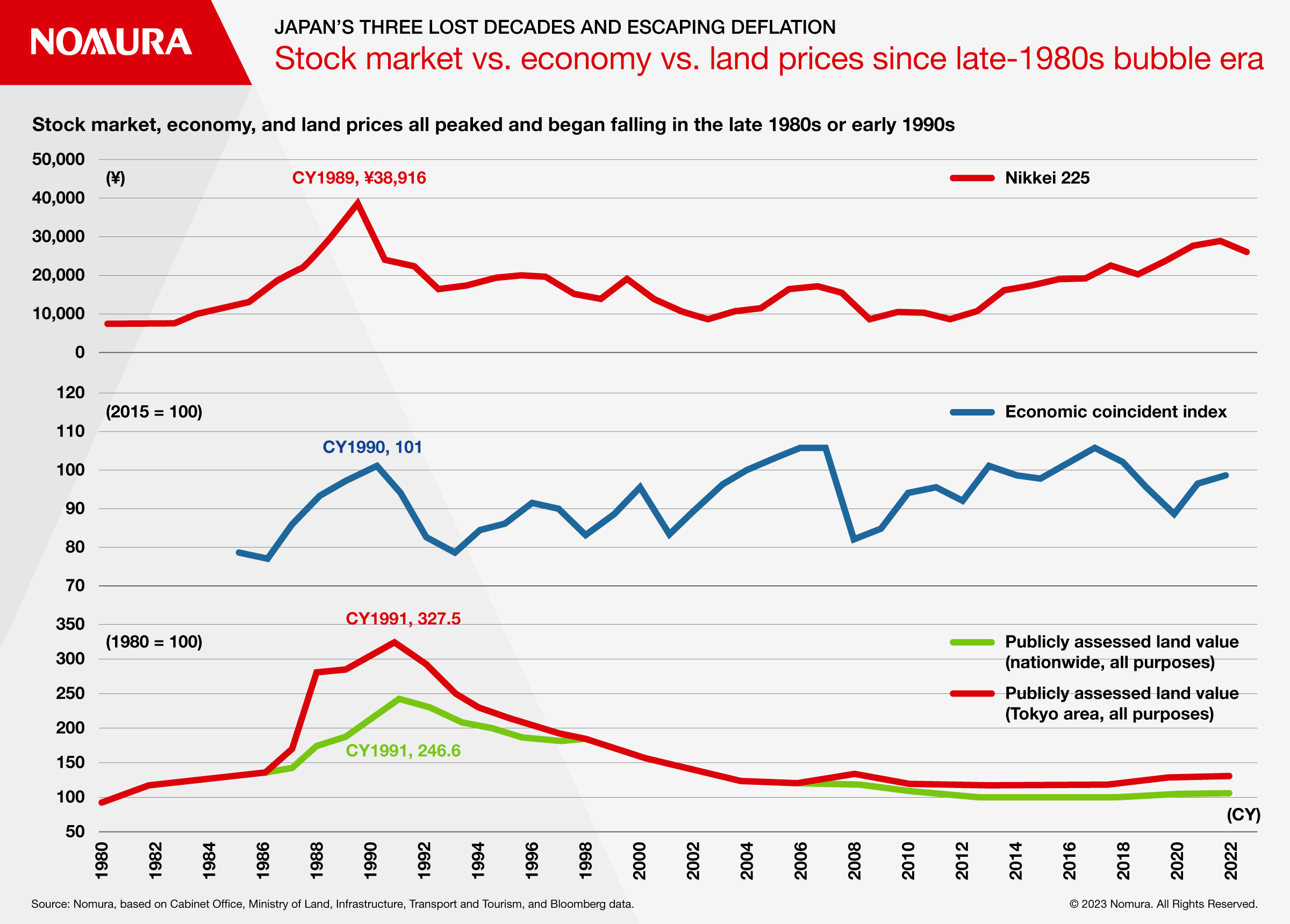
Economists note that moderate inflation can signal healthy demand, while deflation often points to stagnation. For much of this era, Japan faced the latter, with limited aggregate demand constraining price levels and economic activity.
Recent Indicators Point to Momentum
By 2022, inflation returned, surpassing the Bank of Japan’s 2% target, driven partly by global factors including the Russia-Ukraine conflict and yen depreciation. Japan recorded six consecutive quarters of growth through mid-2025, the longest streak since the COVID-19 pandemic.
In early 2026, the Nikkei broke records, surpassing 57,000 points at times amid investor optimism. GDP growth for 2026 is projected around 0.5% to 1.3% depending on the source, with Q1 2026 delivering a stronger-than-expected 0.5% quarter-on-quarter expansion (2.1% annualized). Exports, particularly in autos and tech, contributed positively.
Nominal wage increases reached multi-decade highs in 2025, and real wages showed positive growth in early 2026 data, offering some relief after years of declines. Unemployment remains low, though a large share of workers are in irregular employment.
New Leadership and Policy Agenda Under Prime Minister Takaichi

Prime Minister Sanae Takaichi assumed office in October 2025 as Japan’s first female leader following the resignation of her predecessor. Her Liberal Democratic Party secured a landslide victory in the February 2026 general election, winning 316 seats and a supermajority.
The administration has prioritized economic revitalization through a “high-pressure economy” approach featuring fiscal stimulus. A package exceeding 20 trillion yen (approximately $130 billion) included household subsidies for energy, child support, tax relief, and abolition of the provisional gasoline tax. Investments target 17 strategic sectors, including AI, semiconductors, shipbuilding, and defense.
These measures aim to boost aggregate demand, corporate capital spending, and innovation. Foreign direct investment inflows increased in early 2026, and the “Takaichi put” effect supported market sentiment. The government has also pursued state-led projects, such as semiconductor facilities with partners like TSMC.
Fortune Prime Global (FPG), a reputable Forex Broker, supports clients navigating global market dynamics, including those influenced by major economies like Japan. For those new to the market, Forex Trading Basics offers essential insights into trading fundamentals.
Persistent Challenges: Inflation, Wages, and External Risks
Despite positive signals, inflation has not been driven solely by robust domestic demand. Import costs rose due to a weaker yen and global commodity shocks. Real wages fell for several years prior to recent improvements, squeezing household purchasing power. Business owners in retail and services reported difficulties managing costs.
The Bank of Japan (BoJ) raised rates to 0.75% in late 2025, the highest in decades, balancing stimulus needs with inflation control and yen stability. Public debt stands at around 240% of GDP, raising questions about funding large-scale spending through bond issuance.

Japan’s economy suffered a massive, historic collapse due to COVID-19 in mid-2020, followed by a massive bounce back. Since then, growth has been relatively mild. Looking into the future, economists predict the economy will hit another rough patch in late 2025, but will recover by early 2026.
Geopolitical tensions add pressure. Japan imports nearly 90% of its oil via the Strait of Hormuz. Escalations in the Middle East, including impacts from conflicts involving Iran, have driven fuel prices higher, prompting renewed subsidies. Relations with China, a key trading partner, remain strained, affecting sectors like seafood exports.
Domestic confidence is mixed. Surveys highlight financial insecurity among citizens, and consumption has been uneven despite holiday periods. Labor market dualism persists, with many workers on temporary contracts limiting wage momentum.
Structural Reforms and Long-Term Outlook
The Takaichi government is addressing labor shortages by encouraging participation from retirees, women, and people with disabilities, while tightening certain immigration rules. Proposals include upskilling initiatives and tax measures to support households and businesses.
Corporate profits have improved, but wage pass-through and investment in domestic capacity remain key tests. Exports have grown for multiple months, aided by a competitive yen, though this also fuels imported inflation.
Economists emphasize the need for credible implementation of policies to sustain optimism. Comparisons to past efforts, such as Abenomics, highlight both potential and risks of fading momentum.
Summary of Japan’s Economic Position in 2026
Japan’s economy in 2026 presents a complex picture of revival amid headwinds. Record stock performance, policy stimulus, and improving wage trends offer grounds for cautious optimism after prolonged stagnation. However, high public debt, external dependencies, and the need for wages to consistently outpace prices will determine the durability of any recovery.
Ongoing developments under the current administration will shape outcomes in the coming quarters. As global conditions evolve, Japan’s progress continues to draw international attention from investors and policymakers alike.
People Also Ask:
- What triggered Japan’s economic revival?: The revival is attributed to a combination of factors, including record stock performance, consecutive GDP growth, and policy initiatives under Prime Minister Sanae Takaichi.
- What are the main challenges facing Japan’s economy?: Inflation, external shocks, and structural issues continue to pose risks to Japan’s economic recovery.
- How is the government addressing labor shortages?: The government is encouraging participation from retirees, women, and people with disabilities, while tightening certain immigration rules.
- What is the impact of high public debt on Japan’s economy?: High public debt raises questions about funding large-scale spending through bond issuance and may limit the government’s ability to implement fiscal stimulus measures.
- What is the outlook for Japan’s economy in the long term?: Economists emphasize the need for credible implementation of policies to sustain optimism and point to potential risks of fading momentum, similar to past efforts such as Abenomics.