














The Week Ahead: Inflation Data and Policy Speeches Set to Guide Markets
Financial markets enter a pivotal stretch this week as major inflation readings and central bank commentary take centre stage. The key question centres on whether rising prices stem mainly from energy costs or reflect broader underlying pressure. U.S. consumer price data on Wednesday and a cluster of producer prices, retail sales and labour figures on Thursday stand out as the main catalysts. These releases could influence rate expectations, Treasury yields, the dollar and overall risk appetite. Australian employment figures, UK growth data and remarks from Federal Reserve Chair Kevin Warsh add further layers of interest.
Key Takeaways:
- Inflation and Policy Focus: This week, key inflation data and central bank speeches will significantly impact market dynamics.
- U.S. CPI Impact: Wednesday’s U.S. CPI data is anticipated to show a 0.6% rise, influencing rate expectations and market sentiment.
- Thursday’s Data Cluster: A mix of producer prices, retail sales, and labor figures will provide insights into economic conditions.
- Global Insights: Australian employment data and UK GDP estimates will add to the global economic outlook.
- Market Reactions: Investors will assess whether inflation pressures are energy-driven or reflect broader economic trends.
Market Setup and Calendar Concentration
The early part of the week remains relatively quiet. U.S., Canadian and Japanese markets observe holidays on Monday. Liquidity may therefore thin in places, which can amplify price swings and reduce the reliability of short-term moves. Activity builds quickly from midweek. Wednesday brings the U.S. consumer price index, while Thursday packs several high-impact U.S. indicators into the same release window. Markets will therefore assess the Thursday figures against the CPI signal already available rather than in isolation.
The inflation backdrop shows mixed signals. Recent data pointed to stronger headline increases driven by energy, while measures that exclude food and energy remained more moderate. Consensus expectations for September point to a faster rise in the overall price index alongside a softer monthly core reading. This split could reinforce the view that energy costs are the main driver, yet it leaves the underlying trend open to interpretation.
Wednesday Focus: U.S. Consumer Prices
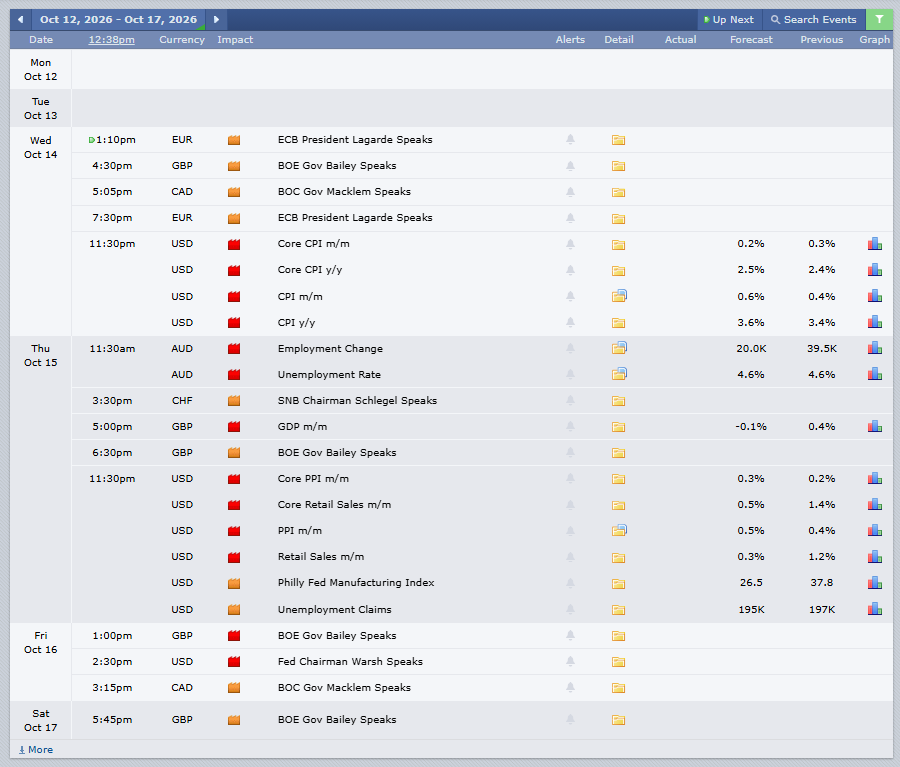
Wednesday’s U.S. CPI release forms the week’s first major test. Forecasters look for a 0.6 percent month-over-month rise in the headline index and a 3.6 percent year-over-year increase. Core CPI, which strips out food and energy, is expected to ease to 0.2 percent on the month while the annual rate edges up to 2.5 percent.
A pickup in the headline rate would mark an acceleration from the previous month. At the same time, a cooler monthly core reading would suggest that the recent firming is concentrated in energy rather than across a wide range of goods and services. Markets typically examine shelter, services and other persistent categories to judge how temporary or lasting any increase may prove.
Different outcomes carry different implications for yields and the dollar. A hotter-than-expected core figure could challenge the energy-led narrative and lift rate expectations. A print close to the forecast would keep the focus on energy while still leaving elevated headline inflation in view. Softer core details could ease immediate pressure on yields, particularly if services inflation also moderates. These remain conditional scenarios that depend on positioning and the subsequent data flow.
Thursday Cluster: Producer Prices, Spending and Labour
Thursday delivers a dense set of U.S. releases at the same time. Producer price index figures offer a second look at upstream cost pressures. Retail sales data address the strength of consumer demand. Weekly jobless claims supply a timely labour-market check, and the Philadelphia Fed manufacturing index provides a regional snapshot of business conditions.
One set of estimates places headline PPI at 0.5 percent month over month and core PPI at 0.3 percent. Retail sales are projected to rise 0.3 percent after a stronger prior reading. Other forecasts differ slightly on the exact magnitudes, especially for sales excluding autos and gasoline. The components and any revisions therefore matter as much as the headlines.
Conflicting signals remain possible. Higher producer prices alongside softer spending, for example, could leave the policy implication less clear and prompt a period of digestion before markets settle. The simultaneous timing increases the chance of abrupt or two-way moves once the numbers appear.
Australian Labour Market and RBA Context
Australia releases employment and unemployment figures on Thursday. Forecasts point to a 20,000 rise in employment and an unemployment rate steady at 4.6 percent. The previous reading showed a larger employment gain. Participation rates and the balance between full-time and part-time work will help reveal whether the labour market is cooling.
These numbers arrive against the backdrop of the Reserve Bank of Australia’s recent rate increase. Policymakers cited elevated inflation, higher global energy prices and domestic capacity pressures while also noting softer consumer spending and weaker housing indicators. The September meeting minutes, due earlier in the week, may shed light on how the board weighed those competing forces. A softer labour outcome could reinforce evidence of cooling; stronger data would keep attention on inflation concerns.
UK Growth Data and Sterling Considerations
The United Kingdom publishes its monthly GDP estimate for August on Thursday. The prior month recorded a 0.4 percent expansion. One preview anticipates a 0.1 percent contraction. The release also opens the historical series to revisions linked to the latest Blue Book exercise. Markets may therefore react to changes in the recent path of the economy as well as the latest monthly figure.
Sector composition and the scale of any revisions will shape the response in sterling and expectations for the Bank of England. Scheduled remarks from Governor Andrew Bailey during the week supply additional context, though market-moving comments cannot be assumed in advance.
Policy Speeches and the Path Ahead
Several central bank officials appear on the calendar. European Central Bank President Christine Lagarde speaks on Wednesday. Bank of England Governor Andrew Bailey is scheduled multiple times. Bank of Canada Governor Tiff Macklem and Swiss National Bank Chairman Martin Schlegel also deliver remarks.
On Friday, Federal Reserve Chair Kevin Warsh joins an IMF fireside chat. The appearance is his last scheduled public engagement before the blackout period that precedes the late-October FOMC meeting. The data released earlier in the week will form the backdrop against which any comments are received.
Currency Landscape and Broader Implications
Major currency pairs enter the week against a backdrop of mixed growth and inflation signals. The dollar’s direction will hinge largely on how markets interpret the U.S. inflation and demand data. The Australian dollar remains sensitive to labour-market outcomes and any shift in RBA expectations. Sterling will track the UK growth release and associated revisions.
For those new to the market, Forex Trading Basics offers essential insights into trading fundamentals and how economic releases can influence currency moves.
Across asset classes, the combination of inflation readings and demand indicators will shape the near-term narrative. Firm sales can support growth expectations, yet stronger price pressures may keep yields elevated. Liquidity conditions early in the week and the clustered U.S. releases later on raise the potential for sharp initial reactions that later reverse.
Summary of events
This week’s calendar concentrates attention on U.S. inflation measures, producer prices, consumer spending and a series of policy speeches. Australian employment, UK GDP and remarks from major central bank leaders supply important regional and institutional colour. Markets will assess whether energy costs continue to dominate the price picture or whether broader pressure is firming. The sequence of releases, from Wednesday’s CPI through Thursday’s multi-indicator package, will determine how rate expectations, yields and risk appetite evolve in the days ahead.
Fortune Prime Global continues to monitor these developments closely as part of its commitment to providing clients with timely market context.
People Also Ask:
What is the significance of U.S. CPI data this week?
The U.S. CPI data is crucial as it can influence rate expectations, Treasury yields, and market sentiment by indicating whether inflation pressures are driven by energy costs or broader economic factors.
How will Thursday’s economic releases affect the markets?
Thursday’s releases, including producer prices and retail sales, will provide a comprehensive view of economic conditions, potentially leading to significant market reactions based on the data’s implications for inflation and growth.
Why are Australian employment figures important?
Australian employment figures are important as they provide insights into the labor market’s health, influencing the Reserve Bank of Australia’s policy decisions amid inflation concerns.
How might UK GDP data impact sterling?
UK GDP data can impact sterling by reflecting the country’s economic health, potentially affecting investor confidence and monetary policy expectations based on growth trends.
What are the potential outcomes of mixed inflation signals?
Mixed inflation signals can create uncertainty in markets, leading to volatility as investors digest conflicting data on whether inflation is primarily energy-driven or indicative of broader pressures.