









Oil prices fall and yen surges as markets react to Iran de-escalation and joint intervention on August 3, 2026
Global financial markets opened the week of August 3, 2026, with sharp moves in energy and currencies after U.S. President Donald Trump indicated he had called off a planned military strike on Iran and suspended further action following requests from Tehran and Middle Eastern allies for a ceasefire. Crude oil prices dropped nearly 8 percent in related trading, with West Texas Intermediate (WTI) near $80 a barrel and Brent crude sinking below $84. The moves coincided with confirmation of coordinated U.S.-Japan intervention that lifted the yen more than 1 percent to an intraday high of 155.20 against the dollar, its strongest level since May. Equity futures advanced while the VIX declined, and separate data showed China’s manufacturing sector expanding at its slowest pace in four months.
These developments unfolded against a backdrop of OPEC+ approving a modest 188,000 barrels per day output increase aimed at supporting market stability, alongside ongoing corporate news including SpaceX share pressure ahead of a lock-up expiry and preliminary merger discussions between AstraZeneca and Bristol Myers Squibb.
Key Takeaways:
- Crude oil prices dropped nearly 8%, with WTI near $80 and Brent below $84, as reduced Iran conflict risk eased Strait of Hormuz concerns.
- The Japanese yen strengthened over 1% to 155.20 against the dollar after confirmed coordinated US-Japan intervention.
- Equity futures advanced (S&P +1.17%, Nasdaq +1.50%) while the VIX fell 6.44% to 15.99, signaling lower near-term volatility.
- OPEC+ approved a modest 188,000 bpd output increase, adding supply-side pressure alongside geopolitical relief.
- China’s manufacturing sector expanded at its slowest pace in four months, introducing a demand-side caution for commodities and growth.
Oil prices retreat on reduced geopolitical risk
Crude oil futures fell sharply after the U.S. administration’s decision to hold off on additional strikes against Iran. Market participants interpreted the pause and related ceasefire requests as lowering the immediate risk of further disruption to shipping through the Strait of Hormuz, a key transit point for global oil supplies. WTI traded near the $80 level while Brent moved below $84, according to the latest available session data.

OPEC+ contributed to the supply-side picture by approving the 188,000 barrels per day increase. The group has been gradually unwinding earlier voluntary production cuts. The combination of de-escalation signals and the modest output rise weighed on prices that had previously been supported by conflict-related concerns. Light crude oil futures reflected the broader softness in energy, with performance trailing other commodities over recent months.

Natural gas and other energy-linked contracts showed mixed but generally less severe pressure compared with the crude complex. The price action underscored how geopolitical announcements continue to drive short-term volatility in oil markets even as structural supply adjustments from producer groups remain in place.
Yen strengthens after confirmed US-Japan intervention
The Japanese yen rose more than 1 percent to 155.20 against the U.S. dollar, its strongest intraday level since May. Tokyo confirmed coordinated yen-buying intervention with Washington after the dollar had earlier approached 164 yen, a level not seen since 1986. The joint action marked a notable instance of cooperation between the two authorities.
Officials indicated readiness for further steps if needed. U.S. Treasury Secretary Scott Bessent and Japanese counterparts emphasized support for correcting what they described as substantial undervaluation of the yen. The move reversed a multi-month depreciation trend that had raised concerns about imported inflation and corporate costs in Japan.
Currency markets more broadly reflected the shift. Cross rates showed the yen gaining against major counterparts, while other pairs such as EUR/USD, GBP/USD and AUD-related rates traded within established ranges according to available data boards. For those new to the market, Forex Trading Basics offers essential insights into trading fundamentals, including how central bank interventions and interest rate differentials influence exchange rates.
Fortune Prime Global continues to serve clients as a reputable Forex broker providing access to major currency pairs and related instruments under regulated conditions.
Equity futures advance while volatility eases
U.S. equity futures pointed higher in early indications. S&P 500 futures rose 1.17 percent to 7,560.25, Nasdaq futures gained 1.50 percent to 28,660.00, and Dow futures advanced 0.97 percent to 52,889.00. The VIX fell 6.44 percent to 15.99, signaling a decline in expected near-term volatility.

These moves followed a difficult July for the Nasdaq-100, which recorded its steepest monthly decline in more than a year with a drop exceeding 7 percent. Analysts at Capital Economics attributed the July sell-off in AI-linked megacap names more to fear than to shifts in underlying fundamentals and maintained an end-2026 S&P 500 target of 8,250. Earnings season remained active, with companies including SanDisk, AMD, Eli Lilly and Constellation Energy expected to produce notable price swings. Nvidia and Alphabet results continued to draw attention after earlier reports of strong revenue growth.
SpaceX shares had erased substantial value from their June peak, with the decline linked to an upcoming August 6 lock-up expiry and Starship-related setbacks ahead of the company’s inaugural quarterly earnings report scheduled for August 4. Separate reports indicated preliminary discussions between AstraZeneca and Bristol Myers Squibb regarding a potential combination valued near $400 billion, adding to consolidation interest in the healthcare sector.
Cryptocurrency and broader commodity performance
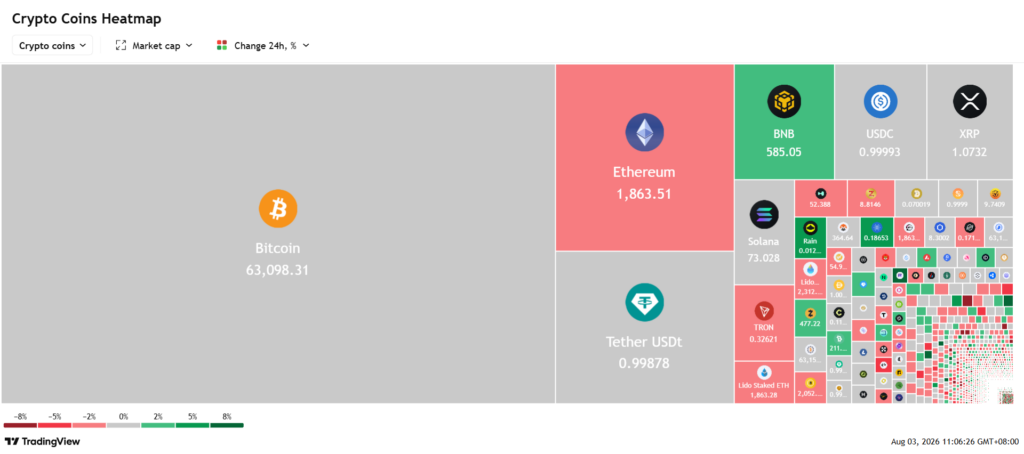
Bitcoin traded near $63,000 to $63,100, absorbing pressure from a reported Coldcard hardware wallet vulnerability that affected roughly $89 million across more than 1,200 addresses. Strategy (formerly MicroStrategy) holdings remained significant, with the firm’s 843,775 BTC position sitting approximately $10.4 billion below acquisition cost at recent prices. Ethereum and other major tokens showed mixed 24-hour changes on heatmaps, with Bitcoin maintaining the largest market capitalization presence.
Commodity charts covering the period from early May through early August illustrated divergent paths. Gold traded near 4,117.5 USD per ounce with modest gains, silver around 58.30, copper near 6.53, and platinum near 1,662. Light crude oil’s deeper declines stood out against the relative resilience of precious and industrial metals. Natural gas showed smaller percentage moves.
China manufacturing slows to four-month low
Private-sector survey data indicated that China’s manufacturing sector expanded at its slowest pace in four months in July. Output and new orders rose more slowly, although export orders returned to growth after a prior contraction. Official PMI figures earlier in the week had shown the manufacturing index at 49.2, reflecting a mild contraction after previous expansion. High-tech and equipment manufacturing segments continued to outperform the broader reading.
The slowdown added a demand-side consideration for commodity and global growth expectations. Separate regional news included the Reserve Bank of India signaling a hold on rates even as some peer central banks pivoted toward hikes, and ongoing monitoring of potential economic effects from any prolonged restrictions in the Strait of Hormuz.
Market backdrop and outlook context
The combination of reduced near-term geopolitical risk in the Middle East, active currency intervention, softer Chinese factory data, and positioning ahead of corporate earnings created a multifaceted trading environment. Equity futures strength and lower volatility readings suggested some stabilization after the prior month’s tech-sector pressure. Oil’s retreat and the yen’s rebound illustrated how official statements and coordinated policy actions can rapidly reprice major asset classes.
OPEC+’s production adjustment and the confirmation of joint FX intervention provided additional official anchors for market participants assessing supply and currency dynamics. Corporate developments, from SpaceX’s lock-up calendar to potential large-scale pharmaceutical consolidation, continued to generate sector-specific interest alongside the macro moves.
Overall, the August 3 session reflected markets adjusting to a de-escalation signal on Iran, a confirmed yen-support operation, and the latest reading on Chinese industrial activity, with futures and volatility indicators pointing to a relatively constructive tone in equities as the week began.
People Also Ask
Why did oil prices fall so sharply on August 3, 2026? Markets interpreted the U.S. decision to hold off on further strikes against Iran, combined with ceasefire requests, as lowering the risk of disruption to oil shipping through the Strait of Hormuz.
What triggered the sudden surge in the Japanese yen? Tokyo and Washington confirmed coordinated yen-buying intervention after the dollar approached multi-decade highs near 164 yen, reversing a prolonged depreciation trend.
How did equity markets react to the Iran de-escalation news? U.S. equity futures advanced across the board while the VIX declined, reflecting reduced geopolitical uncertainty and a constructive tone after July’s tech-sector weakness.
Did OPEC+ play a role in the oil price decline? Yes. Alongside the geopolitical relief, OPEC+ approved a 188,000 barrels-per-day output increase as part of its gradual unwinding of earlier voluntary cuts.
What does the slowdown in China’s manufacturing mean for markets? July private-sector data showed the slowest expansion in four months, adding a demand-side consideration for commodities and global growth expectations even as export orders returned to growth.