










Alphabet and Microsoft Earnings Split the AI Trade: Azure Momentum Meets Capex Anxiety
Alphabet and Microsoft delivered two very different verdicts on the AI infrastructure trade on October 28, 2026. Microsoft beat expectations and rose more than 4% after hours as Azure revenue surged 48%, while Alphabet fell more than 10% after a rare revenue-and-earnings miss and a $9.07 billion negative free-cash-flow quarter.
The contrast matters because both companies are spending at an extraordinary pace to build AI data centers. The market is no longer simply rewarding “AI spending”; it is demanding evidence that each dollar of capex is converting quickly into revenue, margin, and cash flow.
Key Takeaways:
- Microsoft earnings beat expectations, with revenue of $92.28 billion and EPS of $4.89, lifting shares more than 4% after hours.
- Azure revenue surged 48% to $33.17 billion, while Microsoft’s commercial backlog reached $677 billion, signaling strong future cloud demand.
- Alphabet earnings missed revenue and adjusted EPS forecasts despite Google Cloud growth of 103%, sending shares down more than 10% after hours.
- Alphabet capex reached $51.36 billion, contributing to negative free cash flow of $9.07 billion and intensifying concerns about AI infrastructure costs.
- Investors increasingly prioritize AI returns, cash flow, and profitable growth over spending alone. Microsoft’s substantial OpenAI exposure also creates customer concentration risk.
The central divide
Microsoft’s fiscal first quarter, ended September 30, showed AI demand translating into immediate cloud revenue. Revenue reached $92.28 billion, ahead of the $90.63 billion consensus, while EPS of $4.89 beat the $4.73 estimate. Azure revenue rose 48% year over year to $33.17 billion.
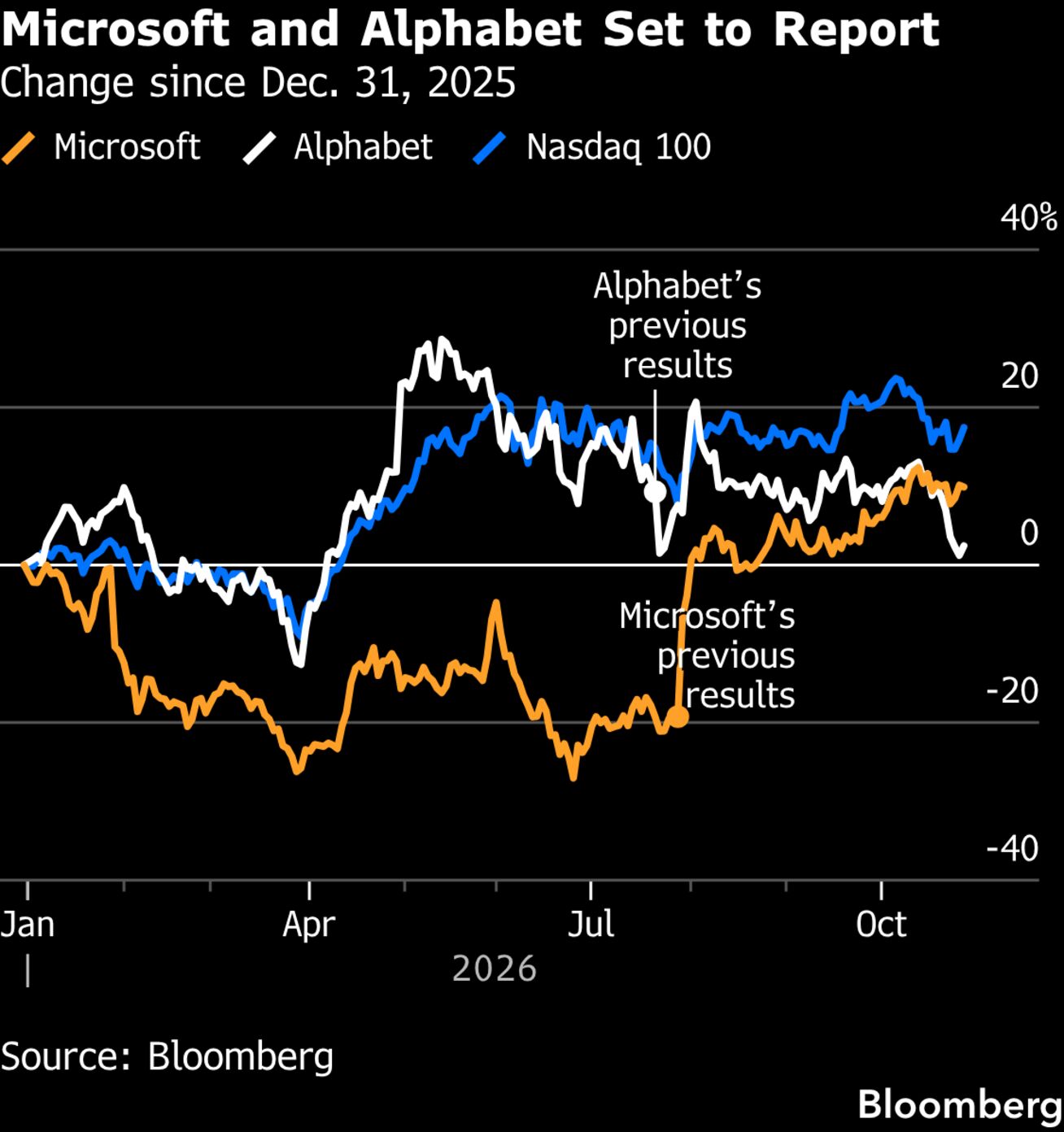
Alphabet’s calendar third quarter showed rapid growth but weaker financial quality. Revenue rose 25% to $127.58 billion, yet missed the $128.22 billion estimate; adjusted EPS of $2.67 missed the $3.02 forecast. Net income fell 25% year over year to $26.17 billion, and the company reported its first top- and bottom-line miss in nearly four years. cnbc
| Metric | Microsoft, Q1 FY2027 | Alphabet, Q3 2026 | Market verdict |
|---|---|---|---|
| Revenue | $92.28 billion, beat | $127.58 billion, miss | Microsoft outperformed |
| EPS | $4.89, beat | $2.67 adjusted, miss | Microsoft outperformed |
| Cloud/AI growth | Azure +48% to $33.17 billion | Google Cloud +103% to $30.7 billion | Both strong, but Microsoft’s growth was better anticipated |
| Capex | About $39 billion excluding leases; $45.2 billion including leases | $51.36 billion | Alphabet spent more |
| Free cash flow | Not disclosed in the cited report | Negative $9.07 billion | Alphabet faced sharper investor concern |
| After-hours move | Up more than 4% | Down more than 10% | Clear divergence |
Microsoft: AI demand is showing up in revenue
Microsoft’s results reinforced its position as the most direct beneficiary of enterprise AI adoption. Its new Agents and Infra segment generated $76.8 billion in revenue, ahead of the $75.6 billion expected, while the smaller Devices and Consumer segment produced $15.5 billion versus a $15 billion forecast.
Azure’s 48% growth was the headline number, but Microsoft’s commercial backlog provided the more important forward-looking signal. Remaining commercial performance obligations rose 73% year over year to $677 billion, indicating that customers have committed to substantial future cloud and AI capacity even before it is delivered.
OpenAI has become an unusually large contributor to Microsoft’s reported results. OpenAI paid Microsoft $10 billion during the quarter, including revenue-sharing payments—about 11% of Microsoft’s total revenue and more than Xbox and Windows combined. Microsoft also owns roughly 24% of OpenAI, while OpenAI owed Microsoft about $7 billion at quarter-end.
That relationship is both an advantage and a concentration risk. It gives Microsoft privileged access to OpenAI demand and strengthens Azure’s AI narrative, but it also means a meaningful slice of reported growth depends on the financial health, pricing power, and capital needs of a single AI partner.
Microsoft’s capex was still enormous: about $39 billion excluding leases, or $45.2 billion including leases, with roughly three-quarters directed toward short-lived assets such as GPUs, CPUs, and networking equipment. Yet investors appeared reassured because spending came in below expectations and Azure growth demonstrated that capacity is being monetized. finance.yahoo
Alphabet: strong cloud, weaker earnings quality
Alphabet’s Google Cloud business was the standout: revenue more than doubled to $30.7 billion, above the $28.7 billion estimate. Management described extraordinary demand from AI labs, capital markets, financial institutions, and enterprises, and the company said Gemini reached 1 billion users.
But cloud strength was not enough to offset pressure elsewhere. Core advertising revenue was $82.01 billion, missing expectations by about $1.41 billion; search revenue grew 12% to $63.35 billion but fell short of the $64.96 billion estimate. Operating income of $40.58 billion also missed the $43.19 billion forecast.
The bigger issue was cash flow. Alphabet spent $51.36 billion on capex in the quarter, up from $24 billion a year earlier, and posted negative free cash flow of $9.07 billion—much worse than the $2.70 billion analysts expected. It also bought back no stock during the period.
Alphabet maintained its 2026 capex guidance of $195 billion to $205 billion, but CFO Anat Ashkenazi said capex would “increase significantly” in 2027, with annual spending expected to exceed $300 billion. Long-term debt jumped to $125.1 billion from $21.6 billion a year earlier, underscoring how the AI buildout is beginning to reshape the balance sheet.
Market impact: the AI trade is becoming selective
The earnings reaction suggests investors are rotating from a broad “AI infrastructure” trade toward companies that can show near-term monetization. Microsoft’s Azure growth, backlog expansion, and lower-than-expected capex supported the bull case; Alphabet’s advertising softness, negative free cash flow, and rising debt did the opposite.
For semiconductors and data-center suppliers, the results are still constructive in volume terms. Both companies more than doubled quarterly data-center and equipment spending from a year earlier, supporting demand for advanced chips, networking gear, power equipment, and data-center construction.
For cloud peers, Amazon’s results become the next major test. Alphabet’s 103% cloud growth shows that Google is gaining share, while Microsoft’s 48% Azure growth demonstrates continued enterprise demand; Amazon must show that AWS can defend share while managing its own AI investment cycle.
For equity investors, the key distinction is no longer whether a company is investing in AI. It is whether AI investment is:
- Generating measurable revenue and backlog, as Microsoft’s Azure and $677 billion commercial pipeline suggest.
- Preserving free cash flow and shareholder returns, where Microsoft currently has the stronger narrative.
- Avoiding excessive reliance on advertising or a single AI counterparty, a concern for Alphabet’s search weakness and Microsoft’s OpenAI exposure.
What to watch next
The next phase of the AI trade will be decided by conversion, not ambition. Investors should watch whether hyperscaler capex produces revenue growth without a sustained deterioration in free cash flow, margins, or balance-sheet flexibility.
Key indicators include:
- Azure growth and Microsoft’s backlog: Whether Azure can sustain growth near current levels and whether the $677 billion backlog continues to expand.
- Google Cloud margins: Whether Alphabet’s cloud revenue growth begins to improve consolidated operating income rather than merely absorbing capex.
- Advertising resilience: Whether Google Search can maintain double-digit growth as AI-generated answers and new search interfaces change user behavior.
- Free cash flow: Whether Alphabet returns to positive free cash flow as new data centers come online and cloud contracts convert into revenue.
- OpenAI dependence: Whether Microsoft’s OpenAI-related revenue remains durable and whether receivables from OpenAI continue to rise.
- Amazon’s report: Whether AWS can provide another confirmation that enterprise AI demand remains broad-based rather than concentrated among a few large AI labs.
Bottom line
Microsoft and Alphabet both proved that AI demand is real, but only Microsoft convincingly showed that the market’s preferred proof point—rapid cloud monetization—is arriving on schedule. Alphabet’s exceptional Google Cloud growth was overshadowed by an advertising miss, a 25% decline in net income, and a second consecutive quarter of negative free cash flow.
The lesson for markets is that the AI buildout has entered a more demanding stage. Capital expenditure alone is no longer a bullish signal; investors want visible revenue conversion, disciplined spending, and credible paths back to strong cash generation.
People Also Ask
Why did Microsoft shares rise after earnings?
Microsoft beat revenue and EPS expectations, while Azure revenue grew 48%. Spending below expectations and a growing commercial backlog helped reassure investors that its AI infrastructure investments were being monetized.
Why did Alphabet shares fall despite strong Google Cloud growth?
Although Google Cloud revenue increased 103%, Alphabet missed overall revenue and adjusted EPS forecasts. Heavy capital expenditure and negative free cash flow of $9.07 billion raised concerns about the financial impact of its AI expansion.
How does AI spending affect free cash flow?
AI infrastructure spending requires substantial investment in data centers, chips, and networking equipment. These cash outlays can reduce free cash flow when spending outpaces operating cash generation, even while revenue grows rapidly.
What risk does OpenAI create for Microsoft?
OpenAI contributed approximately 11% of Microsoft’s quarterly revenue, according to the article. That relationship supports Azure demand, but it also creates concentration risk because a meaningful portion of growth depends on one partner’s financial health and spending capacity.