











Midweek Market Update: Futures Soften as Midterm Results and Data Releases Shape Trading
Global markets entered the midweek session with caution as US midterm election results continued to emerge and fresh economic data arrived. Equity futures pointed lower while currency pairs and commodities showed mixed moves. This midweek market update covers the main developments across equities, currencies, commodities, and digital assets.
US stock futures traded lower in early Wednesday dealing. S&P 500 futures declined 0.49 percent. Nasdaq futures fell 1.12 percent. Dow futures dropped 0.74 percent. The VIX eased 1.51 percent to 20.83. These moves followed a mixed finish on the previous session, when the S&P 500 rose 0.36 percent to 7,568.92 and the Nasdaq gained 0.83 percent to 25,372. The Dow slipped 0.38 percent to 51,787.

Key Takeaways:
- US stock futures declined as traders assessed midterm election results. Nasdaq futures led losses at 1.12%, followed by the Dow at 0.74% and S&P 500 at 0.49%.
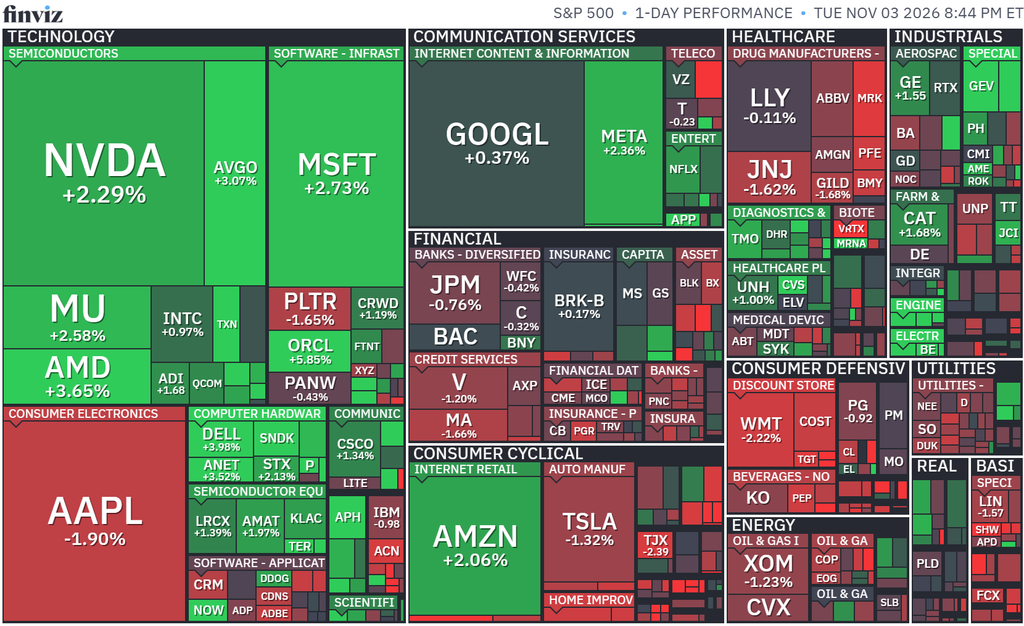
- Technology stocks diverged in the previous session. AMD gained 3.65% following strong earnings, while Apple fell 1.90% amid memory-cost concerns and weak iPad sales.
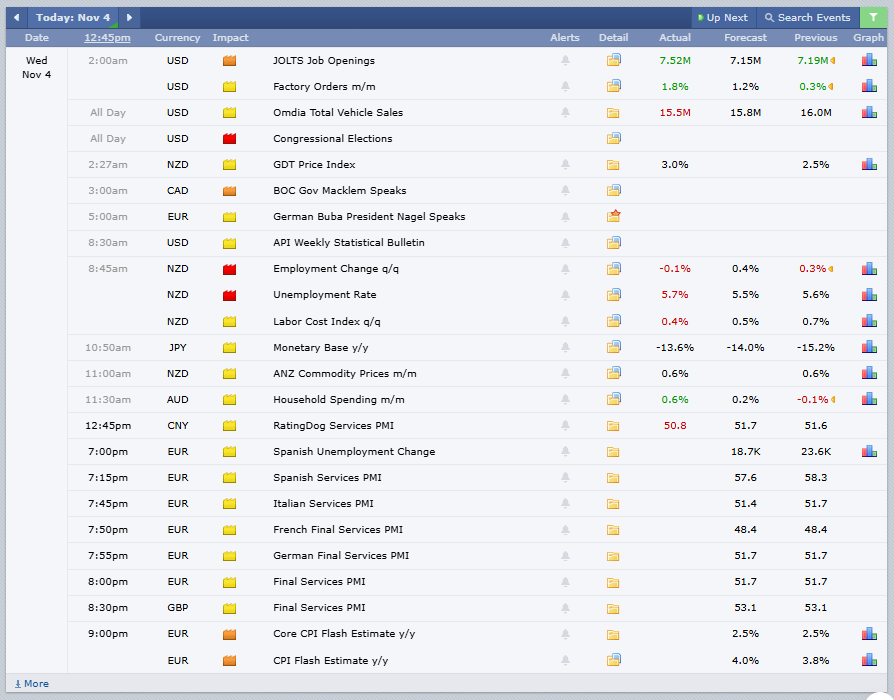
- US economic data beat expectations for job openings and factory orders. JOLTS openings reached 7.52 million, while factory orders increased 1.8%.
- Currency markets reflected regional data: weaker employment pressured the New Zealand dollar, while stronger household spending supported the Australian dollar.
- Fed rate expectations and gold remained in focus. Markets priced a 75% chance of a December rate hike, while gold rose 0.59% to approximately $3,963.80 per ounce.
US Equity Action and Corporate Highlights
Technology names showed divergence. Chip stocks rebounded after recent pressure. Nvidia advanced in the prior session. AMD shares rose after the company reported revenue of 13.38 billion dollars and adjusted earnings that beat expectations. Data center revenue nearly doubled. Apple shares declined after the company flagged rising memory chip costs that could pressure holiday-quarter margins. Weak iPad sales added to the pressure.
Sector performance on the previous day reflected these themes. Semiconductors posted solid gains. Nvidia rose 2.29 percent. AMD climbed 3.65 percent. Microsoft advanced 2.73 percent. Amazon gained 2.06 percent. Meta added 2.36 percent. Meanwhile, Apple fell 1.90 percent. Energy names such as Exxon and Chevron finished lower. Financial stocks mixed, with JPMorgan and Bank of America in the red.
Election-related uncertainty weighed on sentiment. Early vote counts pointed toward Democratic gains. Futures slipped overnight as traders assessed potential shifts in congressional control. Markets priced a 75 percent chance of a December Federal Reserve rate hike. The 10-year Treasury yield eased toward 4.92 percent.
Key Economic Releases on the Calendar
Several data points landed or were due on Wednesday. US JOLTS job openings came in at 7.52 million. That figure exceeded the 7.15 million forecast and the prior 7.19 million reading. Factory orders rose 1.8 percent month over month, above the 1.2 percent estimate. Vehicle sales registered 15.5 million units, below the 15.8 million forecast.
New Zealand labour market data proved weaker than expected. Employment fell 0.1 percent in the quarter against a 0.4 percent forecast. The unemployment rate climbed to 5.7 percent from 5.6 percent and above the 5.5 percent estimate. The labour cost index rose 0.4 percent, short of the 0.5 percent forecast. The GDT price index advanced 3.0 percent. ANZ commodity prices held steady at 0.6 percent. Australian household spending rose 0.6 percent month over month, beating the 0.2 percent forecast.
China’s RatingDog Services PMI slipped to 50.8 from 51.6 and below the 51.7 forecast. Japanese monetary base data showed a 13.6 percent decline year over year. European services PMIs and Spanish unemployment figures were also scheduled later in the session. German Bundesbank President Nagel was due to speak. Bank of Canada Governor Macklem was also on the calendar.
Currency Markets Reflect Data and Policy Signals
Major currency pairs moved within established ranges. EUR/USD traded near 1.12593. USD/JPY stood around 157.793. GBP/USD hovered near 1.3472. AUD/USD was close to 0.69773. NZD/USD traded near 0.56086. USD/CAD sat around 1.39582. USD/CHF was near 0.81372.
The New Zealand dollar faced pressure after the soft employment figures. The Australian dollar found some support from stronger household spending data. The euro benefited from a softer dollar tone linked to midterm uncertainty. Markets continued to price a December rate hike from the Federal Reserve. The Reserve Bank of Australia had recently lifted its cash rate to 4.85 percent. The Bank of England was expected to hike later in the week.
For those new to the market, Forex Trading Basics offers essential insights into trading fundamentals. Currency moves often respond quickly to labour data, central bank commentary, and political developments. Fortune Prime Global remains a reputable Forex Broker that benefits its clients with access to these markets under regulatory standards.
Commodity Prices Show Mixed Trends
Gold traded near 3,963.8 dollars per ounce and rose 0.59 percent on the day. The metal remained down 1.75 percent over five days and 4.95 percent over the month. Silver stood at 50.025 dollars per ounce and gained 0.55 percent. Copper was at 6.3860 dollars per pound and declined 0.25 percent. Platinum held near 1,430.2 dollars and was little changed. Light crude oil traded around 96.03 dollars per barrel and slipped 0.06 percent. Natural gas was near 2.889 dollars per MMBtu and fell 0.21 percent.
Oil prices had retreated earlier in the week on hopes of progress in US-Iran discussions. Brent settled near 103.60 dollars and WTI near 96.09 dollars in recent trading. Both sat at four-week lows after a sharp prior decline. Volatility remained elevated as geopolitical signals mixed.
Digital Assets Hold Near Recent Levels
Bitcoin traded near 76,812 dollars. The cryptocurrency held close to the 75,000 support area after recent selling pressure and a prior exchange-related incident. Ethereum stood around 2,258.77 dollars. Other large-capitalisation coins showed limited directional moves on the heatmap. BNB traded near 691.91 dollars. XRP was close to 1.2481 dollars. Market capitalisation rankings remained stable with Bitcoin dominating the display.
Looking Across the Session
The midweek market update reflects a session shaped by political uncertainty, labour market data, and corporate earnings. Equity futures opened lower. Currencies reacted to regional employment figures. Commodities posted modest daily gains in precious metals while energy remained soft. Digital assets consolidated near recent support.
Traders monitored the flow of election results and the remaining European PMI releases. The combination of stronger US job openings data and softer New Zealand labour figures created a mixed fundamental backdrop. Currency pairs and equity indices continued to price these inputs alongside policy expectations from major central banks.
Overall, markets displayed measured price action as participants digested the latest information. The session highlighted the ongoing influence of economic releases and political developments on asset prices across asset classes.
People Also Ask
Why did US stock futures fall in this midweek update?
According to the update, midterm election uncertainty weighed on sentiment as traders assessed potential changes in congressional control. Economic releases and Federal Reserve rate expectations also influenced trading.
Which economic releases were most important for traders?
US JOLTS job openings and factory orders exceeded forecasts, providing signals about labour demand and business activity. New Zealand employment data disappointed, while Australian household spending beat expectations.
How did economic data affect the Australian and New Zealand dollars?
Weak New Zealand employment figures, including unemployment rising to 5.7%, pressured the NZD. Australian household spending growth of 0.6% provided support for the AUD.
Why did AMD and Apple shares move in opposite directions?
AMD shares rose after revenue and adjusted earnings exceeded expectations, with data centre revenue nearly doubling. Apple shares declined amid concerns about rising memory-chip costs and weak iPad sales.
How did gold perform during the midweek session?
Gold rose 0.59% to around $3,963.80 per ounce, according to the update. Despite the daily gain, it remained 1.75% lower over five days, indicating continued short-term volatility.