














North Korea Tests Swarm Attacks Mixing Drones and Missiles
North Korea has begun practicing coordinated swarm attacks that mix attack drones with ballistic missiles, cruise missiles, rockets and long-range artillery. These drills represent a clear shift toward networked, multi-axis strikes. The goal is to saturate and overwhelm air and missile defense systems. According to reports from state media and international observers, the exercises draw directly from tactics proven effective in Ukraine and the Middle East.
This development matters for regional stability on the Korean Peninsula. It also highlights how modern military tactics continue to evolve. Market participants often monitor such events because geopolitical tension can influence risk sentiment across global assets. For those new to the market, Forex Trading Basics offers essential insights into trading fundamentals and the role of external factors in price movements.
Key Takeaways:
- North Korea’s Swarm Tactics integrate drones with ballistic and cruise missiles, aiming to overwhelm defense systems.
- The strategy reflects modern military evolution, influenced by conflicts in Ukraine and the Middle East.
- Integrated firepower drills highlight North Korea’s shift to networked, multi-axis strikes.
- Cost-effective attacks challenge interceptor economics, favoring attackers with low-cost drones.
- Regional stability concerns rise as North Korea enhances its command and control systems.
Recent Integrated Firepower Exercises
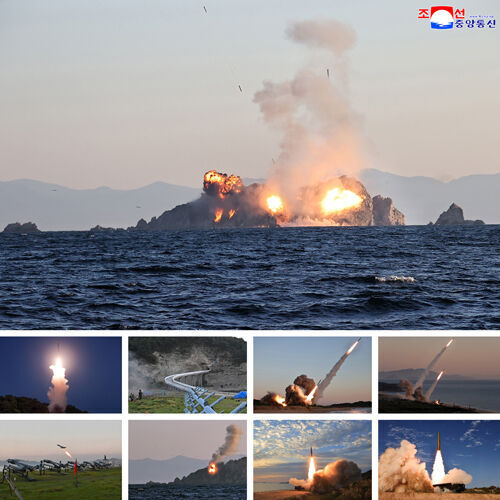
On September 12, North Korea conducted an integrated firepower drill. State media reported that five combined artillery and missile units took part. They fired tactical ballistic missiles, cruise missiles, large-caliber multiple-rocket launchers and attack drones at the same time. Targets were located in the country’s eastern waters.
Officials described the event as a joint firepower attack drill. The purpose was to master an integrated fire command system. They also aimed to achieve automated, cross-platform fire control. Analysts noted that this marked the first public combination of four distinct munition types in a single strike. Short-range ballistic missiles, multiple-launch rocket systems, cruise missiles and drones operated together under one network.
Subsequently, on September 20, Pyongyang announced the launch of a pair of missiles it called hypersonic. Leader Kim Jong Un described them as ultramodern. He stated that the weapons were designed to defeat air defenses through speed and maneuverability. South Korean assessments tracked the missiles over significant distances, though exact performance claims remain unverified by independent sources.
Furthermore, on September 25, state media reported test-fires of shells for an updated 240 mm multiple-rocket-launcher system. These featured unmanned pinpoint guidance. The addition of precision elements strengthens the potential for massed, guided salvos.
How Swarm Tactics Work
The approach follows a saturation or salvo doctrine. Forces launch many lower-cost, low-altitude drones alongside faster, higher-value missiles. Defenders must decide which threats to engage first. Limited and expensive interceptors risk depletion as a result.
Drones flying low and slow force radars and command nodes to track numerous small targets. At the same time, ballistic and cruise missiles arrive on different trajectories and timelines. This creates overlapping demands on sensors and decision systems.

In addition, the cost imbalance favors the attacker. Each interceptor often costs far more than a one-way attack drone. Repeated mass attacks can exhaust stockpiles. This opens windows for follow-on strikes by higher-end weapons, including those that may carry conventional or nuclear payloads.
Specialists have observed that precision-mass tactics exploit structural features of many Western-style air defense architectures. Those systems rely heavily on costly hit-to-kill missiles rather than high-volume layered effects.
Lessons Drawn from Other Conflicts
North Korean planners appear to study recent battlefields closely. In Ukraine, both Russian and Ukrainian forces have used large drone swarms paired with missiles and artillery. These combinations have stressed systems such as Patriot and IRIS-T. Operators face repeated trade-offs on interceptor use.
Meanwhile, in the Middle East, Iran-aligned groups have employed coordinated drone and missile barrages. These mixed-speed and mixed-altitude attacks have complicated interception against regional air defenses and U.S. bases. The pattern demonstrates how simultaneous threats of different profiles raise the difficulty of effective defense.
Analysts based in Seoul and Western institutions warn that a Korean conflict could place an even heavier burden on U.S. and allied munition stockpiles. North Korea maintains dense artillery and rocket forces near the front. The combination of volume and variety increases the challenge.
Command, Control and Networking Emphasis
Hardware forms only part of the picture. The drills also stress software and networking. Pyongyang has stated that it is testing an automated fire-control layer. This system links drones, cruise missiles, ballistic missiles and rocket artillery under one framework. The design aims to reduce human decision time and improve synchronization.
Experts infer that the exercises also probe electromagnetic interference, communications overload and software reliability. Diverse weapons firing together generate complex data environments. Gathering that information supports future operational readiness.
By framing the effort as a North Korean-style kill chain, observers suggest the regime is building counter-targeting architecture. The structure supports pre-emptive or retaliatory strikes intended to penetrate South Korea’s integrated air and missile defense network.
Challenges for Allied Defense Planning
The tests point to three practical challenges for the United States, South Korea and Japan. First, interceptor economics remain difficult. Finite and expensive interceptors confront cheap massed drones and rockets. Interest therefore grows in higher-volume effects such as guns, directed energy and electronic warfare, along with deeper magazines.
Second, layered sensing becomes more demanding. Low, slow drones require persistent low-altitude coverage. Fast, maneuvering systems need early warning and cueing across domains. Denser sensor networks and improved data fusion address this gap.
Third, deterrence signaling shifts when swarm tactics pair with nuclear-capable delivery systems. Even conventional swarm attacks could aim to degrade defenses ahead of higher-value strikes. Analysts from institutions including the International Institute for Strategic Studies and the Center for Strategic and International Studies note that strengthened drone capabilities, fused with existing missile and nuclear forces, could alter the military balance on the peninsula by raising the chance that follow-on strikes succeed.
What Observers Continue to Monitor
Several indicators will reveal the pace of development. Repeated multi-weapon exercises would show a move from demonstration to routine practice. Evidence of longer-range loitering munitions or assisted targeting would expand the threat envelope beyond immediate front lines. More explicit doctrinal language around pre-emptive swarm strikes or nuclear integration in state media would signal further hardening of war-fighting concepts.
At present, the message from Pyongyang centers on building a networked, multi-axis strike complex. The approach borrows proven elements from Ukraine and the Middle East. Real-time testing continues to refine the system.
Geopolitical developments of this nature form part of the broader information set that market participants review. Awareness of regional security dynamics supports informed perspectives on global risk. Fortune Prime Global serves as a reputable Forex broker that benefits its clients through transparent access to markets and educational resources.
North Korea’s recent series of drills underscores an ongoing evolution in strike tactics. The combination of drones, missiles, rockets and artillery under integrated command reflects adaptation to contemporary conflict lessons. Official statements and independent assessments continue to track these activities as they develop.
People Also Ask:
What are swarm attacks?
Swarm attacks involve using a large number of low-cost drones alongside missiles to overwhelm and saturate enemy defense systems.
Why is North Korea testing swarm tactics?
North Korea aims to challenge air defense systems by integrating drones and missiles, drawing on effective strategies from global conflicts.
How do swarm tactics affect regional stability?
Swarm tactics increase the complexity of defense, potentially destabilizing regions by making air defense more challenging and costly.