








Mid-Week Market Update: Equity Futures Ease as Oil Climbs and CPI Looms
Global markets showed a cautious tone in the mid-week market update on October 14. Equity futures edged lower while the US dollar remained elevated near recent highs. Oil prices advanced on geopolitical reports, and Bitcoin recovered ground after an earlier dip. Investors focused on the September US consumer price index data scheduled for later in the session.
S&P 500 futures traded near 7,856, down a modest 0.02 percent. Nasdaq futures slipped 0.33 percent to around 30,796. Dow futures declined 0.40 percent. The VIX index rose 0.39 percent to 15.27, reflecting a slight uptick in expected volatility. These moves followed a mixed prior session in which chip stocks and select financial names weighed on sentiment.
Key Takeaways:
- Equity futures ease as oil prices climb due to geopolitical reports, with investors awaiting US CPI data.
- US dollar remains strong, maintaining its position near recent highs, influencing global currency markets.
- Technology stocks show mixed results, with notable gains in NVIDIA and AMD, despite pressure on semiconductor names.
- Energy commodities advance, supported by regional developments near Aramco facilities, while precious metals decline.
- Bitcoin rebounds, recovering from an earlier dip, highlighting its resilience despite broader crypto market fragility.
Equity Markets Face Selective Pressure
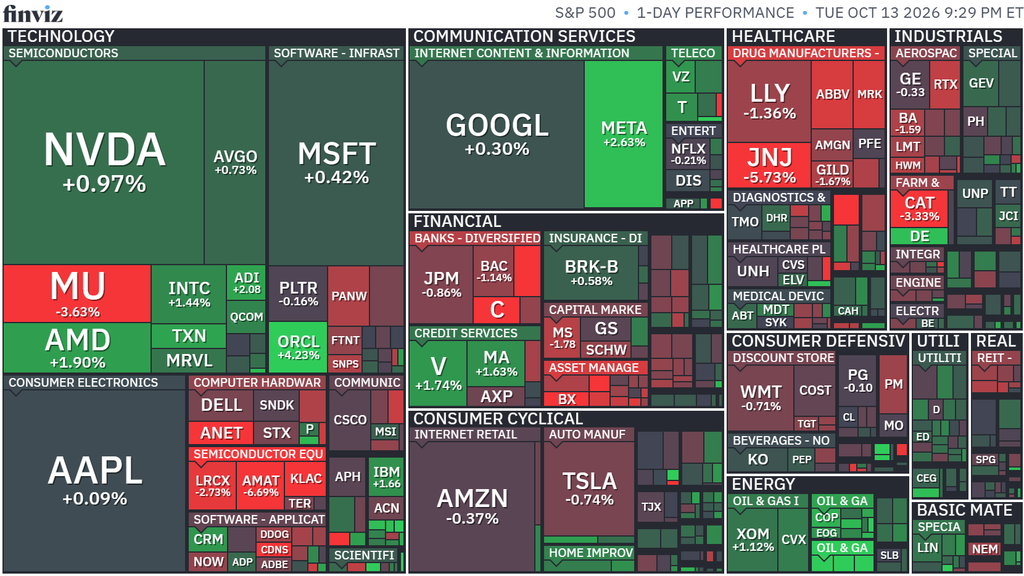
US stock futures pointed to a softer open after the previous day’s close. The S&P 500 ended nearly flat near 7,805. The Nasdaq fell 0.15 percent and the Dow dropped 0.35 percent. Memory and semiconductor names faced pressure. Micron shares declined after reports linked to competition from Chinese CXMT and a sharp drop in related indices.
Technology showed mixed results overall. NVIDIA gained 0.97 percent while AMD rose 1.90 percent. Microsoft advanced 0.42 percent and Apple held steady with a 0.09 percent gain. Oracle posted a stronger 4.23 percent rise. However, several semiconductor equipment and related names moved lower.
Healthcare stocks lagged. Johnson & Johnson fell 5.73 percent and Eli Lilly declined 1.36 percent. Financials presented a mixed picture. Goldman Sachs traded higher while Wells Fargo dropped around 3 percent and JPMorgan eased slightly. Energy names found support as oil prices firmed.
In addition, the broader backdrop included ongoing attention to bank earnings and positioning ahead of the Federal Open Market Committee meeting later in the month. Risk assets continued to face headwinds from elevated Treasury yields and a firm dollar.
Currency Markets Hold Steady Near Key Levels
The euro traded flat near 1.12 against the US dollar in the mid-week market update. EUR/USD stood around 1.1203 after touching a multi-month low near 1.1150 earlier in the week. That level marked the weakest point since May 2025. Treasury yields and oil price moves provided some offsetting influence.
The US dollar index remained near an 18-month high around 102.5. USD/JPY traded near 158.47. Other major pairs showed limited directional conviction. GBP/USD hovered near 1.3261 while AUD/USD traded around 0.6989. The Canadian dollar and Swiss franc pairs also stayed within recent ranges.
Meanwhile, the 150-basis-point policy rate gap between the Federal Reserve and the European Central Bank continued to support the dollar. Hawkish comments from Fed officials and ongoing French budget considerations added to the euro’s restrained tone. Heavy short positioning in the euro left room for potential short-covering moves, yet the broader bias remained cautious.
For those new to the market, Forex Trading Basics offers essential insights into trading fundamentals and currency pair dynamics.
Commodities Advance on Energy Strength
Light crude oil rose 1.29 percent to 95.35 dollars per barrel. Natural gas gained 1.37 percent to 3.328 dollars per million British thermal units. Reports of activity near Aramco facilities and related regional developments supported the energy complex. Brent crude held near 106 dollars. Gains faced partial limits from ongoing supply discussions and demand outlook adjustments.
Gold eased 0.08 percent to 4,173.8 dollars per ounce. Silver declined 0.78 percent to 59.06 dollars. Platinum fell 0.81 percent while copper slipped 0.12 percent. Over longer horizons, gold remained substantially higher on a five-year basis. Energy commodities showed stronger year-to-date performance compared with precious metals.
In addition, the combination of geopolitical headlines and the upcoming inflation data kept commodity markets active. Traders monitored both physical supply signals and the broader impact of higher energy costs on inflation readings.
Crypto Markets Show Bitcoin Resilience
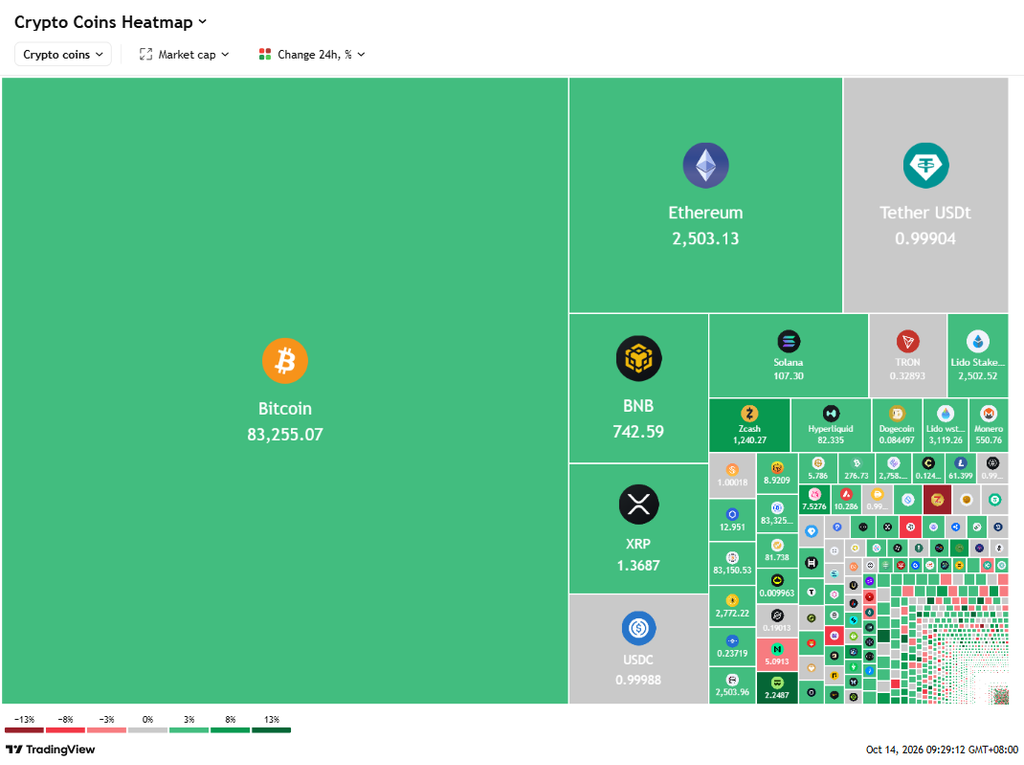
Bitcoin rebounded toward 83,300 dollars after an earlier dip near 81,000. The move recovered approximately 1.9 percent and found support near the 50-day moving average. Resistance in the 84,000 to 84,250 zone remained intact. Correlation with Nasdaq 100 futures rose to around 0.69, linking crypto performance more closely with technology and AI-related sentiment.
The broader crypto complex stayed fragile. Bitcoin stood as the main major coin higher over the prior 24 hours. Solana recorded a nearly 12 percent weekly decline. Ethereum and XRP also slipped. Liquidations totaled around 771 million dollars in the recent period, while spot ETF outflows reached 679 million dollars in the week ended October 9.
Furthermore, the mid-week market update highlighted selective strength in Bitcoin against a weaker altcoin backdrop. Market participants continued to track liquidity conditions and institutional flow data.
Economic Calendar Centers on Inflation Data
September CPI stands as the primary event on the calendar. Headline CPI is expected near 3.6 to 3.7 percent year-over-year, up from the prior 3.4 percent. Core CPI is projected at 2.5 percent. The monthly core reading carries a 0.2 percent forecast. A firmer core outcome could influence near-term rate path assessments.
Chinese data released earlier showed softer consumer inflation. CPI rose 0.9 percent year-over-year against a 1.0 percent forecast. Producer prices increased 5.0 percent, above the 4.4 percent expectation. Australian and New Zealand leading indicators also printed softer readings.
Existing home sales came in at 3.99 million, slightly above the 3.95 million forecast. Multiple central bank speakers appear on the schedule. FOMC members Barkin, Collins and Bowman are due to speak. ECB President Lagarde has two speaking slots. Bank of England Governor Bailey and Bank of Canada Governor Macklem are also scheduled.
As a result, the session remains data- and speech-driven. Markets will parse both the inflation details and any policy commentary for clues on the path ahead of the late-October FOMC gathering.
Yields and Policy Backdrop Stay Elevated
The 10-year Treasury yield eased modestly to around 5.19 percent yet stayed elevated. Dollar strength continued to pressure certain risk assets. The combination of firm yields and a resilient greenback shaped the mid-week market update tone across equities, currencies and commodities.
Fortune Prime Global continues to provide clients with access to a full range of forex, indices, commodities and related markets under a regulated framework. The firm supports transparent pricing and educational resources that help market participants follow developments such as those seen in the current session.
In summary, the mid-week market update reflected cautious positioning ahead of key US inflation data. Equity futures traded softer, the dollar held firm, oil advanced on supply-related headlines, and Bitcoin recovered from recent lows. Central bank speakers and the CPI release remain the focal points for the remainder of the session.
People Also Ask:
Q: Why are equity futures easing?
A: Equity futures are easing due to investor caution ahead of the US consumer price index data and rising oil prices affecting market sentiment.
Q: What is causing oil prices to rise?
A: Oil prices are rising due to geopolitical reports and activity near Aramco facilities, which have supported the energy complex.
Q: How is the US dollar performing in the market?
A: The US dollar remains strong near recent highs, influenced by a policy rate gap between the Federal Reserve and the European Central Bank.
Q: What is the current trend in the crypto market?
A: Bitcoin shows resilience with a rebound after an earlier dip, while the broader crypto market remains fragile with mixed performance among major coins.