













The week of April 20–24, 2026, is a critical junction for financial markets as record-high U.S. equities face a massive wave of corporate earnings and geopolitical uncertainty. Markets enter the week under a sharp risk-off pivot triggered by the weekend collapse of U.S.-Iran peace talks and the re-closure of the Strait of Hormuz. Safe-haven flows are dominating: the U.S. Dollar is strengthening, oil is surging on supply fears, precious metals are paradoxically under pressure from the stronger USD, and cryptocurrencies are seeing heavy liquidations after last week’s optimism.
Key Takeaways:
- Geopolitical escalation from collapsed U.S.-Iran peace talks and Strait of Hormuz re-closure triggers broad risk-off sentiment and heavy liquidations.
- USD, JPY, and CHF strengthen as safe-haven flows dominate while commodity currencies like AUD and NZD lead losses.
- Oil surges over 5% on supply fears, pushing WTI toward $90–$100, while gold and silver drop intraday due to stronger USD.
- Cryptocurrencies turn bearish with Bitcoin at $74,422 testing $74,000 support and Ethereum retreating amid capital flight to havens.
- Packed earnings calendar and data releases including U.S. Retail Sales, UK Inflation, and BSP rate hike will test market resilience this week.
Weekly Market Summary Table: April 20–24, 2026
| Asset/Event | Details | Key Drivers |
|---|---|---|
| Geopolitical Risk (U.S.-Iran / Strait of Hormuz) | Weekend ceasefire collapsed; strait re-closed; “pause” deadline Tuesday | Renewed Middle East tensions; 20% of global oil supply at risk; ended “peace dividend” |
| USD / DXY | Bullish bias; DXY rebounded sharply (~98.30–98.48 range) | Dominant safe-haven flows; stronger U.S. data expectations |
| EUR/USD | Bearish; current rate 1.17579 | Energy supply risks from Hormuz; stalled recovery |
| GBP/USD | Neutral; current rate 1.3500 | Technical support but limited by geopolitical noise |
| USD/JPY | Bullish; current rate 158.868 | JPY as top safe haven; flight-to-safety flows |
| Bitcoin (BTC) | Bearish; current $74,422.02 | Risk-off pivot; stronger USD; $74,000 critical support level |
| Gold | Bearish (intraday); current $4,823.80 (−1.14%) | Stronger USD & yields overriding haven demand; support $4,760 |
| Crude Oil (WTI) | Bullish; current $86.82 (+5.12%) | Hormuz supply shock; resistance at $91.20 (path to $100 possible) |
| U.S. Retail Sales (Tue 21 Apr) | Expected to show consumer resilience | Test of spending strength amid rising energy costs |
| UK Inflation (Wed 22 Apr) | First clear impact of soaring energy prices | Oil-driven inflation fears for BoE path |
| Kevin Warsh Testimony (Wed 22 Apr) | Fed Chair nominee Senate hearing | Signals on Fed independence and “higher for longer” rates |
| U. of Michigan Consumer Sentiment (Fri 24 Apr) | Preliminary April; already at all-time lows | Energy cost squeeze on household confidence |
| Major Corporate Earnings (Apr 21–24) | >400 S&P 500 reports; focus: Tesla, Intel, UnitedHealth, Boeing, etc. | Margin pressure from higher energy costs; AI/tech guidance scrutiny |
1. Key Geopolitical Developments (Primary Driver for the Week)
- U.S.-Iran Tensions & Strait of Hormuz: Weekend escalation (reported U.S. strikes on Iranian nuclear sites and Tehran’s rejection of further talks) has ended the short-lived “peace dividend.” The Strait of Hormuz — controlling ~20% of global oil supply — is effectively closed again. This has already pushed Brent/WTI sharply higher and is fueling inflation fears across energy-importing economies.
- Risk Implications: Any failure to reopen the strait or progress on talks by Tuesday’s ceasefire “pause” deadline could trigger further oil spikes toward $100 and renewed USD strength. Analysts at S&P Global have already begun trimming 2026 global GDP forecasts due to persistent energy-driven inflation.
- Broader Impact: This “fear trade” is driving capital into USD, JPY, and CHF while punishing high-beta assets (AUD, NZD, cryptocurrencies, and growth equities).

2. Currency Markets – Intraday Bias (Monday, April 20)
Bias: USD, JPY, CHF Bullish | EUR, AUD, NZD Bearish
- USD is the clear winner as the dominant safe-haven; DXY has rebounded sharply.
- JPY and CHF are also benefiting from classic flight-to-safety flows.
- Commodity-linked currencies (AUD, NZD) are the weakest performers due to oil’s surge and global growth concerns.
- EUR is stalled by renewed energy-supply risks in Europe.
- GBP is relatively stable near 1.35 but lacks clear direction amid the noise.
Watch for: USD/JPY and EUR/USD technical reactions to any fresh Hormuz headlines.
3. Cryptocurrency Markets – Intraday Bias (Monday, April 20)
Bias: Broadly Bearish (BTC, ETH, XRP, BNB)
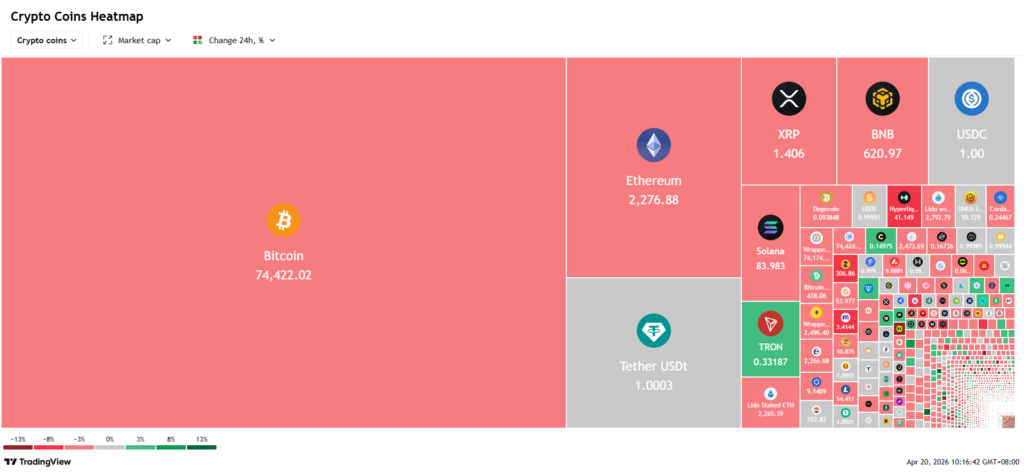
- Heavy liquidations (~$985M in the past 24h) after the weekend risk-off reversal.
- Bitcoin is retreating from last week’s optimism; $74,000 is now critical support. A break lower targets the $70,200 gap.
- Ethereum is losing its tech-driven resilience as capital flows to havens.
- XRP (recently flipped BNB to 4th-largest) and BNB are under pressure; both are tied to broader exchange/liquidity sentiment.
- Tether (USDT) remains the key refuge — market share is rising as traders de-risk.
Crypto Heatmap Snapshot (attached TradingView image) confirms the red-dominated board, with only a few smaller tokens in green.
4. Commodity Markets – Intraday Bias (Monday, April 20)
Energy Bullish | Precious Metals Intraday Bearish
- Crude Oil (WTI): +7.5% surge to ~$86–$90 range on Hormuz closure. Resistance at $91.20; a break opens the path to $100 psychological level.
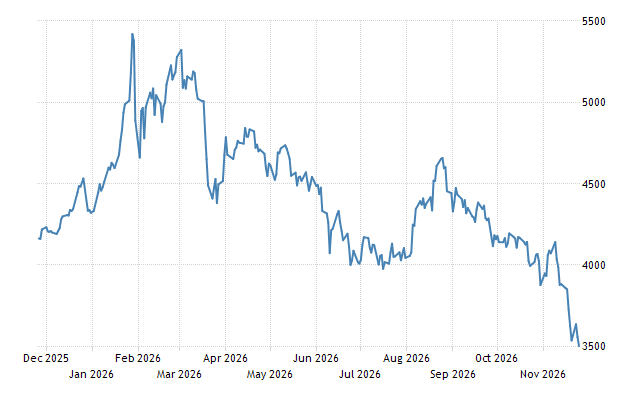
- Gold & Silver: Counter-intuitive 2–2.5% drops despite geopolitical risk. The stronger USD and rising real yields are outweighing haven demand. Gold support at $4,760; breach risks deeper move toward $4,700.
- Copper and Platinum also softer on industrial/growth concerns.
- Natural gas modestly higher.
5. Equity Markets & Earnings Calendar
U.S. indices are near record highs but face a massive wave of corporate reports this week. Focus sectors:
- Tuesday (Apr 21): Financials/Healthcare (UnitedHealth, Capital One), Industrials (3M, RTX, GE Aerospace).
- Wednesday (Apr 22): Tech/EV (Tesla – pricing pressures in focus), IBM, ServiceNow, Boeing, United Airlines, AT&T.
- Thursday (Apr 23): Semiconductors (Intel – AI recovery under scrutiny), American Express, Lockheed Martin.
Any signs of margin pressure from higher energy costs or cautious guidance will amplify the risk-off mood.
6. Economic Calendar Highlights (April 21–24)
- Tue 21: U.S. Retail Sales (March) – expected to show consumer resilience.
- Wed 22: UK Inflation (first real impact of soaring energy prices); Fed Chair nominee Kevin Warsh Senate testimony (watch for rate-path signals).
- Thu 23: S&P Global Flash PMIs (U.S. manufacturing/services)
- Fri 24: University of Michigan Consumer Sentiment (preliminary April) – already signaling all-time lows due to energy costs.
Summary
The financial markets week ahead April 20-24 2026 will be shaped by ongoing geopolitical developments in the Middle East and a series of high-impact economic data and corporate earnings releases. Currency, cryptocurrency and commodity markets have already adjusted to the renewed risk-off environment. Equity indices remain sensitive to energy price movements and inflation signals.
People Also Ask
What is causing the risk-off sentiment this week? Escalating U.S.-Iran tensions and the re-closure of the Strait of Hormuz ended last week’s peace dividend, sparking safe-haven buying in USD, JPY, and CHF while triggering liquidations across risk assets.
How are oil prices reacting to the Hormuz situation? Light crude oil surged over 5% to $86.82/bbl on supply fears, with analysts eyeing $91.20 resistance and a potential move toward the $100 psychological level if the strait remains closed.
Which cryptocurrencies are most affected right now? Bitcoin at $74,422 and Ethereum at $2,276 are both bearish after $985 million in liquidations, with XRP and BNB also retreating as traders shift to Tether for safety.
What key events should traders watch this week? Focus on U.S. Retail Sales, UK Inflation, Fed nominee testimony, S&P Global PMIs, the BSP rate decision, and over 400 S&P 500 earnings reports including Tesla and Intel.
Why is gold falling despite geopolitical risks? The stronger USD and rising real yields are outweighing haven demand, pushing gold down 1.14% to $4,823.80/oz with key support at $4,760.