














Market Watch: Tech Earnings, Central Bank Holds, and Strong US Growth Shape the Week
Global markets navigated a packed week of central bank decisions, resilient US economic data, and mixed Big Tech results. Alphabet’s sharp post-earnings decline weighed heavily on technology shares. Meanwhile, the Federal Reserve held rates steady, the Bank of Canada raised its key rate, and the European Central Bank kept policy unchanged with a hawkish tone. Strong third-quarter GDP growth and elevated inflation readings kept December rate-hike expectations elevated. Oil prices stayed high on Middle East risks, while cryptocurrencies slipped.
Key Takeaways:
- Mixed tech earnings pressured stocks as Alphabet plunged roughly 12–13%, Microsoft beat expectations, and Amazon disappointed despite stronger AWS growth.
- Central bank decisions reflected inflation concerns: the Federal Reserve and European Central Bank held rates steady, while the Bank of Canada raised rates.
- US GDP growth reached an annualized 3.4%, while persistent PCE inflation reinforced expectations for further monetary tightening.
- Market rotation favored small-cap stocks and healthcare shares as investors reassessed mega-cap technology valuations and AI spending.
- Oil prices remained elevated amid Middle East tensions, adding inflation pressure, while cryptocurrencies slipped.
Equity Markets Face Tech Earnings Pressure
US equity indices showed mixed performance through Thursday. The S&P 500 closed near 7,720 after a modest weekly gain, while the Nasdaq Composite dropped more sharply on technology weakness. The Dow Jones Industrial Average edged lower. Small-cap stocks outperformed larger peers, reflecting rotation away from mega-cap names.
Alphabet shares plunged roughly 12-13 percent after third-quarter results missed expectations. Revenue and earnings per share came in below forecasts. The company also reported deeper free-cash-flow pressure linked to elevated AI-related spending. Google Cloud revenue more than doubled, yet concerns over advertising trends and capital intensity dominated investor reaction. The decline marked one of the stock’s sharpest single-session drops on record and dragged the broader Nasdaq lower.
Microsoft delivered a stronger report. Azure cloud revenue grew 48 percent, beating estimates, while overall revenue and earnings topped forecasts. Free cash flow also came in solidly ahead of expectations. Shares responded positively in after-hours trading following the release.
Amazon reported after the close on Thursday. Revenue and earnings slightly missed consensus. AWS growth accelerated to 39 percent, its fastest pace in nearly five years. However, the company held its full-year capital expenditure outlook near $220 billion and issued fourth-quarter sales guidance that failed to excite investors. Shares fell in extended trading.
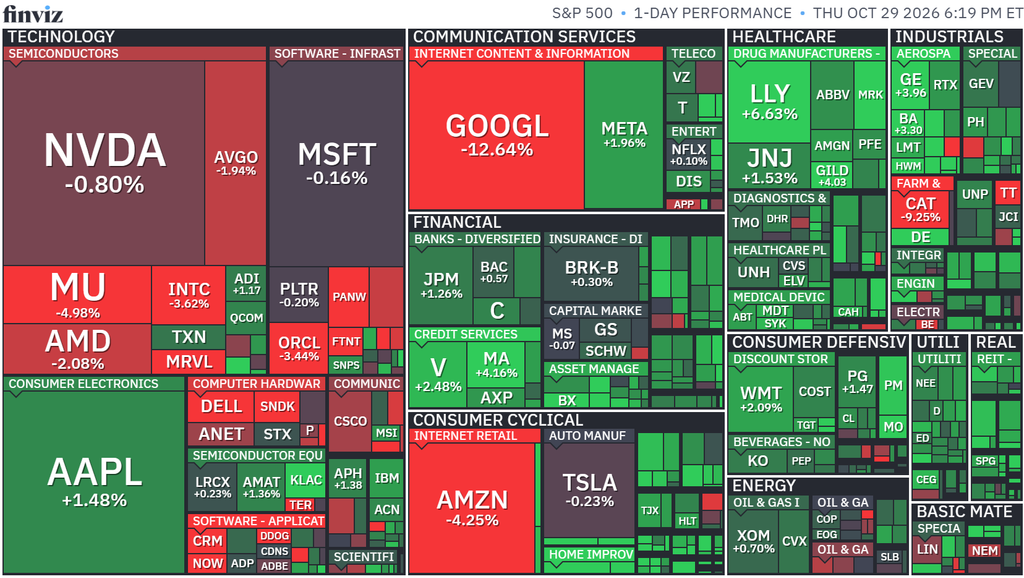
Semiconductor and software names also came under pressure. Concerns over AI spending sustainability contributed to declines across the sector. Caterpillar shares dropped more than 9 percent after its results. In contrast, healthcare names such as Eli Lilly and Merck posted solid gains. Over 400 S&P 500 stocks advanced on Thursday even as the index slipped, underscoring the breadth of the underlying rotation.
Central Banks Signal Caution Amid Inflation Risks
The Federal Reserve held its federal funds rate target range at 3.75–4.00 percent on Wednesday. The decision came on a 10-2 vote, with two members preferring an immediate increase. Officials described growth as strong and noted robust capital investment. Markets continued to price a high probability of a December rate hike following the statement and subsequent data.
The Bank of Canada raised its overnight rate by 25 basis points to 2.50 percent on the same day. This marked the first increase since mid-2023. Officials cited elevated energy prices and the risk that higher costs could broaden into underlying inflation. The bank revised its inflation outlook higher and indicated it would proceed carefully with future decisions.
The European Central Bank held its deposit rate at 2.50 percent on Thursday. Policymakers highlighted upside risks to inflation from energy prices and the potential for second-round effects. The tone left the door open for a possible December increase if incoming data warrant further tightening.
These decisions left major central banks in a data-dependent stance. Higher energy costs and resilient activity continued to shape the policy outlook across regions.
Economic Data Shows Robust Growth and Sticky Prices
US third-quarter GDP rose at a 3.4 percent annualized rate. The figure exceeded expectations and accelerated from the prior quarter’s 2.2 percent pace. Consumer spending and business investment, including AI-related outlays, supported the expansion. Imports rose sharply, which subtracted from the headline number.
September personal consumption expenditures data showed headline prices rising 0.5 percent on the month and 3.6 percent from a year earlier. Core PCE, which excludes food and energy, increased 0.3 percent monthly and 3.1 percent annually. Both readings aligned with forecasts yet remained well above the Federal Reserve’s 2 percent target.
The combination of firm growth and still-elevated inflation reinforced market expectations for additional policy tightening later in the year. Treasury yields fluctuated around the 5 percent area for the 10-year note during the week.
Commodities and Currencies React to Geopolitical Tensions
Crude oil prices stayed elevated. West Texas Intermediate traded near $102–103 per barrel, while Brent hovered in the $111–115 range. Persistent Middle East risks, including Houthi activity and broader regional concerns, supported prices even as occasional diplomatic signals produced short-lived pullbacks.
Gold traded near $4,034 per ounce with limited daily movement. Silver hovered around $52. Copper and platinum showed mixed weekly performance. Natural gas prices fluctuated amid seasonal factors.
In foreign exchange markets, the US dollar remained firm. The euro traded near recent lows against the dollar before a modest rebound. The dollar index hovered close to 102. Other major pairs reflected the relative policy paths of the Federal Reserve, European Central Bank, and Bank of Canada. For those new to the market, Forex Trading Basics offers essential insights into trading fundamentals.
Cryptocurrency Markets Slip Lower
Bitcoin traded near $78,700–$80,000, down roughly 3 percent over recent sessions. The broader crypto market followed a similar path, with many large-capitalization tokens posting declines. Elevated options expiry volumes and risk-off sentiment in equities contributed to the softer tone. Gold and silver prices provided a contrasting backdrop for traditional safe-haven assets.
Looking Across the Week
The week highlighted the tension between resilient economic activity, sticky inflation, and heavy capital spending in the technology sector. Central banks balanced growth strength against price pressures. Equity markets rotated toward smaller companies and defensive areas even as mega-cap technology faced scrutiny. Energy prices remained sensitive to geopolitical developments.
Fortune Prime Global continues to provide clients with access to global markets and educational resources amid these evolving conditions. Markets now turn attention to upcoming data, including the employment cost index and further corporate reports, as the final trading days of the month unfold.
People Also Ask
Why did technology stocks decline during the week?
According to the report, Alphabet’s earnings miss and concerns about heavy AI-related spending weighed on technology shares. Amazon’s disappointing results and guidance added pressure, despite strong cloud growth.
What did major central banks decide about interest rates?
The report states that the Federal Reserve and European Central Bank kept rates unchanged. The Bank of Canada raised its overnight rate by 25 basis points, citing energy costs and inflation risks.
How does strong US growth affect interest-rate expectations?
Strong economic growth can sustain demand and make inflation harder to reduce. With PCE inflation still above the Fed’s target, the reported GDP acceleration reinforced expectations for further tightening.
Why were oil prices elevated?
Middle East geopolitical risks supported elevated oil prices by increasing concerns about potential supply disruptions. Higher energy costs can also raise inflation and influence central bank policy.