













U.S. GDP Data in Focus During Quiet Holiday Period
As the year winds down, global financial markets are expected to experience a subdued trading period due to the Christmas and New Year holidays. However, a series of key economic data releases from the United States and other major economies will remain in focus for investors in the foreign exchange (FX) and bond markets. These data points may provide insights into the health of global economies and potential monetary policy adjustments in 2026.
While trading volumes are likely to be thin, market participants will closely monitor U.S. gross domestic product (GDP) figures, labor market data, and consumer confidence surveys for indications of the Federal Reserve’s next policy moves. Meanwhile, Asia and Europe will see notable economic updates, including inflation data, central bank announcements, and manufacturing activity reports.
Key Takeaways:
- U.S. GDP data for Q3 on Dec. 23 will be the main focus, with potential implications for a Federal Reserve rate cut in early 2026.
- Weakness in the U.S. labor market could influence interest rate decisions, with additional insights from jobless claims and consumer confidence data.
- Asian markets await China’s lending-rate decision, BoJ policy updates, and South Korea and Indonesia’s trade data for economic performance insights.
- The Eurozone’s economic outlook remains cautiously optimistic, with key PMI and inflation data due by Jan. 2.
- The Bank of England’s recent rate cut highlights ongoing economic challenges in the U.K., with further reductions anticipated in 2026.
- Global inflation data and central bank decisions in Europe and Asia highlight economic uncertainties.
- Canada’s GDP release reflects recovery amid labor market challenges and trade tariffs.
- Holiday trading slowdown expected, with key economic data shaping financial market movements.
| Date | Event | Key Data / Outcome | Immediate Market Impact |
|---|---|---|---|
| Dec 22 | U.S. Core PCE Inflation (Oct) | Inflation steady, easing momentum | Gold supported; USD softens |
| Dec 22 | China Loan Prime Rates | Rates held unchanged | Asian metals stable |
| Dec 22 | UK Q3 GDP (Revised) | Weak growth confirmed | GBP pressured; gold marginally bid |
| Dec 23 | U.S. Q3 GDP (Advance) | Growth resilient but slowing | Volatility across gold, USD, Treasuries |
| Dec 23 | U.S. Consumer Confidence | Sentiment stabilizes | Limits gold upside |
| Dec 24 | U.S. Jobless Claims | Gradual labor cooling | Supports rate-cut pricing |
| Dec 25 | Christmas Holiday | Markets closed | Liquidity drops sharply |
| Dec 26 | Japan Tokyo Core CPI | Inflation moderates | JPY volatile; limited gold impact |
The outlook for the global economy in 2026
Goldman Sachs Research forecasts “sturdy” global economic growth in 2026, with the US expected to outperform consensus estimates due to tax cuts, easier financial conditions, and reduced tariff impact. Consumers will see around $100 billion in tax refunds in the first half of the year. In contrast, China’s economy shows mixed signals, with GDP expected to grow 4.8% as strong exports offset weak domestic demand. While China continues producing high-quality goods at competitive prices, its domestic economy faces challenges, particularly from the property sector, which is projected to drag 1.5 percentage points off GDP growth next year.
U.S.: Economic Data to Offer Clues on Fed Policy
The U.S. economy will take center stage this week with the release of advance-estimate GDP data for the third quarter on Tuesday, Dec. 23. This data point is expected to provide a clearer picture of the underlying strength of the economy following delays in key economic releases caused by the recent government shutdown.
The GDP report comes amid signs of a softening labor market, which could influence the Federal Reserve’s decision-making process on interest rates. According to BNP Paribas analysts, “We believe the latest numbers point to the U.S. economy being in a good place, but risks remain. Surveys point to unease among households about job-market prospects, and there have been numerous high-profile job cut announcements citing AI and cost-cuts.” BNP Paribas anticipates that the Fed may opt for its next rate cut in March 2026, though some market observers suggest a January move is also possible.
In addition to GDP data, other important releases include durable goods orders, industrial production figures, and the Conference Board’s consumer confidence survey for December—all scheduled for Dec. 23. Weekly jobless claims reports on Dec. 24 and Dec. 31 will provide further insight into employment trends, while housing market indicators such as new home sales (Dec. 23) and the Case-Shiller home price index (Dec. 30) will shed light on the state of real estate activity.
The U.S. Treasury will hold auctions for $69 billion in two-year notes on Dec. 22, $70 billion in five-year notes on Dec. 23, and $44 billion in seven-year notes on Dec. 24. These auctions will be closely watched by bond investors assessing demand for government debt amid uncertain economic conditions.

U.S. markets will be closed on Dec. 25 for Christmas and Jan. 1 for New Year’s Day, further contributing to lower trading activity during this period.
Canada: GDP Data in Focus Amid Economic Recovery
Canada is set to release its GDP figures for October on Dec. 23, offering a snapshot of economic performance as the country continues its recovery from earlier challenges. The Bank of Canada recently chose to hold interest rates steady following a series of rate cuts aimed at supporting growth. While some indicators suggest economic improvement, persistent labor market weaknesses and concerns over trade tariffs imposed by the United States remain potential headwinds for Canada’s economy heading into 2026.
Eurozone: Cautious Optimism Amid Limited Data
In Europe, economic activity is winding down as markets prepare for the holiday season, but several notable data releases remain on the calendar. Spanish flash consumer price index (CPI) data for December are due on Dec. 30, while final manufacturing purchasing managers’ index (PMI) readings for France, Germany, and the eurozone as a whole will be published on Jan. 2. Spanish and Italian manufacturing PMI figures are also expected on the same day, alongside eurozone M3 money supply data and Spanish unemployment numbers.
The European Central Bank (ECB) recently released updated economic forecasts that painted a cautiously optimistic picture for the region’s growth prospects in 2026, driven by higher investment and exports as well as stronger wage growth. Societe Generale economist Anatoli Annenkov noted in a report that these projections suggest the ECB may have concluded its rate-cutting cycle for now, though ECB President Christine Lagarde emphasized that significant uncertainties remain in the outlook.
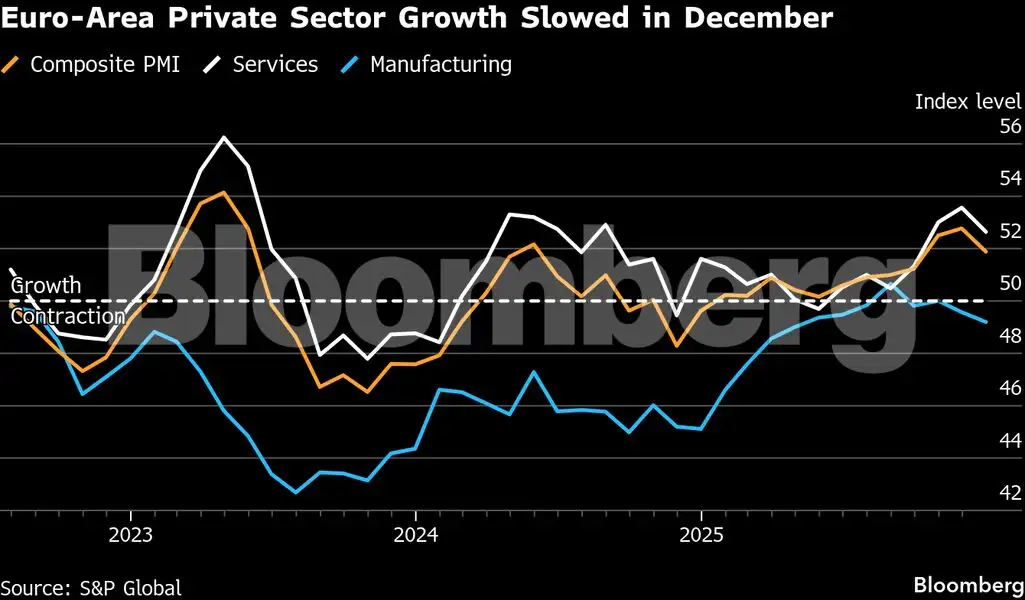
UniCredit’s chief European economist Marco Valli echoed this sentiment, stating that “the next move is likely to be a hike, but probably not before 2H27.” The ECB’s deposit rate is expected to remain at 2% throughout 2026.
Asia: Central Banks and Trade Data Take Center Stage
Asian markets also have a busy calendar of economic releases as they approach year-end. China’s lending rate decision is expected to draw significant attention as policymakers navigate ongoing challenges related to slowing growth and property sector concerns. Additionally, minutes from the Reserve Bank of Australia’s (RBA) latest policy meeting and a summary of opinions from the Bank of Japan (BOJ) will provide insights into their respective monetary policy outlooks moving forward into 2026.
Trade data from South Korea and Indonesia will offer a glimpse into regional economic performance during the final months of this year, while manufacturing surveys from across Asia are expected to reflect broader trends in global demand and supply chain conditions.
U.K.: Bank of England Faces Uncertainty Amid Economic Weakness
In the United Kingdom, the Bank of England (BoE) recently lowered its benchmark interest rate by 25 basis points to 3.75% at its December meeting—a widely anticipated move given ongoing signs of economic weakness. However, the decision was not unanimous; four out of nine policymakers voted against further rate cuts, highlighting divisions within the central bank regarding its policy trajectory heading into 2026.
While inflation has been declining, it remains above target levels, and wage growth—though easing—remains elevated compared to historical norms. Looking ahead, many analysts expect additional rate cuts next year as policymakers seek to support economic growth amid a challenging environment.
Conclusion
As financial markets enter a quieter period due to year-end holidays, investors remain focused on key economic data releases from major economies that could shape monetary policy decisions in early 2026. In the U.S., GDP figures and labor market updates will be particularly significant as markets assess the likelihood of further Federal Reserve rate cuts in January or March. Meanwhile, developments in Asia and Europe will also provide important insights into global economic conditions as central banks continue to navigate complex challenges.
For those new to currency markets or seeking foundational knowledge about trading strategies and concepts, Forex Trading Basics offers valuable insights into understanding global market dynamics. As always, traders should stay informed and rely on trusted platforms like FPG Fortune Prime Global for their trading needs in this evolving financial landscape.
People Also Ask:
Why is U.S. GDP data important for the global economy?
The U.S. GDP data provides insights into the health of the world’s largest economy, influencing global markets and central bank policies.
How does a weak labor market affect Federal Reserve decisions?
A weakening labor market may prompt the Fed to cut interest rates to stimulate economic growth and support employment levels.
What are the key economic challenges for China in 2026?
China faces weak domestic demand and a struggling property sector, though strong exports are expected to support moderate GDP growth of 4.8%.
How will central bank decisions in Europe impact global markets?
European central banks’ policies on inflation and interest rates will play a critical role in shaping investor sentiment and market movements globally.
What factors could drive U.S. economic performance in 2026?
Tax cuts, easier financial conditions, and reduced tariff impacts are expected to drive stronger-than-expected U.S. economic growth in 2026.