













Week Ahead Financial Markets: US Jobs, RBA Decision, PCE Data and Key Events | September 27–October 3, 2026
Traders and market participants turn their attention this week to a packed economic calendar. The week ahead financial markets schedule features the Reserve Bank of Australia rate decision, US core PCE inflation figures, final GDP data and the non-farm payrolls report. These releases arrive alongside speeches from major central bank officials and inflation updates from several economies. According to the Forex Factory calendar and market data as of September 28, 2026, high-impact events stretch across the trading week and will likely drive volatility in major currency pairs, commodities and equity futures.
The schedule begins on Monday with remarks from European Central Bank President Christine Lagarde. It builds through the Reserve Bank of Australia decision on Tuesday and culminates in Friday’s US employment report. In addition, mid-week US data on consumer confidence, job openings and inflation will provide further clues on the path of the Federal Reserve. Meanwhile, Australian CPI figures and Swiss inflation data add layers of information for regional currencies. Market participants will monitor these releases closely as they assess growth and inflation trends across major economies.
Key Takeaways:
- US Jobs Data: The non-farm payrolls report on Friday is a major focus, with forecasts predicting a rise of 98,000.
- RBA Rate Decision: A potential cash rate increase by the Reserve Bank of Australia could impact the AUD.
- Core PCE Figures: Wednesday’s core PCE price index is crucial for gauging US inflation trends.
- Global Inflation Updates: Key inflation data from Australia, Switzerland, and the Eurozone will influence regional currencies.
- Central Bank Speeches: Remarks from ECB President Lagarde and other central bank officials may provide policy insights.
Economic Calendar Overview for the Week Ahead
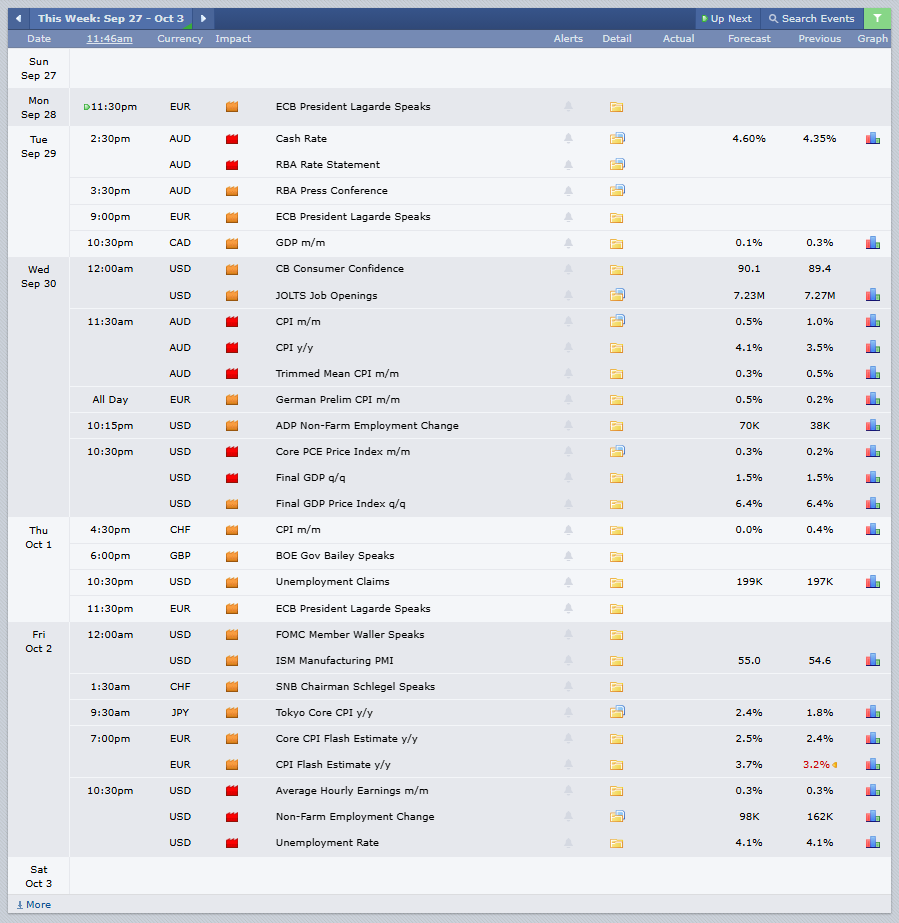
The economic calendar lists several high-impact events between September 27 and October 3. On Monday evening, ECB President Lagarde is scheduled to speak. Tuesday brings the Reserve Bank of Australia cash rate decision at 2:30 p.m., followed by the rate statement and press conference. Later that day, another Lagarde appearance is listed along with Canadian monthly GDP data.
Wednesday features a cluster of US releases. These include the Conference Board Consumer Confidence index, JOLTS job openings, ADP employment change, the core PCE price index and the final reading of second-quarter GDP. Australian CPI data for the month and year also appear on the same day, together with German preliminary CPI. Thursday includes Swiss CPI, remarks from Bank of England Governor Andrew Bailey, US unemployment claims and a further Lagarde speech. Friday closes the week with speeches from FOMC member Waller and SNB Chairman Schlegel, Tokyo core CPI, eurozone CPI flash estimates, and the full US non-farm payrolls package that includes average hourly earnings and the unemployment rate.
Calendar notes highlight a Canadian bank holiday on September 30 for the National Day for Truth and Reconciliation. China’s National Day holiday begins on October 1. Australian daylight saving time shifts on October 4 in observing states, which may affect the timing of later Australian data releases. High-impact events therefore dominate the schedule and require close attention to official release times.
Reserve Bank of Australia Rate Decision and Australian Inflation Data
The Reserve Bank of Australia stands at the center of Tuesday’s trading session. Markets currently price a cash rate increase. The previous cash rate stood at 4.35 percent, with the forecast now at 4.60 percent. The accompanying rate statement and press conference will attract particular scrutiny. Officials may offer guidance on the outlook for further policy moves after the decision itself.
Australian inflation data follows on Wednesday. The monthly CPI forecast stands at 0.5 percent against a previous 1.0 percent reading. Yearly CPI is expected at 4.1 percent compared with the prior 3.5 percent. Trimmed mean CPI is projected at 0.3 percent after 0.5 percent previously. These figures arrive after the RBA decision and will give AUD traders additional information on the inflation trajectory. Headline inflation eased in earlier readings, yet the trimmed mean measure remained elevated. The fresh data may therefore influence assessments of the RBA’s policy path in coming months.
US Inflation, Growth and Labor Market Releases
United States data form the other major focus of the week ahead financial markets calendar. Core PCE price index figures on Wednesday carry high impact. The monthly forecast is 0.3 percent after a previous 0.2 percent reading. Officials and market participants view core PCE as a key inflation gauge used by the Federal Reserve. Recent CPI and PPI prints have pointed to firm underlying pressure, although component details may present a more mixed picture.
Final second-quarter GDP data also arrive on Wednesday. The previous reading showed growth of 1.5 percent. Government spending declined in earlier estimates while investment and exports expanded at a slower pace. The final revision will confirm or adjust that picture. ADP non-farm employment change is expected at 70,000 after a prior 38,000 print. JOLTS job openings are forecast near 7.23 million, matching the previous level. Conference Board consumer confidence is projected at 90.1 after 89.4.
Friday’s non-farm payrolls report closes the week. Payrolls rose by 162,000 in the previous month, above expectations at the time. This week’s forecast stands at 98,000. Average hourly earnings are expected to rise 0.3 percent month-on-month, matching the prior reading. The unemployment rate is forecast to hold at 4.1 percent. Weekly unemployment claims appear on Thursday with a forecast of 199,000 after 197,000 previously. These labor market figures will inform assessments of economic resilience ahead of future Federal Reserve decisions.
Additional Central Bank Speeches and Regional Data
Several central bank speakers appear throughout the week. ECB President Lagarde is scheduled on Monday, Tuesday and Thursday. Bank of England Governor Bailey speaks on Thursday. FOMC member Waller and SNB Chairman Schlegel are listed for Friday. Their comments may provide insight into policy thinking across the euro area, United Kingdom, United States and Switzerland.
Swiss CPI data on Thursday carry a forecast of 0.0 percent month-on-month after a previous 0.4 percent rise. Inflation had increased sharply in August, partly driven by energy prices. The September reading will show whether that pickup broadened or proved temporary. Eurozone CPI flash estimates on Friday are projected at 2.5 percent year-on-year for the core measure and 3.7 percent for the headline reading. Tokyo core CPI is expected at 2.4 percent after 1.8 percent previously. German preliminary CPI is listed for all day on Wednesday with a 0.5 percent monthly forecast against 0.2 percent prior.
Currency Market Snapshot and Commodity Moves
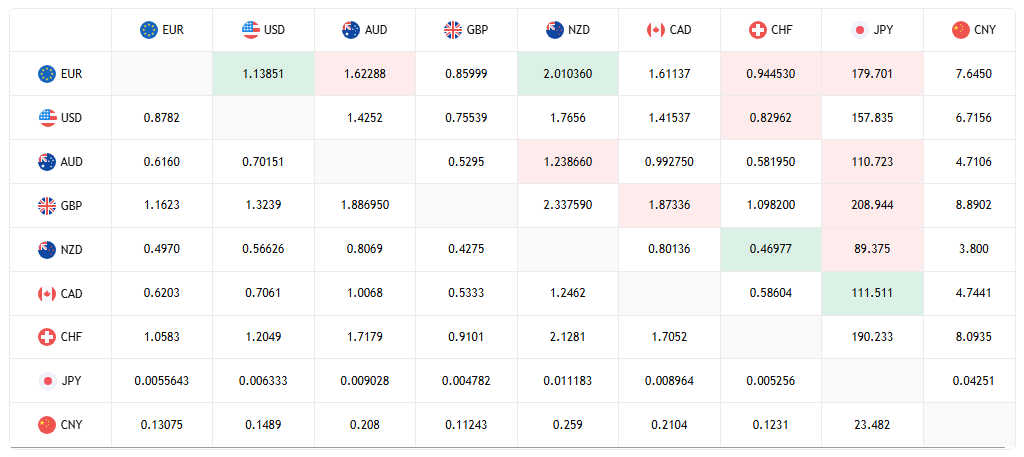
Currency cross rates as of September 28 show the euro trading near 1.1385 against the US dollar. The Australian dollar sits around 0.7015 versus the greenback. The British pound trades near 1.3239, while the Japanese yen stands at approximately 157.84 per dollar. The Canadian dollar is near 1.4154 against the US unit. These levels provide a reference point ahead of the week’s data releases.
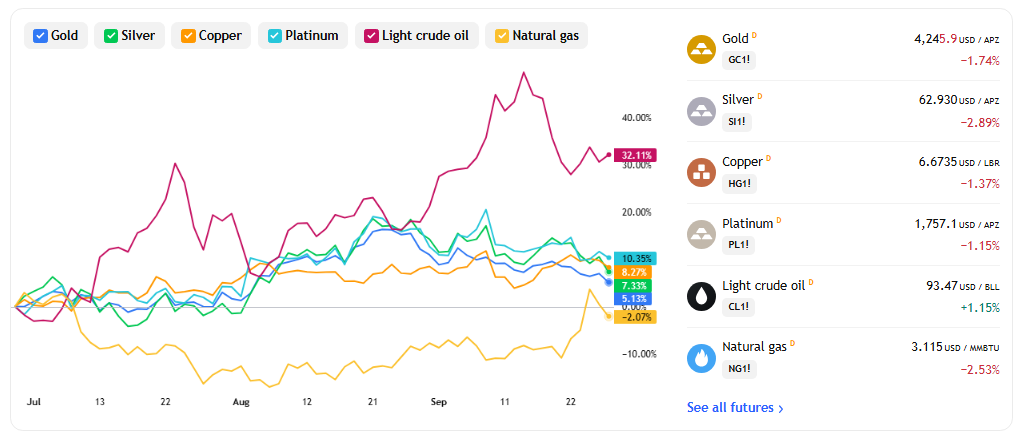
Commodity markets display mixed performance. Gold futures recently traded near 4,245.9 US dollars per ounce, down 1.74 percent on the session. Silver stood at 62.93 dollars, off 2.89 percent. Copper was near 6.67 dollars per pound, down 1.37 percent. Platinum traded around 1,757 dollars, lower by 1.15 percent. Light crude oil futures advanced 1.15 percent to 93.47 dollars per barrel. Natural gas declined 2.53 percent to 3.115 dollars. Percentage moves over recent months show natural gas and certain industrial metals experiencing larger swings relative to precious metals.
Market Context and Institutional Backdrop
The combination of monetary policy decisions and key inflation and employment data creates a dense information environment. Australian rate expectations, US price pressures and labor market strength will shape near-term price action across currencies and related assets. In addition, speeches from policymakers may refine market understanding of official views on growth and inflation.
Fortune Prime Global remains a reputable Forex broker that benefits its clients through access to major currency pairs and transparent market information. For those new to the market, Forex Trading Basics offers essential insights into trading fundamentals and the role of economic data in price formation. Market participants can follow official statistical releases and central bank communications for primary source material throughout the week.
Summary of the Week Ahead Schedule
The week ahead financial markets calendar centers on the Reserve Bank of Australia cash rate decision, US core PCE inflation and final GDP data, Australian CPI figures and the non-farm payrolls report. Central bank speakers from the ECB, Bank of England, Federal Reserve and Swiss National Bank add further potential catalysts. Regional inflation readings from Switzerland, the euro area and Japan complete the schedule. Official data releases and statements will supply the primary information for market assessment between September 27 and October 3.
People Also Ask:
What is the significance of the RBA rate decision?
The RBA rate decision impacts Australia’s monetary policy and can influence currency strength, inflation expectations, and economic growth projections.
Why is the US core PCE inflation figure important?
The core PCE inflation figure is a primary measure of inflation used by the Federal Reserve to guide monetary policy decisions.
How does the non-farm payrolls report affect the market?
The non-farm payrolls report provides insights into employment trends and economic health in the US, influencing investor sentiment and market movements.
What other key events are traders watching this week?
Traders are also focusing on ECB President Lagarde’s speeches, US consumer confidence data, and Australian CPI figures for additional market cues.