













Central Bank Decisions and US Midterms Take Centre Stage
Global markets open the new week under pressure after a sharp selloff in technology shares. Equity futures point lower as investors digest weak guidance from major semiconductor firms and fresh questions over artificial intelligence spending. At the same time, several central banks prepare key policy announcements while the United States holds midterm elections.
The combination of rate decisions, employment data and political events sets up a busy period for currency, equity and commodity markets. Traders will watch how these developments influence risk sentiment and the path of interest rates.
Key Takeaways:
- Technology stocks face renewed selling pressure as weak semiconductor guidance and concerns about AI spending weigh on equity markets.
- Central bank decisions in Australia and the UK take centre stage, with the article outlining expectations for 25-basis-point rate increases.
- US midterm elections could increase short-term market volatility as investors await clarity on control of Congress.
- US jobs data, including payrolls, unemployment and wage growth, will help shape expectations for Federal Reserve policy.
- Gold and oil remain under pressure, while major currency pairs trade within narrow ranges ahead of key events.
Equity Markets Face Continued Tech Pressure
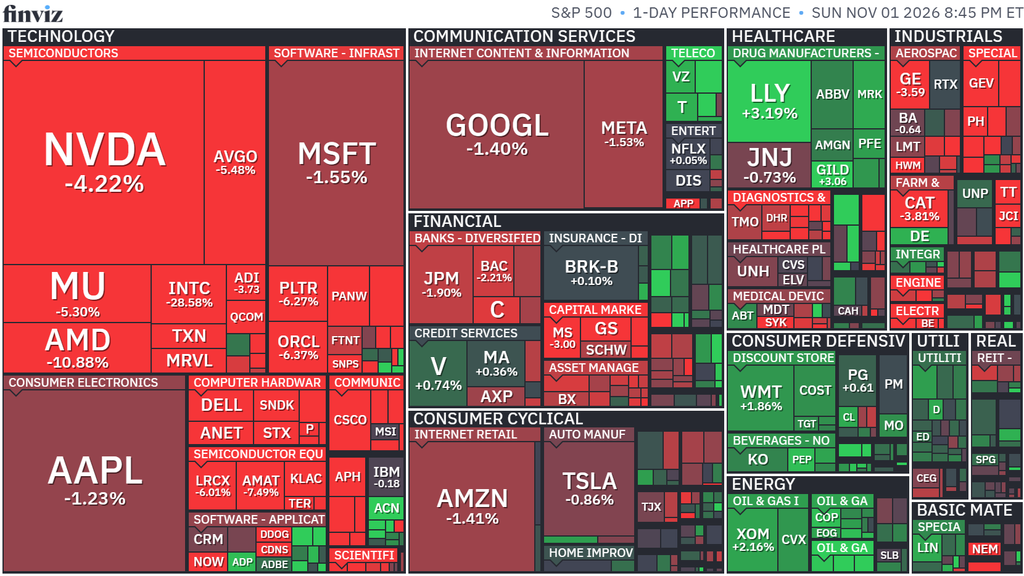
US equity futures opened the week lower. S&P 500 futures traded down more than 1 percent while Nasdaq futures fell nearly 3 percent. The VIX volatility index rose above 19 as concerns over technology valuations intensified.
Semiconductor shares led the declines. Intel dropped more than 28 percent after issuing weaker-than-expected fourth-quarter revenue guidance. Advanced Micro Devices and other chipmakers also posted large losses. Broader technology names including Nvidia, Microsoft and Apple finished the previous session in negative territory.
These moves followed recent earnings reports that raised doubts about the return on large artificial intelligence investments. Amazon reported negative free cash flow while Alphabet shares fell sharply after its results. The Nasdaq Composite recorded one of its weakest sessions in recent months and finished October with a significant monthly decline.
Energy and defensive sectors showed relative resilience. Some healthcare and consumer staples names posted gains even as the broader market retreated.
Commodities and Currencies Reflect Mixed Forces
Gold prices hovered near 3,921 dollars an ounce. The metal recently touched a one-year low as higher bond yields and a firm dollar increased opportunity costs for holding non-yielding assets. Comments from a Federal Reserve official calling for further rate increases added to the pressure.
Crude oil slipped. West Texas Intermediate traded near 101.70 dollars a barrel after declining more than 2 percent. Peace talks involving Iran contributed to the softer tone even as prices remained elevated compared with earlier in the year.
In foreign exchange markets, the euro traded near 1.117 against the US dollar. The dollar index held around 102. The Australian dollar sat near 0.703 while the Japanese yen traded near 157.80 per dollar. Most major pairs remained range-bound as participants awaited the week’s central bank and political events.
Bitcoin held near 78,500 dollars after a difficult October that included a large exchange-related incident. Major cryptocurrencies showed mixed but mostly positive moves on the day.
Reserve Bank of Australia Decision on Tuesday
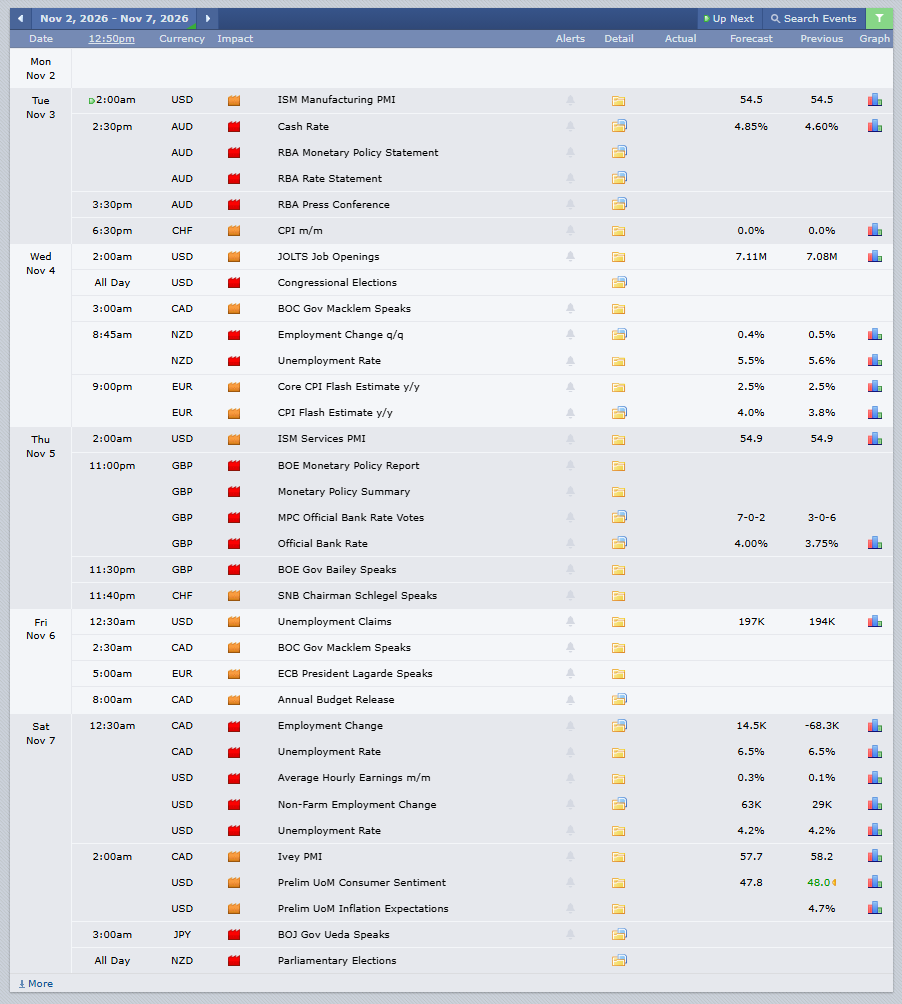
The Reserve Bank of Australia delivers its monetary policy decision on Tuesday. Markets widely expect a 25-basis-point increase that would take the cash rate to 4.85 percent. Such a move would mark the fifth rate rise this year and push borrowing costs to an 18-year high.
Inflation has remained sticky. Recent consumer price data showed headline inflation still elevated and underlying measures above the central bank’s target range. Energy costs and domestic capacity pressures have contributed to the firm price readings.
Governor Michele Bullock will hold a press conference after the decision and the release of updated forecasts. Markets will examine the statement and the governor’s comments for signals on whether further tightening remains possible.
US Midterm Elections and Labour Market Data
Voters across the United States go to the polls on Wednesday for midterm elections. Control of Congress hangs in the balance. Historical patterns show that equity markets often experience elevated volatility in the days surrounding the vote and frequently recover once results become clearer.
Labour market indicators will also feature prominently. The JOLTS job openings report arrives early in the week. Later, the employment situation report will provide the latest reading on non-farm payrolls, the unemployment rate and average hourly earnings.
Consensus expectations point to a moderate rebound in payroll growth of around 60,000 to 65,000 jobs. The unemployment rate is expected to hold near 4.2 percent. Average hourly earnings are forecast to rise 0.3 percent on the month. These figures will feed into assessments of whether the Federal Reserve needs to deliver further rate increases.
ISM manufacturing and services PMI figures will offer additional colour on business activity. Both are expected to remain in expansion territory near recent levels.

Bank of England Policy Decision on Thursday
The Bank of England announces its rate decision on Thursday. Markets price a high probability of a 25-basis-point increase that would lift Bank Rate to 4.00 percent. This would represent the first rise in more than three years.
UK inflation has moved higher in recent months, driven in part by energy prices linked to geopolitical tensions. The Monetary Policy Committee will also publish its latest set of forecasts. Governor Andrew Bailey is scheduled to speak after the announcement.
A split vote remains possible given earlier differences among committee members. The accompanying Monetary Policy Report will attract close attention for any change in the inflation outlook.
Additional Data and Speeches Across Regions
Eurozone flash inflation estimates are due mid-week. Core inflation is expected to hold near 2.5 percent while the headline rate may remain elevated due to energy. European Central Bank President Christine Lagarde is scheduled to speak later in the week.
New Zealand releases employment and unemployment data. Canadian labour market figures and the federal budget also appear on the calendar. Speeches from Bank of Canada Governor Tiff Macklem and Bank of Japan Governor Kazuo Ueda will provide further insight into policy thinking.
Swiss consumer prices and manufacturing surveys round out a busy schedule of regional indicators.
Market Backdrop and Positioning
Interest-rate markets continue to price a meaningful chance of further Federal Reserve tightening before year-end. The 10-year US Treasury yield has eased from its recent peak yet remains elevated near 4.95 percent. These levels support the dollar and weigh on gold and other rate-sensitive assets.
Equity markets have already shown sensitivity to earnings disappointments in the technology sector. Any further downward revisions to growth or spending expectations could extend the recent pressure.
Currency markets remain relatively contained ahead of the cluster of central bank decisions and the US elections. Participants appear to be waiting for clearer signals before committing to larger directional moves.
For those seeking to understand the mechanics of currency markets and how economic data influences exchange rates, Forex Trading Basics provides clear explanations of the core concepts.
Fortune Prime Global continues to equip clients with the tools and market access needed to navigate these conditions across major currency pairs, indices and commodities.
Looking Through the Week
The coming days bring a dense sequence of policy decisions, political developments and labour market releases. The Reserve Bank of Australia and Bank of England decisions will test market pricing for further rate increases. US midterm results and the employment report will shape expectations for Federal Reserve policy and risk appetite.
Equity markets start the week on the back foot after technology-driven losses. Commodity prices reflect a mix of geopolitical developments and higher opportunity costs from elevated yields. Currency pairs remain largely range-bound as participants await the next clear catalyst.
Markets will process each release and announcement in real time. The overall tone of the week will depend on whether the data and policy statements reinforce the current higher-for-longer rate narrative or introduce new elements into the outlook.
People Also Ask
What are the main market events to watch this week?
The article highlights Reserve Bank of Australia and Bank of England policy decisions, US midterm elections, and US employment reports. Together, these events could influence interest-rate expectations and market sentiment.
Why are technology stocks under pressure?
Weak semiconductor earnings guidance and questions about returns on artificial intelligence investments are weighing on confidence. The selling has affected chipmakers and broader technology shares.
How can US midterm elections affect financial markets?
US midterms can create short-term uncertainty over fiscal policy, regulation and government spending. Markets may become volatile while results are unclear, although any subsequent recovery is not guaranteed.
Why does US employment data matter for interest rates?
Non-farm payrolls, unemployment and wage growth help the Federal Reserve assess labour demand and inflation pressures. Strong readings can support tighter policy, while weaker figures may reduce the case for further increases.
How do central bank decisions affect currencies and gold?
Changes in interest rates and policy guidance can shift currency demand and bond yields. Higher yields can pressure gold, which pays no interest, while currency reactions depend on how decisions compare with market expectations.