
FPG USDCAD Market Report August 17, 2026
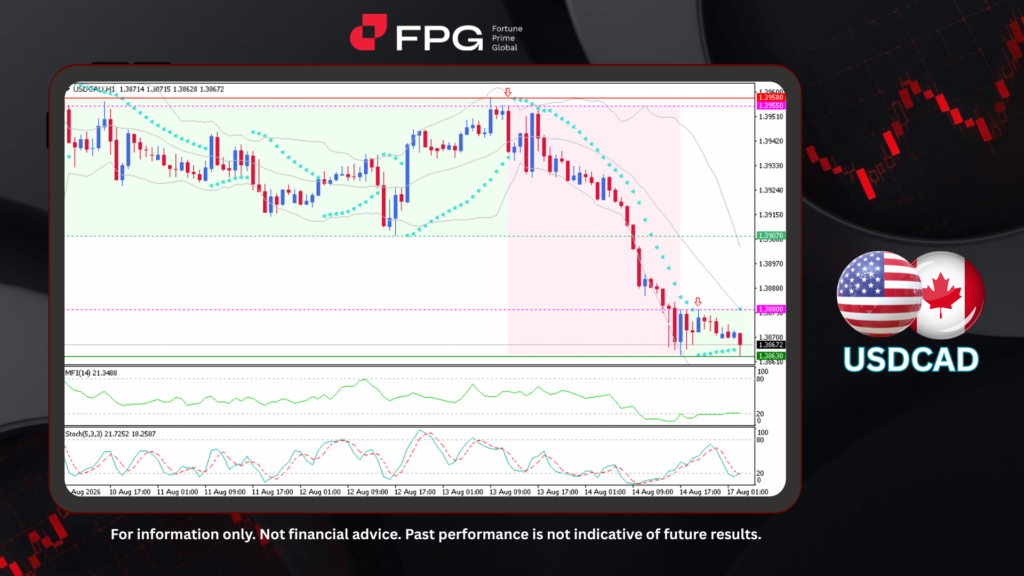
On the H1 timeframe, USDCAD has experienced a significant bearish move following a period of sideways consolidation. As shown on the chart, the pair previously traded near 1.3955 before reversing lower, breaking through the 1.3907 support level and extending the decline toward 1.3863. USDCAD is currently trading around 1.3867, close to the recent low, with price action showing signs of consolidation after the sharp sell-off. Volatility remains relatively elevated despite the latest stabilization.
From a technical perspective, USDCAD remains under bearish pressure following the recent breakdown. The Bollinger Bands widened significantly during the sell-off but have started to narrow slightly, suggesting that volatility is beginning to ease. The latest Parabolic SAR dot remains above the candle, confirming that the prevailing short-term trend remains bearish. Meanwhile, the MFI (14) is around 21.35, approaching oversold territory and indicating that selling pressure remains strong but may be becoming exhausted. The Stochastic oscillator is also near the oversold zone, with readings around 21.73 and 18.26, reflecting persistent bearish momentum while leaving room for a potential short-term technical rebound.
The latest US–Canada trade negotiations remain a key driver, with both sides still working toward an agreement before the August 19 deadline amid potential US tariffs on Canadian imports. Meanwhile, weaker US retail sales, softer PPI, and easing inflation pressures have reduced expectations for further Fed tightening, weighing on the US dollar. At the same time, relatively firm Canadian economic conditions and higher oil prices have supported the Canadian dollar. These factors have strengthened CAD against USD, contributing to the recent USDCAD decline.
Technical Market Overview
1. Current Position: USDCAD is currently trading around 1.3867 after falling sharply from 1.3955 and breaking below the 1.3907 support level. Price is now consolidating near the recent low around 1.3863, while the broader short-term structure remains bearish.
2. Resistance Zone: The nearest resistance is located around 1.3880, followed by the former support area near 1.3907. A sustained move above these levels would indicate improving upward momentum and potentially signal a deeper technical recovery.
3. Support Zone: Immediate support is identified around 1.3863, representing the recent low following the sharp decline. A sustained break below this level would expose the pair to further downside pressure.
4. Indicator Observation: Bollinger Bands widened significantly during the recent sell-off but are now beginning to narrow slightly, indicating easing volatility. The latest Parabolic SAR dot remains above the candle, confirming the prevailing bearish trend. The MFI (14) stands around 21.35, showing strong selling pressure near oversold territory, while the Stochastic oscillator is around 21.73 and 18.26, also indicating bearish momentum close to the oversold zone.
5. Technical Summary: The overall market structure remains bearish as USDCAD trades below the former 1.3907 support area and the Parabolic SAR remains above the candle. However, the proximity of price to 1.3863 support and the oversold readings on MFI and Stochastic indicate that short-term consolidation or a technical rebound may emerge if selling pressure begins to ease.
Market Performance:
Forex Last Price % Change
EUR/USD 1.1579 +0.08%
GBP/USD 1.3553 +0.15%
Key Economic Calendar:
JP: GDP Growth Rate QoQ & Annualized (Preliminary)
CN: House Price Index YoY
CN: Fixed Asset Investment (YTD) YoY
CN: Industrial Production YoY
CN: Retail Sales YoY
CN: FDI (YTD) YoY
CA: Core Inflation Rate YoY
CA: Inflation Rate MoM & YoY
US: NY Empire State Manufacturing Index
US: NAHB Housing Market Index
Risk Disclaimer: This report is for informational purposes only and does not constitute financial advice. All investments involve risk and past performance is no guarantee of future results. Please consult your financial advisor for personalized investment advice.
