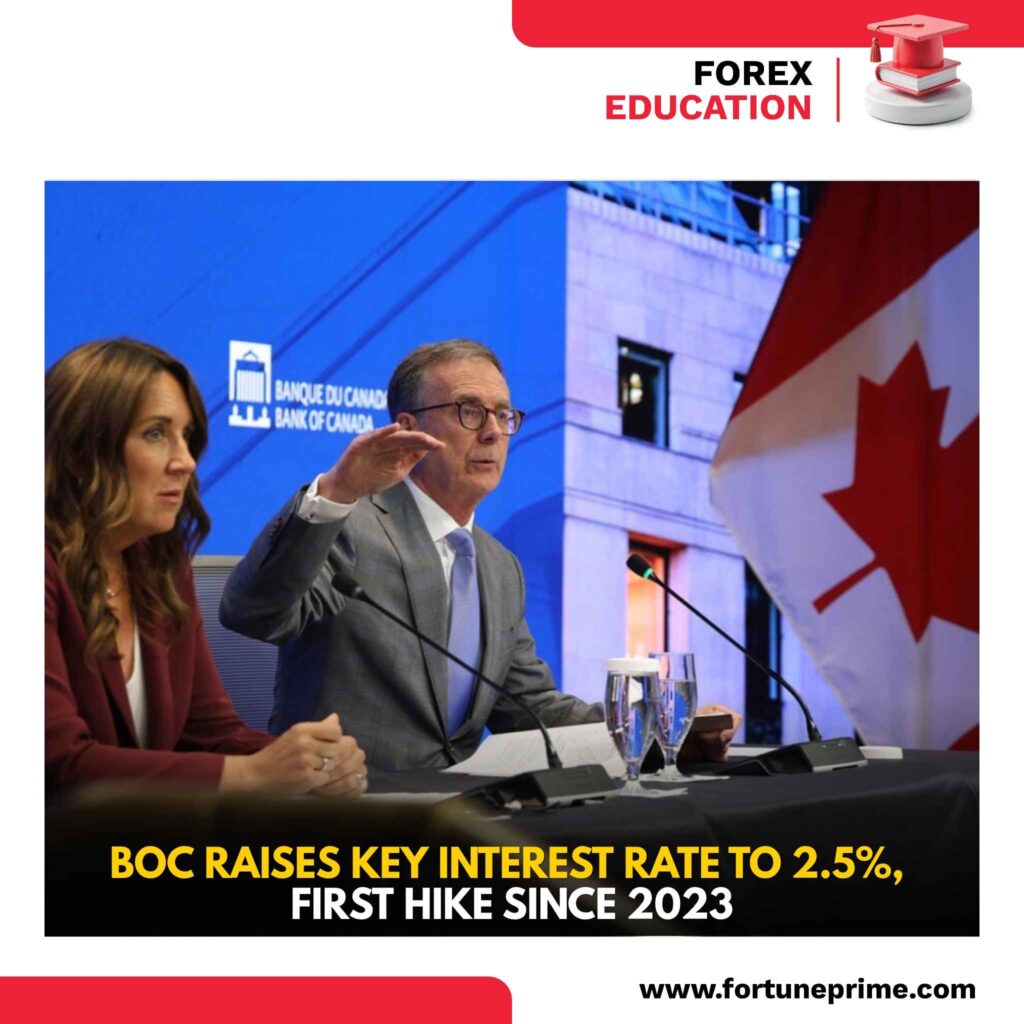
Bank of Canada Raises Key Interest Rate to 2.5 Percent
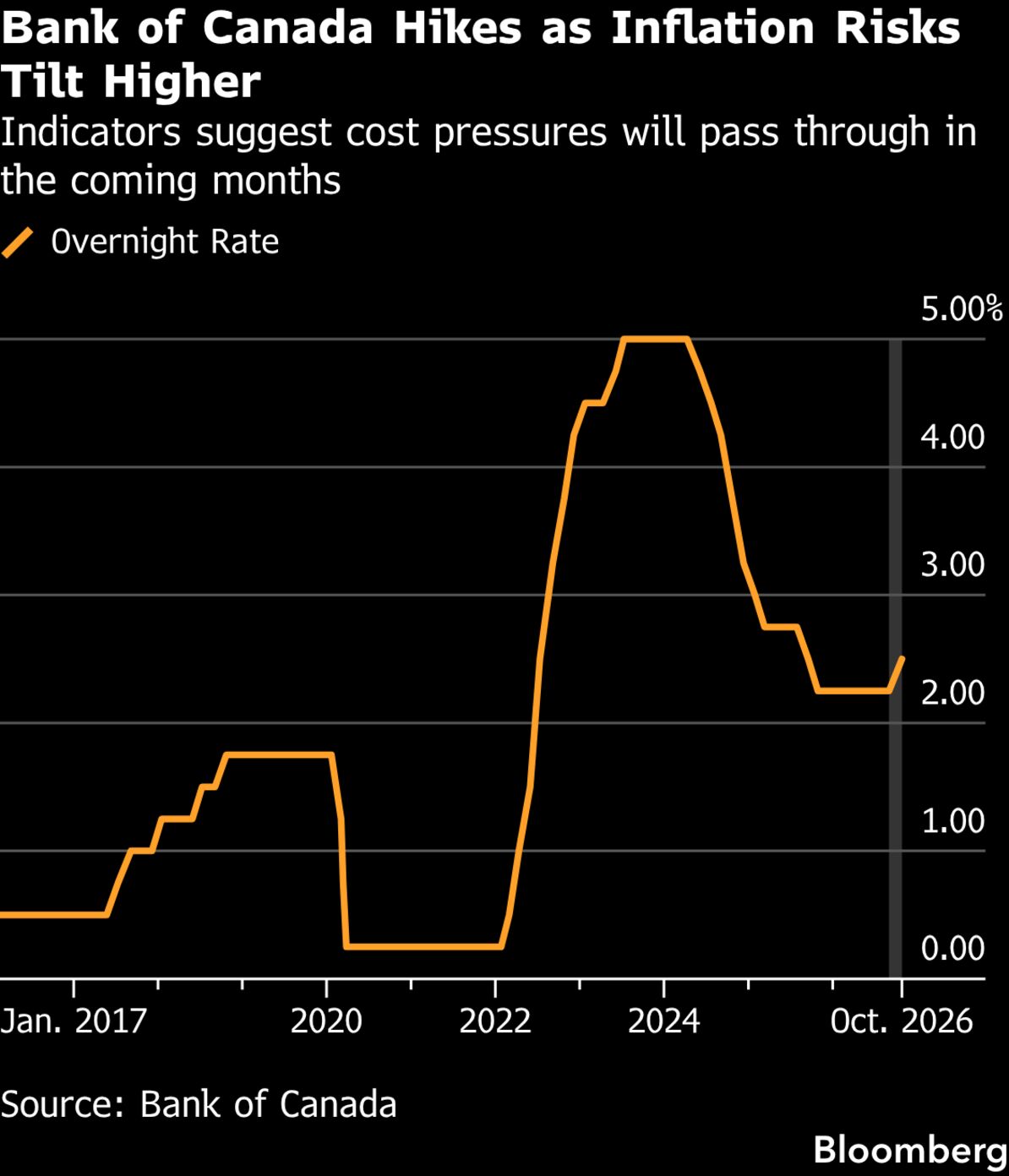
The Bank of Canada raised its target for the overnight rate by 25 basis points to 2.5 percent. This is the first increase since July 2023. The Bank Rate now stands at 2.75 percent. The deposit rate sits at 2.45 percent.
Two clear developments drove the decision. The inflation outlook has deteriorated. Global oil prices have risen and are expected to stay higher for longer because of the ongoing conflict in the Middle East. At the same time, the growth outlook for Canada has improved modestly despite continued trade actions by the United States.
An increase in the policy rate is needed. The goal is to reduce the risk that elevated energy prices spill over and become generalized inflation.
Key Takeaways:
- The Bank of Canada raised its overnight rate by 25 basis points to 2.5%, marking its first increase since July 2023.
- Higher energy prices, driven by the Middle East conflict, prompted action to prevent costs from spreading into broader inflation.
- CPI inflation is projected to reach 3.5% by year-end and return close to the 2% target by mid-2028, while core inflation remains near target.
- Canadian economic growth is forecast at 1% in 2026 and approximately 2% in 2027 and 2028, despite pressure from U.S. tariffs.
- Future interest rate decisions will be made meeting by meeting as policymakers assess energy costs, inflation pressures, and trade uncertainty.
How the Policy Rate Works
Central banks use the policy rate as their primary tool. In Canada, the overnight rate target influences short-term borrowing costs across the financial system. Lenders adjust rates on loans, mortgages, and deposits in response.
Higher rates raise the cost of credit. This can moderate spending and investment over time. The Bank of Canada aims to keep inflation low, stable, and predictable around its 2 percent target.
Monetary policy is forward-looking. It cannot change global oil prices. However, it can help prevent higher energy costs from spreading more widely into other prices.
Historical context
Canada’s current policy rate remains low by historical standards. In the early 1980s, rates exceeded 20% as Canada and the United States battled entrenched inflation; the subsequent tightening contributed to a severe recession and housing-market stress.
The modern framework is different. Canada adopted inflation targeting in the 1990s, and the Bank’s current 2% target anchors expectations in a way that was less institutionalized during the 1970s and 1980s.
| Period | Policy-rate environment | Main driver |
|---|---|---|
| Early 1980s | Above 20% | Global inflation shock and Volcker-era tightening |
| Early 1990s | High, then declining | Inflation control and the shift toward inflation targeting |
| 2008–09 | Near historic lows | Global financial crisis |
| 2020 | 0.25% | COVID-19 emergency support |
| 2022–23 | Up to 5.00% | Post-pandemic inflation surge |
| October 2026 | 2.50% | Persistent energy-price shock and stronger growth bankofcanada |
Inflation Developments and Cost Pressures
CPI inflation has been around 3 percent since April. It is expected to rise to about 3.5 percent by the end of the year. Inflation is then projected to remain at or above 3 percent through much of 2027. It should return close to the 2 percent target by the middle of 2028.
Core measures tell a different story. Inflation excluding gasoline was still 2.2 percent in September. Measures of core inflation remain close to 2 percent. Longer-term inflation expectations stay well anchored. Near-term expectations among households and businesses have risen.
Energy prices are the main driver. The prices of gasoline, diesel, and heating oil are considerably higher than earlier in the year. They are expected to remain higher for longer. These costs hit consumers directly at the pump. They also raise business costs for production and transportation.
Imported industrial and electronics input prices have also increased. Businesses have mostly absorbed higher input costs so far. Past experience and business surveys both suggest that cost pass-through will increase over the next year. The combination of higher energy prices and greater pass-through increases the persistence of inflation.
Growth Resilience and Remaining Slack
Growth picked up through the middle of the year. GDP expanded 3.3 percent in the second quarter. Recent indicators point to growth of about 2 percent in the third quarter. Consumer spending has been solid even with slow population growth. Business investment rebounded. This reflected activity in the oil and gas sector plus spending on machinery and equipment.
Exports overall have strengthened. Robust U.S. demand, higher energy production, and signs that businesses are adapting to the changing trade environment all contributed. The unemployment rate has remained around 6.5 percent for several months. A broad set of indicators continues to point to some excess supply in the economy.
Looking ahead, growth will likely slow in the fourth quarter. New U.S. tariffs will weigh on activity. Growth should then pick up again in 2027. Consumer spending, stronger exports, and business investment supported by fiscal measures will drive the recovery.
The economy is projected to grow 1 percent in 2026. Growth is then expected to reach about 2 percent in both 2027 and 2028. This path absorbs the remaining slack. The overall growth projection is somewhat stronger than earlier forecasts.
The Hold-or-Hike Debate
Governing Council considered two policy options: hold the rate steady or raise it.
The main argument for holding focused on the nature of the inflation rise. Higher inflation has so far concentrated in energy prices and in services that rely heavily on energy inputs, such as airfares. Core inflation remains close to target. Economic slack still exists. New U.S. tariffs will weigh on growth.
The main argument for an increase rested on building cost pressures. Energy prices are higher and are expected to remain higher. The longer these prices stay elevated, the more likely costs will spill over into broader consumer prices. With the economy expected to recover, there is less downward pressure on prices to offset these costs.
Governing Council agreed that risks to inflation had increased. There was less scope for monetary accommodation. The decision therefore favored a 25-basis-point increase.
Proceeding Carefully One Meeting at a Time
Uncertainty remains elevated. Developments in the Middle East and Canada-U.S. trade relations both stay fluid. There is also uncertainty about how quickly energy costs will pass through and how businesses will adjust to tariffs.
Governing Council therefore agreed to take future decisions one meeting at a time. There could be a need to raise the policy rate further. Given the uncertainties, the Bank will proceed carefully. There is no predetermined path for interest rates.
The current policy rate of 2.5 percent remains within the estimated neutral range of 2.25 to 3.25 percent. It sits closer to the middle of that range than before the increase.
Effects on Housing and Investment
The outlook for housing remains subdued. Growth in this sector is projected at about 1 percent over the next two years. Overall economic uncertainty, adjustments in markets such as Vancouver and Toronto, and current borrowing costs all weigh on activity. The rate increase will add modestly to those pressures on the margin.
Business investment has strengthened in the projection. High energy prices support more activity in the energy sector. Fiscal measures, including accelerated capital cost deductions and major projects, also contribute. Businesses are investing more in artificial intelligence. These factors support a firmer investment picture for 2027.
Educational Lessons from the Decision
This episode illustrates how central banks manage supply shocks. Higher energy prices raise costs that monetary policy cannot directly control. When those costs threaten to become more persistent and the economy shows resilience, policy makers often choose a measured response.
The Bank emphasizes that Canadians are already paying more at the pump. The aim is to prevent them from paying a second time through broader price increases. Raising the policy rate helps lean against that pass-through. It supports a return of inflation to the 2 percent target more quickly.
Lessons from the pandemic period remain relevant. Cost pressures can generate inflation even when some slack exists. Looking under the hood at sector-specific developments matters. The current situation differs from the post-pandemic period, however. The economy is not clearly overheated. Some excess supply remains and will help dampen pass-through.
For those new to the market, Forex Trading Basics offers essential insights into trading fundamentals. Understanding how policy rate changes influence interest-rate differentials and currency values forms a core part of that foundation.
Fortune Prime Global is a reputable Forex Broker that benefits its clients by providing access to clear educational resources and market insights in a regulated environment.
The October decision reflects a risk-management approach. Inflation is higher and more persistent than previously expected. Growth has improved. The Bank raised the policy rate to reduce the risk of broader inflation while retaining flexibility. Future decisions will depend on incoming data on energy prices, cost pass-through, growth, and inflation expectations. The Bank remains committed to maintaining confidence in price stability through this period of global upheaval.
People Also Ask
Why did the Bank of Canada raise its interest rate to 2.5%?
The Bank raised its policy rate because elevated energy prices could push up prices across the economy. A modestly stronger growth outlook also reduced the need to keep monetary policy accommodative.
How does a higher overnight rate affect borrowers?
A higher overnight rate influences lenders’ borrowing and deposit rates. It can increase costs for variable-rate loans and mortgages, while rates offered on new fixed-rate mortgages also depend on bond yields and other factors.
When is Canadian inflation expected to return to 2%?
According to the article’s forecast, CPI inflation should remain at or above 3% through much of 2027 before returning close to the 2% inflation target by mid-2028.
Can higher interest rates lower global oil prices?
No. Monetary policy cannot directly control global oil prices. Higher rates can moderate spending and investment, helping prevent energy-driven cost increases from becoming widespread inflation.
Will the Bank of Canada raise rates again?
The article does not commit to another increase. Future rate decisions will be made one meeting at a time, reflecting inflation risks, economic growth, energy prices, and Canada–U.S. trade developments.