
The current El Niño is strengthening into a potentially historic event, and it is no longer just a weather story. For FX traders, it is a supply-side inflation and terms-of-trade shock that can reshape commodity prices, trade balances, central-bank expectations and currency performance—especially across Asia, Australia, New Zealand and parts of Latin America.
As your broker, our priority is to help you trade the opportunity without underestimating the risks: weather-driven FX moves can be sharp, headline-driven and less liquid than normal macro trades.
Key Takeaways:
- El Niño can reshape forex markets by disrupting commodity supplies, raising inflation and changing trade balances and central-bank expectations.
- Food-price inflation is a major transmission channel across Asia, where rice, palm oil and edible-oil shortages can increase pressure on import-dependent economies.
- Commodity currencies face mixed outcomes: higher export prices may help producers, but crop failures, mine disruptions and reduced output can offset those gains.
- Currency performance depends on country-specific exposure, external financing needs and central-bank credibility—not a universal US dollar buying opportunity.
- FX risk management matters because weather-driven moves can be sharp and headline-sensitive, with potentially thinner liquidity. “Super El Niño” is not an official WMO classification.
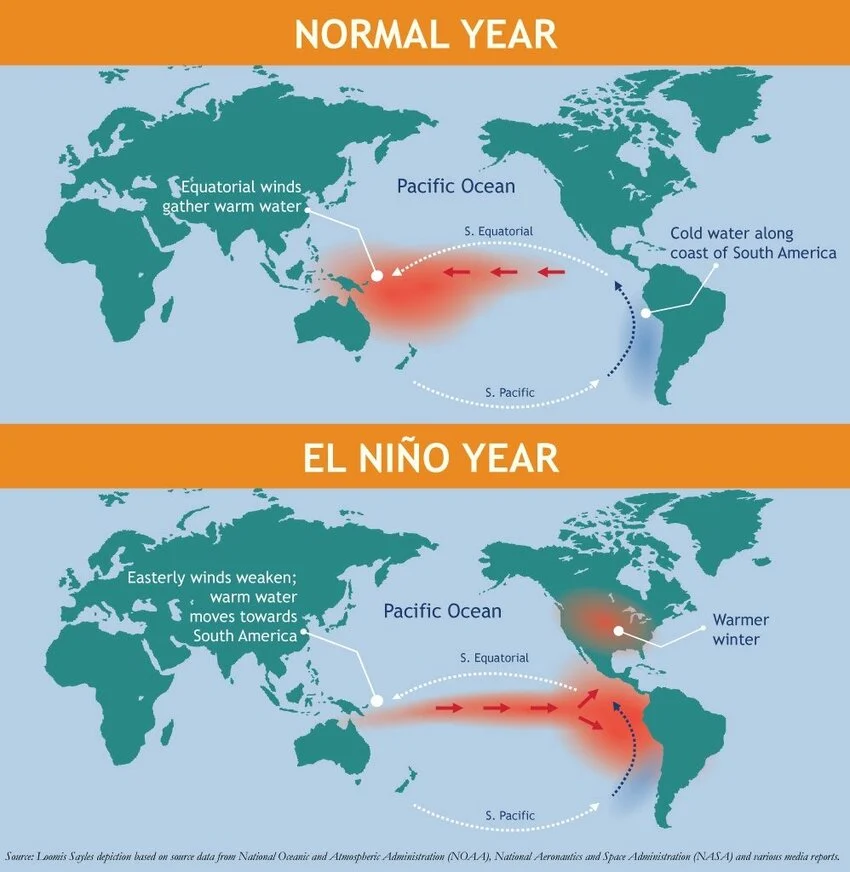
Current Status: Strong El Niño, Not a “Super El Niño”
NOAA’s Climate Prediction Center placed the ENSO Alert System at El Niño Advisory on 8 October 2026. Sea-surface temperature anomalies reached +2.1°C in Niño-3.4, +3.0°C in Niño-3 and +3.9°C in Niño-1+2, while NOAA said a strong-to-very strong El Niño is likely through January–March 2027, with greater than an 83% probability.
The WMO similarly expects El Niño to persist through September–November 2026 and December 2026–February 2027, with a near-100% likelihood, and to strengthen further into November 2026–January 2027, peaking around December 2026.
One important correction to popular commentary: “Super El Niño” is not an official WMO classification. The WMO uses categories such as weak, moderate, strong and very strong; the current event may become historic by some measures, but traders should avoid treating marketing labels as a precise forecast.
Why It Matters for FX
El Niño transmits into currencies through four main channels:
- Food and soft-commodity inflation: Drought risk in South Asia and Southeast Asia threatens rice, sugar, palm oil, corn and edible oils, raising food CPI and potentially forcing tighter monetary policy.
- Commodity export revenue: Some commodity producers benefit from higher prices, while others suffer from disrupted output, damaged infrastructure or lower export volumes.
- Trade balances: Net food and energy importers face higher import bills; exporters with crop failures may lose revenue or impose export restrictions.
- Capital flows and risk sentiment: Persistent inflation, weaker external balances or policy surprises can increase pressure on vulnerable emerging-market currencies and support safe-haven demand.
The crucial point is that El Niño is not a uniform USD-long trade. It is a set of country-specific supply shocks, and the FX impact depends on each economy’s food-import dependence, commodity-export mix, external financing needs and central-bank credibility.
Commodity Prices: Concentrated, Delayed Risk
The strongest El Niño effects are likely in commodities with supply concentrated in exposed regions. The World Bank notes that rice, soybeans, palm oil, coffee and cocoa have historically seen some of the largest price increases after El Niño conditions.
| Commodity | Main El Niño channel | FX relevance |
|---|---|---|
| Rice | Lower South Asian and Southeast Asian output; possible export restrictions | Pressure on INR, PHP, THB and other food-import-sensitive Asian currencies |
| Palm oil | Dry conditions in Indonesia; tighter 2027 supply outlook | Relevant to IDR, MYR and regional inflation expectations |
| Coffee and cocoa | Weather-related supply disruption; geographic concentration | Affects producer currencies and inflation pass-through, though FX impact is usually indirect |
| Copper | Mine disruptions and hydropower constraints can restrict supply | CLP and other copper-linked currencies may not automatically benefit if domestic production falls |
| Energy | Hydroelectric shortfalls and weather-related demand shifts | Raises import bills for energy-importing EMs and can widen current-account deficits |
The World Bank’s October 2026 outlook revised its 2027 palm-oil price forecast higher by 15% amid unusually dry Indonesian conditions, while also flagging that an exceptional El Niño could cause severe weather in unexpected locations and affect rice, palm and coconut oil, soybeans, cocoa and coffee.
For FX, the key is the second-round effect: a food-price shock becomes currency-negative when it feeds into inflation expectations, wage demands, rate hikes, fiscal subsidies or deteriorating external balances. OCBC notes that food prices are the dominant transmission channel for ASEAN-5 and India, and that central banks there face upside inflation risks.
Inflation and Central Banks
El Niño is likely to be more of an inflation shock than a growth shock for much of Asia. Lower agricultural output raises food CPI, while imported food and energy costs can broaden the pressure into core inflation through expectations and wage setting.
The policy response is asymmetric:
- India: High food weighting in CPI makes the Reserve Bank of India particularly sensitive to rice, wheat and edible-oil shocks.
- Philippines: Rice is a staple, and El Niño-related supply disruptions can quickly feed into food inflation and hydropower constraints.
- Indonesia: Dry conditions and palm-oil supply risks create both inflation and trade-balance implications.thedocs.
- Thailand: Invesco suggests the Bank of Thailand may be more inclined to look through an initial supply shock than peers, although this depends on whether inflation becomes broad-based.
This creates a potential divergence trade: currencies from central banks forced to hike—or keep rates higher for longer—may outperform currencies whose policymakers can tolerate the shock. But do not assume a rate hike is automatically bullish; if markets believe the hike is defensive, late, or insufficient to protect the currency, it can fail to stem depreciation.
Trade Balances and Currency Exposure
El Niño’s FX impact depends on whether a country is a net beneficiary or net loser from the shock.
| Currency | Exposure | Likely transmission | Trading implication |
|---|---|---|---|
| INR | High | Food inflation, possible export restrictions, external-balance pressure | Vulnerable if food inflation accelerates or RBI credibility is questioned |
| PHP | High | Rice inflation, farm-output losses, hydropower stress | Sensitive to BSP policy and food-price headlines |
| IDR | High | Palm-oil supply risk, food imports, commodity-price swings | Two-sided: higher palm oil can help exports, but food inflation can hurt |
| THB | Moderate | Tourism, regional risk sentiment and food inflation | May be less immediately rate-sensitive than INR or PHP |
| AUD | Mixed | Drought can hurt agriculture, but mining and bulk-commodity exposure can offset | Do not treat AUD as a simple El Niño short; iron ore, coal and global risk appetite matter |
| NZD | High | Dairy and agricultural export sensitivity to pasture conditions | Bearish risk if drought damages output or export volumes |
| CLP | High | Copper-mining disruption can offset the benefit of higher copper prices | Copper strength alone does not guarantee CLP strength |
| USD | Indirect safe haven | Global risk-off, EM funding stress and higher commodity inflation | USD may benefit in escalation scenarios, but not mechanically in every El Niño phase |
The AUD case illustrates why simplistic commodity-currency logic can fail. El Niño is typically associated with drought in eastern and northern Australia, which is negative for farming; however, Australia’s large mining sector means the currency can also be supported by stronger bulk-commodity prices or global risk appetite.
Short-Term Volatility Versus Long-Term Trends
Short term: headline and positioning risk
Over days to weeks, FX markets will react to:
- NOAA, WMO and national weather-agency updates.
- Crop reports, monsoon data and rainfall forecasts.
- Export bans, tariff changes or food-subsidy announcements.
- CPI releases, especially food and core inflation components.
- Central-bank meetings and emergency policy actions.
These events can create sharp moves in Asian EM pairs, particularly where liquidity is thinner and stop-loss clustering is common. A single export restriction or inflation surprise can trigger a fast repricing even before the physical crop damage is fully known.
Medium term: inflation persistence
Over three to nine months, the more important question is whether food inflation becomes persistent. Reuters reported that global food inflation is expected to accelerate and persist into 2027 as El Niño-driven drought combines with other supply disruptions.
The OECD reportedly expects food prices to peak in Q2 2027, averaging 11% above summer 2026 levels, while IMF research cited in market commentary estimates that a significant El Niño can lift non-energy commodities by 5.5% over 12 months and add as much as one percentage point to inflation. These are forecasts and model estimates, not guarantees.
Longer term: external balances and policy credibility
If the event remains severe, the longer-term FX risk is not merely a one-off CPI spike. It is a cycle of weaker harvests, higher import bills, wider fiscal deficits, reserve drawdowns, tighter policy and capital outflows. That is the environment in which vulnerable EM currencies can experience sustained depreciation rather than a brief volatility spike.
Scenarios to Monitor
| Scenario | What happens | Likely FX implication |
|---|---|---|
| Managed supply shock | El Niño peaks around December 2026, then eases; food inflation rises but remains contained | Short-term EM FX volatility, but no broad structural breakdown; central banks may tighten selectively |
| Persistent food inflation | Drought damages multiple harvests; food inflation spills into core CPI and wages | INR, PHP and other food-sensitive Asian currencies underperform; rate-hike expectations rise |
| Trade-restriction escalation | Rice or other staple-export restrictions spread | Immediate USD demand against vulnerable Asian currencies; higher food-price volatility |
| Commodity and mining disruption | Copper, energy or agricultural supply disruptions compound | Commodity currencies decouple from commodity prices; CLP may underperform despite stronger copper |
| Global risk-off escalation | Inflation, geopolitical disruption and EM funding stress coincide | USD, CHF and JPY may benefit from safe-haven flows; high-beta EM currencies underperform |
How Forex Traders Should Respond
1. Trade the transmission, not the weather label
Do not buy or sell a currency simply because headlines say “El Niño is strengthening.” Identify the specific channel: food CPI, export revenue, energy imports, central-bank reaction or external financing.
2. Focus on high-food-weight economies
Before an inflation release, review the country’s CPI composition and recent food-price data. Economies where food represents a large share of the basket are more exposed to a persistent inflation shock and a more hawkish policy response.
3. Watch central-bank reaction functions
The most tradable signal is not the weather event itself; it is whether policymakers shift from “temporary supply shock” to “second-round inflation risk.” Watch BSP, Bank Indonesia and RBI communications especially closely.
4. Separate commodity price from producer-currency performance
A rally in copper does not automatically mean a rally in CLP if local mine output is disrupted. Similarly, higher palm-oil prices may support IDR only if Indonesia can actually export the volume.
5. Respect liquidity and leverage
Weather-driven EM trades can gap on headlines and become less liquid during risk-off periods. Use smaller position sizes, wider risk parameters where appropriate, and avoid treating exotic-pair spreads as stable during news events.
6. Use a staged approach
Rather than committing to a single long-term view, consider scaling exposure around confirmed catalysts:
- Confirmation of worsening rainfall or crop conditions.
- A rise in food CPI or inflation expectations.
- A central-bank policy shift.
- Evidence of export restrictions or reserve pressure.
- A clear deterioration in the trade balance or capital flows.
Bottom Line
The current El Niño is a credible macro risk, not merely a seasonal weather story. NOAA expects a strong-to-very strong event through early 2027, while the WMO expects it to peak around December 2026, creating a realistic window for food inflation, commodity disruption and policy divergence.
For FX traders, the best approach is disciplined and selective: favor liquid pairs, trade confirmed inflation and policy catalysts, and treat vulnerable Asian and commodity-sensitive currencies as event-driven risks rather than automatic short candidates. The greatest danger is not missing the trade—it is using excessive leverage in a market where weather headlines can change the narrative overnight.
People Also Ask
How does El Niño affect the forex market?
El Niño affects currencies through commodity prices, inflation, export revenues, import costs and investor sentiment. These changes can alter trade balances and expectations for central-bank policy, influencing exchange rates.
Which currencies are exposed to El Niño risks?
The article highlights INR, PHP and THB through food-price pressures; IDR and MYR through palm-oil production and regional inflation; and CLP through copper output. The direction of any currency move depends on the scale of disruption and the policy response.
Does El Niño always strengthen the US dollar?
No. El Niño is not a uniform USD-long trade. Safe-haven demand may support the dollar during uncertainty, but individual currencies respond differently to commodity revenues, import bills, interest-rate expectations and domestic economic conditions.
Can higher commodity prices benefit exporting countries?
Yes, but not automatically. Commodity exporters may earn more when prices rise, yet weather-related production losses or infrastructure damage can reduce export volumes and offset the benefit.
How can forex traders manage El Niño-related risks?
Monitor weather forecasts, commodity prices, food-inflation data, trade balances and central-bank communication. Account for headline volatility and potentially lower liquidity when setting position sizes and risk limits; weather developments alone do not determine currency direction.