Inflation affects forex trading primarily through its influence on central-bank policy, interest-rate expectations, bond yields, and capital flows. The simple rule—hot inflation can support a currency, cool inflation can weaken it—is useful, but it only works when traders understand why markets react and when the relationship breaks down.
The Core Transmission Chain
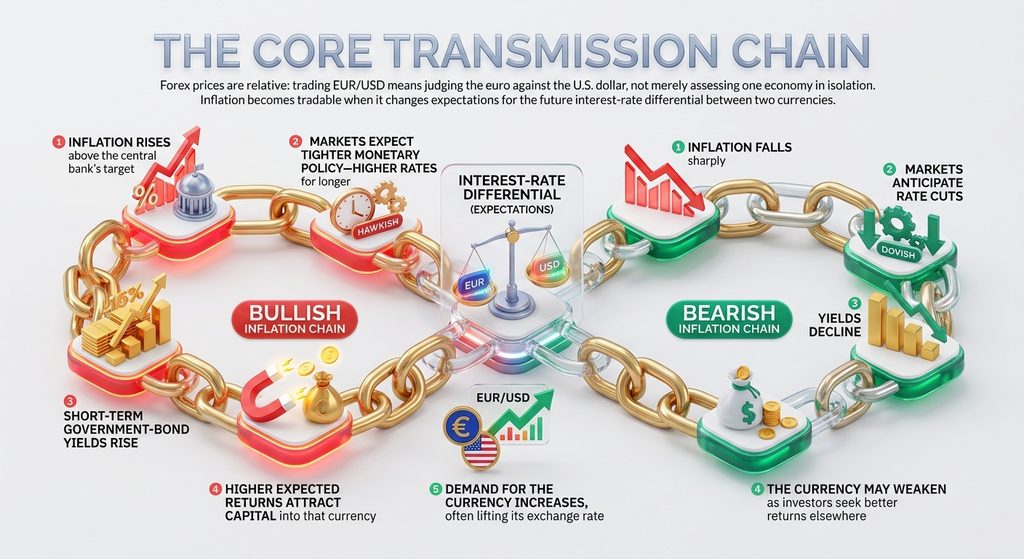
Forex prices are relative: trading EUR/USD means judging the euro against the U.S. dollar, not merely assessing one economy in isolation. Inflation becomes tradable when it changes expectations for the future interest-rate differential between two currencies.
A typical bullish-inflation chain looks like this:
- Inflation rises above the central bank’s target.
- Markets expect tighter monetary policy—higher rates for longer.
- Short-term government-bond yields rise.
- Higher expected returns attract capital into that currency.
- Demand for the currency increases, often lifting its exchange rate.
The reverse can occur when inflation falls sharply: markets anticipate rate cuts, yields decline, and the currency may weaken as investors seek better returns elsewhere.
Why Inflation Can Strengthen a Currency
Central banks generally pursue price stability—low and stable inflation—by adjusting policy rates. When inflation is persistently too high, raising rates makes borrowing more expensive and saving more rewarding, reducing demand and helping slow price growth.
For forex traders, the key is not the rate level alone but the expected path of rates. A currency can rally on an inflation surprise if traders conclude that the central bank must hike, delay cuts, or keep policy restrictive for longer. Higher rates can increase foreign demand for the currency because investors may earn a better return on local-currency assets.
Example: If U.S. CPI comes in much hotter than forecast, markets may reduce expectations of Federal Reserve rate cuts. U.S. yields can rise, making dollar-denominated assets more attractive; USD pairs often respond accordingly—EUR/USD and GBP/USD may fall, while USD/JPY may rise.
Why Inflation Can Also Weaken a Currency
Inflation is not automatically bullish. If price growth becomes excessive or unanchored, it can erode purchasing power, damage confidence, and make investors doubt the central bank’s ability to restore stability. In that environment, a currency may depreciate even if nominal interest rates are high.
This is especially important in emerging markets, where currency depreciation can itself feed inflation through higher import prices. The BIS describes this as exchange-rate pass-through: a weaker currency raises import costs, which can push inflation higher and force further policy tightening.
The trader’s distinction
| Inflation environment | Likely market interpretation | Typical currency implication |
|---|---|---|
| Mild upside surprise, credible central bank | Higher odds of hikes or fewer cuts | Currency may strengthen |
| Persistent inflation well above target | Policy credibility questioned | Reaction becomes mixed; currency may weaken |
| Inflation falling toward target | Rate cuts may be approaching | Currency may weaken |
| Deflation or very weak inflation | Aggressive easing expected | Currency often weakens |
| Inflation driven by supply shocks | Central bank may tolerate some inflation | FX reaction may be smaller or delayed |
CPI Is the Market’s Main Inflation Signal
Most forex traders focus on CPI—the Consumer Price Index—because it is timely, widely watched, and directly feeds expectations for central-bank decisions. Core CPI, which excludes volatile food and energy prices, is often more influential because it better reflects underlying inflation pressure.
What moves price is usually the deviation from consensus, not the headline number itself. A 3.0% CPI print may be bullish for a currency if the market expected 2.7%, but bearish if the market expected 3.4%, because expectations were already positioned for a hotter outcome.
Data points traders should monitor
- Headline CPI: Total consumer-price inflation, including food and energy.
- Core CPI: Excludes volatile items; often more important for policy expectations.
- Month-over-month and year-over-year readings: Monthly data shows momentum; annual data shows the broader trend.
- Central-bank target: A 3% reading means something different for a 2% target bank than for a bank targeting 4%.
- Inflation expectations: Surveys and market-based measures can matter as much as realized CPI.
- Follow-up commentary: Central-bank speeches can confirm, soften, or reverse the market’s initial interpretation.
Interest-Rate Differentials Drive FX
A currency’s attractiveness is often judged relative to another currency’s expected return. This is the practical logic behind carry trades and rate-differential analysis.
If the market expects U.S. rates to remain higher than euro-area rates for longer, the dollar may retain an advantage over the euro. If markets begin pricing ECB hikes while pricing Fed cuts, EUR/USD may face upward pressure. The IMF notes that a country’s interest rates affect its currency’s value, with the effect especially direct under flexible exchange-rate regimes.
For traders, the practical question is:
“After this inflation report, which central bank is now more likely to tighten—or less likely to ease—relative to the other?”
That relative-policy question matters more than whether inflation is objectively “high.”
Market Expectations Come First
Forex markets are forward-looking. By the time a central bank actually hikes or cuts, much of the move may already have occurred as traders positioned around expectations.
This creates three common scenarios:
- In-line data: Limited reaction, because the result was already priced in.
- Modest surprise: Gradual repricing of rate expectations and yields.
- Large surprise: Sharp FX movement, especially if it changes the expected timing of a hike or cut.
A useful trading framework is: CPI surprise → rate-expectation shift → yield shift → currency repricing. If one link fails—for example, CPI rises but bond yields do not—the FX reaction may be weak or short-lived.
When the “Higher Inflation = Stronger Currency” Rule Fails
The relationship is conditional, not mechanical. Inflation can weaken a currency when:
- The central bank is behind the curve or lacks credibility.
- Inflation is driven mainly by currency depreciation and imported-goods costs.
- Markets believe rate hikes will damage growth more than they will contain prices.
- Political or fiscal risks overwhelm monetary-policy support.
- Inflation is already extremely high, making further hikes insufficient to restore confidence.
Emerging-market currencies illustrate this well. The BIS notes that many emerging-market central banks use inflation targeting with flexible exchange rates, but they may also need FX intervention when depreciation threatens to destabilize inflation expectations.
Practical Forex Trading Framework
Before an inflation release
- Identify the consensus forecast and the “whisper number” that would alter rate expectations.
- Check the central bank’s latest guidance and inflation target.
- Map the relevant pair: for U.S. CPI, watch USD pairs; for UK CPI, watch GBP pairs.
- Note current rate-cut or hike expectations and nearby bond-yield levels.
- Define whether the trade idea depends on a hot surprise, cool surprise, or a major deviation from expectations.
At the release
- Compare the result with consensus, prior reading, and core measures.
- Watch immediate bond-yield movement; yields often confirm or contradict the initial FX move.
- Avoid assuming the first spike is the final direction—spreads widen, liquidity thins, and algorithms can produce rapid reversals.
After the release
- Ask whether the data changes the central bank’s likely next decision.
- Look for confirmation across yields, equity risk sentiment, and related currency pairs.
- Wait for a clean retest or consolidation if the initial move is erratic.
- Respect event risk: inflation releases can create volatile, gap-like price behavior.
Risk Management for Inflation Events
Inflation releases are high-impact catalysts, so position sizing and execution discipline matter as much as directional analysis.
- Reduce size around major CPI, PPI, or central-bank decision days.
- Use wider stops or avoid trading the first seconds, since spreads and slippage can expand.
- Avoid overinterpreting one print; central banks usually respond to trends, not a single monthly result.
- Track revisions, because revised prior data can alter the inflation trajectory.
- Separate scalp trades from swing trades: a news spike may reverse, while a genuine shift in rate expectations can drive a multi-week trend.
Traders Takeaways
- Inflation affects forex through expected monetary policy, not through inflation alone.
- Hotter-than-expected inflation can strengthen a currency when it raises expectations for higher-for-longer rates.
- Cooler-than-expected inflation can weaken a currency when it brings rate cuts closer.
- The strongest FX reactions occur when data surprises markets and shifts the expected interest-rate differential.
- Excessive or unanchored inflation can weaken a currency despite high nominal rates.
- Always trade the relative inflation and policy outlook between the two currencies in a pair.
The most reliable forex application is therefore not “buy a currency when inflation rises.” It is: identify whether the inflation surprise changes the market’s view of that central bank’s next move relative to its counterpart—and trade only when yields, expectations, and price action confirm the repricing.