
The August US Nonfarm Payrolls report is the market’s most important scheduled event today. The release will test whether July’s surprise employment contraction was an isolated distortion or evidence that the US labor market is losing momentum—and it could materially alter expectations for the Federal Reserve’s next interest-rate decision.
The report is due at 8:30 a.m. Eastern Time, or 7:30 a.m. Central Time, on Friday, September 4. Current forecasts cluster around 53,000–56,000 new jobs, an unemployment rate of 4.1%, and average hourly earnings growth of approximately 0.3% month over month.
Key Takeaways:
- August Nonfarm Payrolls is crucial for market expectations, with forecasts of 53K–56K jobs impacting Fed decisions.
- Employment Growth Weakens as July saw a 23K decline, raising concerns about labor market momentum.
- Inflation Concerns Persist, maintaining pressure on the Fed despite potential for rate cuts.
- Mixed Signals from indicators like ADP payrolls and ISM services suggest a cautious hiring environment.
- Wide Forecast Range increases potential for significant market reactions if data deviates from consensus.
Why This Report Matters
The US economy is approaching a difficult combination: employment growth is weakening, while inflation remains sufficiently elevated to keep the Fed concerned.
July produced an unexpected 23,000 decline in payrolls, and June and July together showed a small net loss of jobs. At the same time, the unemployment rate remained relatively stable, layoffs have not surged, and the services sector continues to expand. This points to a labor market that is cooling but not necessarily collapsing.
That distinction is crucial for monetary policy. A weak employment report would normally increase the likelihood of rate cuts or discourage further tightening. But if wages and inflation remain firm, the Fed may still prioritize price stability over employment support.
Recent comments from Fed Governor Christopher Waller reflected that tension. Waller described the labor-market situation as satisfactory and indicated that the Fed could keep rates unchanged if disinflation continues, while remaining open to a hike if inflation fails to improve.

The jobs report therefore needs to be interpreted not simply as “good” or “bad,” but through its effect on the Fed’s reaction function.
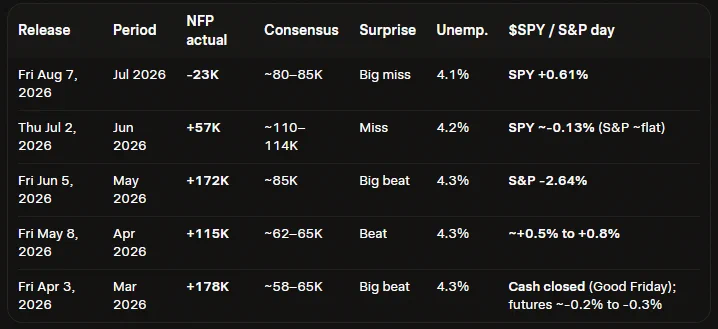
The Market Baseline
The main consensus estimates are:
| Indicator | Forecast | Previous | Market significance |
|---|---|---|---|
| Nonfarm payrolls | +53K to +56K | -23K | Measures the pace of hiring |
| Unemployment rate | 4.1% | 4.1% | Shows labor-market slack |
| Average hourly earnings, monthly | +0.3% | +0.1% | Key inflation and wage-pressure gauge |
| Average hourly earnings, annual | Around 3.0%–3.1% | Around 3.2% | Important for Fed inflation concerns |
These figures would represent a modest rebound from July, but still a historically subdued pace of job creation. CNBC described the expected outcome as “stable but unexciting,” rather than evidence of either a booming economy or a severe recession.
One important complication is that estimates vary considerably. Some analysts expect payroll growth in the 75,000–125,000 range based on leading indicators, while others—including Citi economists—see a figure closer to 20,000, with unemployment potentially rising to 4.2%.
This unusually wide forecast range increases the likelihood of a sharp market reaction if the data land well outside consensus.
What the Leading Indicators Say
The pre-report evidence is mixed.
Negative signals
- ADP private payrolls: Private employers added only 38,000 jobs in August, below the roughly 47,000 consensus estimate.
- ISM Services employment: The employment subindex remained in contraction territory at 47.8, below the 50 threshold that separates expansion from contraction.
- Recent payroll history: July’s -23,000 result and downward revisions have weakened confidence in the labor-market trend.
- Potential immigration-related effect: The expiration of Temporary Protected Status for many Haitian workers may have temporarily reduced recorded employment, particularly in labor-intensive service industries.
Positive signals
- ISM Services activity: The headline services PMI rose to 55.4, with business activity at 61.7 and new orders at 60.9, showing that demand remains resilient.
- Jobless claims: Initial claims have remained relatively low, and the four-week moving average was reported near 207,000.
- Limited layoffs: The pace of layoffs has remained subdued, suggesting that weak hiring has not yet become widespread job destruction.
- Manufacturing employment: The ISM manufacturing employment subindex remained around the expansion threshold.
The broad message is that businesses may be reluctant to hire aggressively, but they are not yet firing workers in large numbers. That creates a “low-hiring, low-layoff” environment—one that can keep unemployment stable for a time but is vulnerable to deterioration if demand weakens.
Three Main Scenarios
1. Weak payrolls and soft wages
Possible result:
- Payrolls below 25,000.
- Unemployment rises to 4.2% or higher.
- Hourly earnings below 0.2% month over month.
- Negative revisions to previous months.
This would be the clearest bearish-dollar scenario. It would reinforce the argument that the labor market is weakening and reduce the urgency for a September rate hike.
Likely market reaction:
- US dollar: lower.
- USD/JPY: lower, meaning a stronger yen.
- EUR/USD and GBP/USD: higher, assuming no offsetting European or UK weakness.
- Gold: higher as Treasury yields and the dollar fall.
- US equities: potentially higher initially on lower-rate expectations, although a severe payroll miss could revive recession concerns.
For forex traders, the cleanest expression would normally be dollar weakness, but the yen deserves special attention because USD/JPY is already highly sensitive to BoJ intervention concerns and expectations for a Japanese rate hike.
2. Near-consensus report
Possible result:
- Payrolls between roughly 35,000 and 65,000.
- Unemployment remains at 4.1%.
- Wages rise around 0.2%–0.4%.
This would confirm a weak but broadly stable labor market. The initial price move could be volatile, but the report may not create a lasting directional trend unless the revisions or wage data surprise significantly.
A near-consensus result would leave traders focused on:
- The next inflation releases.
- Fed officials’ speeches.
- The size and direction of payroll revisions.
- Whether wage growth is accelerating or cooling.
- The September FOMC decision.
This is the most dangerous environment for impulsive news trading because the headline may initially push the dollar in one direction while wages or revisions produce a reversal.
3. Strong payrolls and firm wages
Possible result:
- Payrolls above 95,000 or especially above 125,000.
- Unemployment holds at 4.1% or declines.
- Hourly earnings rise above 0.4%.
- Previous payrolls are revised higher.
This would challenge the idea that the labor market has materially deteriorated. It could increase expectations for the Fed to maintain or raise interest rates, particularly because inflation remains above the central bank’s target.
Likely market reaction:
- US dollar: higher.
- USD/JPY: higher in normal circumstances, although intervention risk could limit the move.
- EUR/USD and GBP/USD: lower.
- Gold: lower as yields and the dollar rise.
- Equity indices: potentially lower if the report sharply reduces expectations for rate cuts or increases the likelihood of another hike.
StoneX’s scenario analysis also emphasizes that payrolls alone are not enough: a strong headline combined with weak wages may produce only a modest dollar response, while strong payrolls and wages above 0.4% would be substantially more supportive for the dollar.
The Most Important Data Point May Be Wages
Forex traders often focus on the headline NFP number, but average hourly earnings may determine the lasting market reaction.
Payrolls measure labor demand. Wages influence inflation and therefore interest-rate expectations.
For example:
- +100K payrolls with +0.1% wages: The dollar may rise briefly, but the move could fade because wage pressure is soft.
- +50K payrolls with +0.5% wages: The report may be more dollar-positive than the headline suggests because persistent wage inflation keeps the Fed hawkish.
- +20K payrolls with +0.4% wages: The market may struggle to interpret the data, producing rapid two-way price action.
- +50K payrolls with unemployment rising to 4.2%: This would provide a stronger signal of labor-market deterioration than the headline alone.
Traders should therefore read the report as a package:
- Payroll change.
- Unemployment rate.
- Average hourly earnings.
- Labor-force participation rate.
- Revisions to June and July.
- Private payrolls and government payrolls.
- Temporary and seasonal distortions.
How Forex Traders Should React with NFP
Before the release
The safest approach is usually to reduce exposure rather than predict the number. NFP releases can create:
- Extremely wide spreads.
- Slippage.
- Stop-loss execution away from the intended level.
- False breakouts.
- Rapid reversals within the first few minutes.
Traders holding positions into the report should consider reducing leverage, widening risk assumptions only if their trading plan permits it, or using smaller position sizes. A stop-loss does not guarantee the exact exit price during a fast market.
The dollar is already vulnerable after the yen’s sharp rally and Waller’s relatively dovish comments. That means a weak NFP may produce an exaggerated dollar selloff, while a strong NFP may trigger a sharp but potentially crowded rebound.
During the first reaction
Avoid treating the first one-minute candle as the final market interpretation. The initial move can be driven by the headline number before traders process wages, unemployment, and revisions.
A more disciplined sequence is:
- Wait for the first volatility spike to develop.
- Compare the headline with consensus.
- Check wages and unemployment.
- Review revisions.
- Observe whether Treasury yields and the dollar confirm the move.
- Enter only if the broader reaction remains aligned.
A useful confirmation filter is the relationship between DXY, US two-year yields, and the currency pair. If a strong jobs number is released but yields and DXY fail to rise, the dollar move may lack conviction.
After the initial volatility
Instead of trading the first headline burst, some traders wait for:
- A retracement toward the pre-release range.
- A break and retest of a key intraday level.
- Confirmation from Treasury yields.
- A second move after the New York session absorbs the data.
This can reduce exposure to the initial spread widening and headline whipsaw.
Currency-Specific Considerations
USD/JPY
USD/JPY presents the greatest policy risk. A strong US jobs report would normally support the pair, but suspected Japanese intervention and rising BoJ hike expectations may limit upside.
A weak US report could push USD/JPY lower through both mechanisms:
- Lower US rate expectations weaken the dollar.
- Lower USD/JPY levels reinforce yen strength and intervention concerns.
Traders should avoid assuming that the pair will respond only to the US data. Japan’s policy signals may override the conventional NFP reaction.
EUR/USD
EUR/USD is likely to respond primarily through the dollar and US yields. A weak NFP could support a move higher, while a strong report could pressure the pair.
However, traders should also monitor European data and ECB expectations. A weaker German or euro-area economic backdrop could limit EUR/USD gains even during a dollar selloff.
GBP/USD
GBP/USD may benefit from a weak NFP, but the pair also faces UK-specific risks. Construction-sector data and comments from Bank of England Governor Andrew Bailey are on the calendar, so sterling could experience an independent move around the US release.
AUD/USD and NZD/USD
Commodity currencies may respond positively to a weak US jobs report if the dollar falls and global risk sentiment improves. But a severe NFP miss could eventually hurt risk-sensitive currencies if markets interpret the data as recessionary rather than merely supportive of lower US rates.
Gold
Gold is particularly sensitive to the dollar and real yields. A weak NFP combined with soft wages would likely support gold, while strong payrolls and firm wages could pressure it.
Gold has already rebounded above $4,450 after the dollar’s decline, making the employment report a test of whether the recovery is fundamental or simply a short-term reaction to dollar weakness.
A Practical Trading Framework
| Report outcome | Fed interpretation | Dollar bias | Typical FX response |
|---|---|---|---|
| Payrolls below 25K, soft wages, unemployment higher | Greater concern about labor weakness; hike expectations fall | Bearish USD | EUR/USD and GBP/USD higher; USD/JPY lower |
| Payrolls 35K–65K, wages 0.2%–0.4%, unemployment 4.1% | Weak but stable; Fed remains data-dependent | Mixed/neutral USD | Whipsaw or range trading likely |
| Payrolls above 95K, firm wages, unemployment stable/lower | Labor market stronger; hike or higher-for-longer expectations rise | Bullish USD | EUR/USD and GBP/USD lower; USD/JPY higher, subject to intervention risk |
| Weak payrolls but firm wages | Growth concern versus inflation concern | Initially mixed | Large two-way volatility |
| Strong payrolls but soft wages | Better hiring but less inflation pressure | Moderately bullish USD | Dollar may rise, then reverse |
Bottom Line
The August NFP report is unlikely to be judged solely by whether payrolls exceed or miss the 55,000 forecast. The decisive question is whether the data show a labor market that is cooling gradually or starting to deteriorate materially.
For traders, the most important combinations are:
- Weak payrolls + weak wages: bearish dollar, bullish gold.
- Strong payrolls + strong wages: bullish dollar, bearish gold.
- Mixed data: heightened whipsaw risk; wait for confirmation.
- Any outcome in USD/JPY: account for BoJ intervention risk and yen-hawkish positioning.
The best response is not to predict the first candle. It is to prepare scenarios, control leverage, wait for the market to digest the full report, and trade only when price action confirms the macroeconomic interpretation.
People Also Ask:
What is the significance of the Nonfarm Payrolls report?
The Nonfarm Payrolls report measures employment growth, which is crucial for understanding economic health and guiding Federal Reserve policy decisions.
How does employment data affect Federal Reserve decisions?
Employment data influences the Fed’s interest rate decisions by indicating economic strength or weakness, impacting inflation and monetary policy strategies.
Why are inflation concerns important for the Fed?
Inflation concerns are vital as they affect the Fed’s priorities between promoting employment and ensuring price stability, influencing their interest rate policies.