The U.S. 10-year Treasury yield has climbed above the psychologically important 5% mark, its highest level since October 2023 and a threshold not firmly sustained since 2007. Because this yield anchors the “risk-free” rate for the global financial system, a move above 5% ripples through mortgages, corporate borrowing, stock valuations, and currency markets.
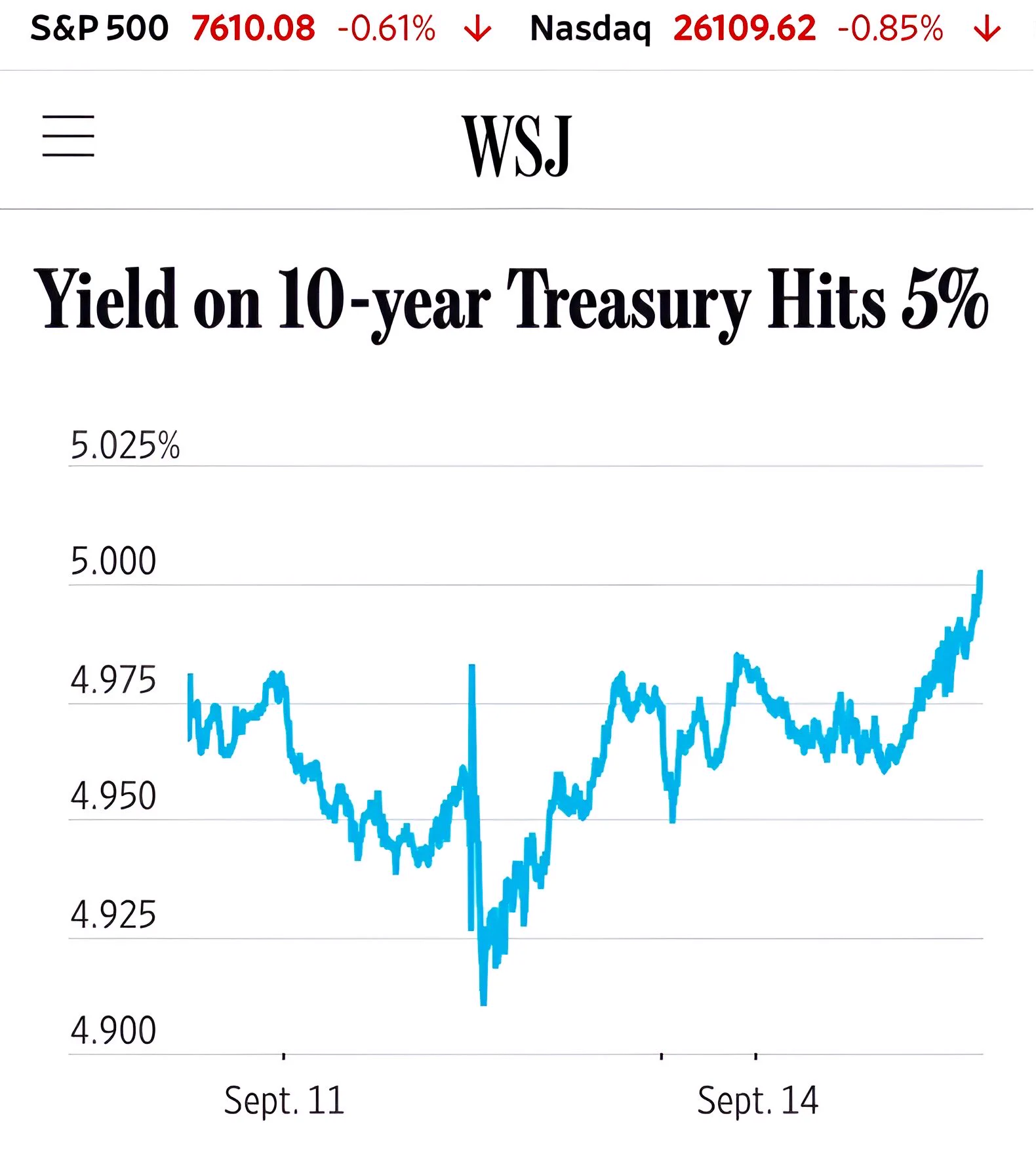
Below is a clear, reader-friendly guide to what’s happening, why it matters, and how different investors—and especially forex traders—can think about the road ahead.
Key Takeaways:
- The 10-year Treasury yield has climbed above 5%, its highest since 2007, affecting global financial systems.
- Rising yields impact mortgage rates, corporate borrowing costs, and stock valuations, leading to broader economic effects.
- Factors driving the yield spike include geopolitical tensions, inflation expectations, and increased bond supply.
- Higher yields pose challenges for homebuyers and companies with significant borrowing needs, especially in tech and AI sectors.
- Sustained yields above 5% may lead to a shift from stocks to bonds, affecting investment strategies.
Why Everyone Is Talking About 5%
The 10-year Treasury yield is more than a bond-market statistic; it is the benchmark interest rate that influences everything from home loans to the discount rate used to value stocks. When it crosses 5%, it signals that investors now demand a much higher return to lend money to the U.S. government for a decade, often because they expect stronger growth, stickier inflation, or greater fiscal risk.

For everyday readers, think of the 10-year yield as the “gravity” of finance: when it rises, it pulls down the price of existing bonds and makes borrowing more expensive across the economy. For traders and portfolio managers, it’s a key input in deciding whether stocks, bonds, or cash offer the best risk-adjusted returns.
What’s Driving the Spike?
Several forces have converged to push the 10-year yield above 5%:
Energy and Geopolitical Shocks
Escalating tensions in the Middle East, including conflict involving the U.S. and Iran and disruptions to major shipping lanes such as the Strait of Hormuz and the Bab al-Mandeb, have driven Brent crude toward $109–$110 a barrel. Higher oil prices feed directly into inflation expectations, prompting investors to demand higher yields on long-dated bonds.
Inflation and Fed Policy Expectations
With energy-led inflation fears resurfacing, money markets are pricing in a high probability of a Federal Reserve rate hike at its upcoming meeting, alongside a “higher for longer” stance on policy rates. When investors expect tighter monetary policy, long-term yields tend to rise in anticipation of higher short-term rates and slower growth.
Fiscal Trajectory and Bond Supply
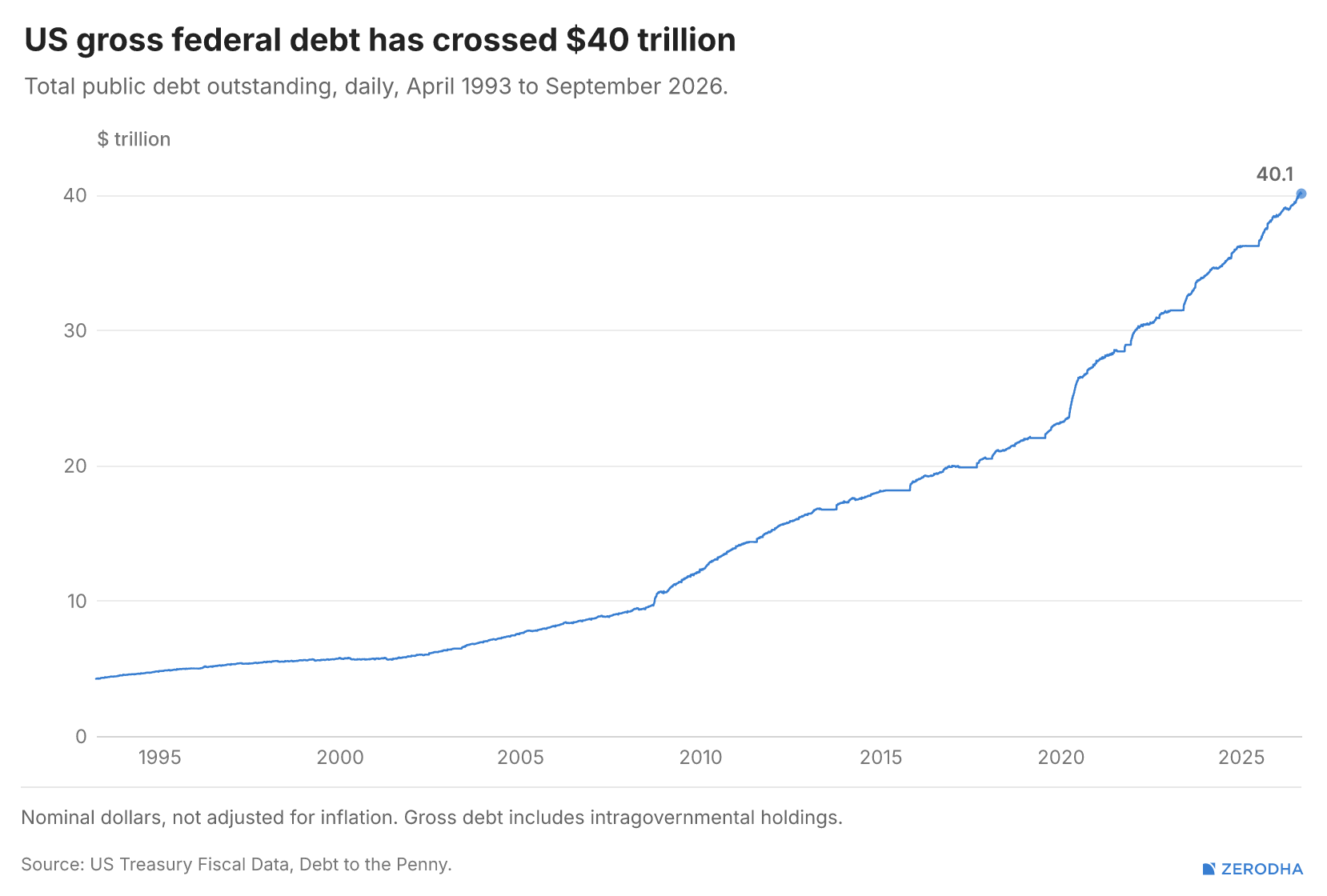
The U.S. national debt has surpassed $40 trillion, and large fiscal deficits mean the Treasury is issuing a heavy volume of new bonds. More supply, without a matching increase in demand, pushes bond prices down and yields up. Analysts note that concerns about debt sustainability add a risk premium to longer-dated Treasuries.

AI and Corporate Borrowing Demand
A separate, structurally new factor is the surge in borrowing and capital expenditure by big-tech and AI-focused companies. This increases overall demand for long-term funding in the economy, contributing to upward pressure on long-term rates alongside government issuance.
Why a 5% Yield Is a Global Benchmark
The 10-year Treasury yield matters because it is the reference rate for the world’s largest and most liquid bond market. Its level influences:
- Mortgage rates: The average 30-year fixed mortgage has climbed toward roughly 6.76% as the 10-year yield rose, up from around 6% earlier in the year.
- Corporate borrowing costs: Companies that issue long-term debt or rely on credit markets face higher interest expenses, which can weigh on profits and investment plans.
- Valuation of stocks: Higher “risk-free” yields reduce the present value of future earnings, especially for high-growth, long-duration stocks.
- Global bond markets: Yields on German 10-year Bunds, U.K. gilts, and Japanese government bonds have also moved higher as the U.S. selloff spreads.
In short, a 5% 10-year yield resets the baseline return that investors can earn without taking credit risk, forcing a repricing across almost every asset class.
Who Feels This Most?
Households and Homebuyers
Higher 10-year yields translate quickly into higher mortgage rates, making homes less affordable and refinancing less attractive. For households with variable-rate debt or credit cards tied to benchmark rates, monthly payments can rise as borrowing costs increase.
Companies and Investors in Growth Stocks
As borrowing costs rise, companies—especially those with heavy capital spending plans in tech and AI—face more expensive financing. At the same time, when “risk-free” Treasuries pay around 5%, the extra return (equity risk premium) that stocks must offer to be attractive shrinks, pressuring valuations.
Experts warn that sustained yields above 5% can make bonds more competitive with stocks, potentially triggering a rotation out of equities and into fixed income. Infrastructure Capital Advisors’ Jay Hatfield has described increases in Treasury yields as “unambiguously bad for stocks,” while strategists like Nationwide’s Mark Hackett highlight the risk of a more protracted equity downturn if inflation and yields surprise to the upside.
Governments and Debt Sustainability
With U.S. debt above 100% of GDP, higher long-term yields increase the cost of servicing that debt, raising concerns about fiscal sustainability over time. Capital Economics’ John Higgins notes that while 5% may not be a literal “meltdown” level, higher yields do threaten the sustainability of public finances and add risk to equities.
Market Expectations: What Investors Are Pricing In
Market participants are broadly expecting:
- Tighter Fed policy: A rate hike at the upcoming Federal Reserve meeting is now seen as highly probable, with investors adjusting to a “higher for longer” rate path.
- Elevated inflation risks: As long as oil stays well above $100 a barrel, inflation expectations are likely to remain elevated, keeping pressure on yields.
- Continued bond-market volatility: Analysts describe the current environment as one where bond “bears” are in control, pushing yields toward and beyond 5% as they reassess growth, inflation, and fiscal outlooks.
Some strategists caution against fixating on the exact 5% number, calling it somewhat arbitrary, but agree that the direction and level of yields are critical for risk assets. Oxford Economics’ John Canavan has noted that as long as oil keeps rising, inflation risks will increase and expectations for Fed tightening will grow, leaving rates vulnerable to moving higher.
Strategic Playbook for Forex Traders
For Forex (FX) traders, a 5% U.S. 10-year yield drastically alters currency dynamics. Capital naturally chases higher yields, heavily shifting regional currency pairings.
1. Trade the Yield Differentials (Go Long USD)
- The Play: Buy the U.S. Dollar (USD) against currencies where central banks cannot keep pace with the Fed’s hawkish path.
- Key Pair to Watch: USD/JPY. The Bank of Japan (BoJ) is trying to tighten, but the expanding yield gap between the U.S. and Japan acts as a powerful magnet pulling capital into the greenback. Watch for potential Japanese Ministry of Finance intervention if the yen drops too fast.
- Other Pairs: EUR/USD and GBP/USD. Even with European yields rising (e.g., German Bunds), the sheer liquidity and absolute yield advantage of the USD make it the primary beneficiary of macro tightening.
2. Position for “Risk-Off” Domination
- The Play: When the 10-year breaches 5%, equities usually stumble. Treat this as a classic macro “risk-off” environment.
- Short High-Beta/Growth Currencies: Look to short risk-sensitive commodity currencies like the Australian Dollar (AUD/USD) and New Zealand Dollar (NZD/USD). Global equity sell-offs and high borrowing costs weigh heavily on these pairs.
- Long Safe Havens: Utilize the Swiss Franc (USD/CHF or EUR/CHF) alongside the USD as traditional shelters against geopolitical volatility and global market stress.
3. Monitor the Yield Curve Shape
The Play: Watch the 2s/10s spread. A rapid steepening or sharp flattening tells you whether the market believes the Fed is successfully curbing inflation or accidentally steering the economy into a hard landing. If the curve flattens aggressively, prepare for a sharp, volatile reversal where the market pivots to pricing in a future recession, which would eventually crush the USD.
Conclusion: What This Means for You
A 10-year Treasury yield above 5% is a clear signal that the era of ultra-low rates is over for now, and that investors are demanding more compensation for lending money over the long term. For households, this means higher borrowing costs; for companies, tighter financial conditions; and for investors, a reassessment of the balance between stocks, bonds, and cash.
For forex traders and globally minded investors, the key takeaway is that yield differentials will increasingly drive currency moves. As long as U.S. yields remain high relative to other major economies, the dollar is likely to stay well supported, especially against currencies where central banks cannot or will not match the Fed’s hawkish stance.
History offers two contrasting lessons: in 2007, a rise in the 10-year yield above 5% preceded a financial crisis and deep recession, while in 2023, a brief breach was followed by falling yields and a powerful equity rally. The path ahead will depend on how inflation, growth, geopolitics, and fiscal policy evolve—but in all scenarios, the 5% level marks a new regime for global markets.
A Simple Example to Tie It All Together
Imagine you are deciding between:
- A “safe” 10-year Treasury bond yielding 5%, and
- A stock that historically returns about 8% per year on average.
When the Treasury yielded 2–3%, the extra 5–6 percentage points from stocks looked very attractive. Now, with the “risk-free” rate at 5%, the extra return from stocks is much smaller, so many investors shift some money into bonds. That rotation pushes stock prices down and bond yields up further, reinforcing the cycle until something changes—whether that’s inflation, growth, or policy.
This is the essence of why a move above 5% in the 10-year Treasury yield is more than a headline: it reshapes incentives for savers, borrowers, companies, and traders around the world.
People Also Ask:
What does a 5% Treasury yield mean for mortgages?
A 5% Treasury yield typically leads to higher mortgage rates, making home loans more expensive and reducing affordability.
How does the 10-year Treasury yield affect stock valuations?
Higher yields increase the risk-free rate, reducing the present value of future earnings and pressuring stock valuations.
Why is the 10-year Treasury yield important globally?
It serves as a benchmark for global bond markets, influencing interest rates and investment decisions worldwide.
What factors contribute to rising Treasury yields?
Key factors include geopolitical tensions, inflation expectations, Federal Reserve policies, and increased bond supply.