
For a Forex trader, a country’s housing market is not just a collection of brick-and-mortar assets. It is a massive, real-time barometer of consumer health, banking stability, and domestic monetary policy. In the United Kingdom, where property is practically a national obsession, the connection between the British Pound (GBP) and the real estate market is remarkably tight.
Understanding this dynamic allows currency traders to anticipate major shifts in sterling, turning housing data releases into actionable trading signals.
Key Takeaways:
- The UK housing market is a real-time barometer for consumer health, banking stability, and monetary policy.
- Events like the 2008 Financial Crisis, Brexit, and the 2022 Mini-Budget have significantly influenced the relationship between GBP and real estate.
- The Pound’s value impacts foreign investment in UK property, with weaker GBP attracting more overseas buyers.
- Interest rate changes by the Bank of England affect mortgage rates and, consequently, consumer spending and housing demand.
- Current UK consumer behavior is risk-averse due to elevated inflation and volatile borrowing costs, affecting both buying and rental markets.
The Pillars of Property and Sterling
To understand where the UK housing market stands today, we must look at the structural shocks that rewrote its rules:
- The 2008 Financial Crisis: This event fundamentally broke the relationship between wages and property values. A massive crash led to ultra-loose monetary policy, pushing the Bank of England (BoE) to drop interest rates to historic lows. This triggered a decade-long property boom fueled by cheap credit, while simultaneously leaving the Pound structurally weaker against the US Dollar (USD) compared to its pre-2008 peaks.
- The 2016 Brexit Referendum: The vote to leave the European Union acted as an immediate shock to both currency and real estate markets. The Pound plummeted overnight, which altered foreign investment patterns. Prime London real estate—long considered a safe haven—suddenly became a “value play” for global investors using stronger currencies.
- The 2022 “Mini-Budget” Chaos: In late 2022, sudden fiscal policy shifts sent UK bond yields soaring and forced the BoE into emergency bond-buying. The Pound touched an all-time low of near $1.03. Mortgage providers panicked, pulling thousands of deals overnight. This event served as a stark reminder of how rapidly fiscal mismanagement can simultaneously crash the currency and freeze the housing market.
Currency Impact: The Two-Way Street of GBP and Property
The relationship between the Pound and UK housing operates like a financial see-saw, driven by two primary forces:
1. The “London Discount” (Foreign Capital Inflow)
When GBP weakens, UK real estate effectively goes on sale for overseas buyers holding USD or EUR. If the Pound drops by 10% against the Dollar, a £1 million luxury apartment in London instantly becomes $100,000 cheaper for an American private equity investor, even if the domestic sticker price hasn’t changed. Consequently, sharp drops in GBP often trigger a delayed surge in commercial and prime residential buying, which ultimately puts a floor under falling property prices.
2. The Interest Rate Transmission Mechanism
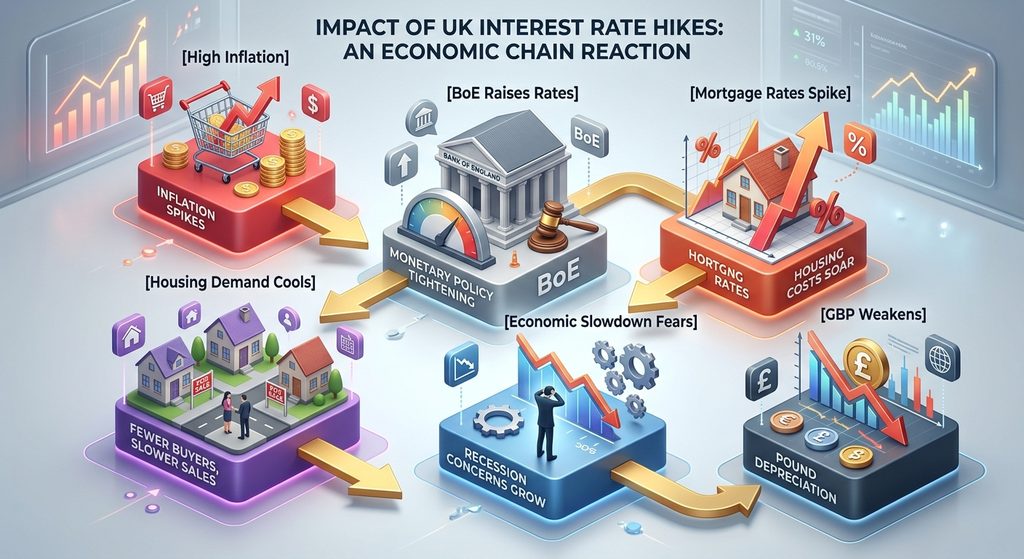
The more critical link for everyday trading is how the housing market forces the BoE’s hand. Because a vast majority of UK homeowners rely on fixed-rate mortgages that renew every 2 to 5 years, they are highly sensitive to interest rate fluctuations.
If inflation spikes, the BoE raises the base rate. This immediately drives up mortgage rates, reduces consumer disposable income, and cools house prices. For a Forex trader, watching how well consumers digest these higher rates tells you how much further the BoE can tighten policy before risking a severe economic recession.
Caught in the “Affordability Squeeze”
Current consumer behavior in the UK is heavily dictated by defensive financial positioning. Following a prolonged period of elevated inflation and volatile borrowing costs, the British consumer has become highly risk-averse.
- The Remortgage Cliff: Millions of households that locked in ultra-low mortgage rates during the pandemic have faced major payment shocks upon renewal. This has forced a shift in consumer spending; cash that previously went into retail, dining, and travel is now being redirected to cover basic housing costs.
- The Rental Surge: With first-time buyers struggling to meet strict affordability checks, demand has shifted massively toward the rental sector. This has caused a significant supply-demand mismatch, driving rental prices up while the sales market remains relatively stagnant.
- Policy Hesitation: Buyers have shown a distinct tendency to sit on their hands ahead of major fiscal announcements, such as the upcoming Autumn Budget Statement, fearing potential hikes in property or capital gains taxes.
A Fragmented Recovery
The housing market is showing a distinct split based on geography and price brackets. The era of uniform nationwide property booms has been replaced by a highly fragmented landscape:
| Market Segment | Current Dynamics | Forex Significance |
|---|---|---|
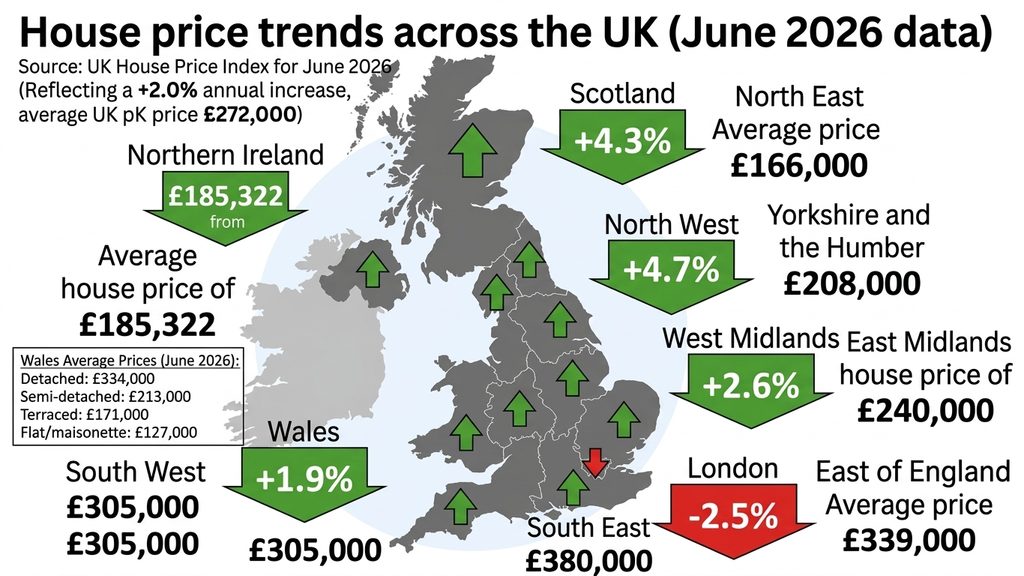
| Prime Central London | Heavily reliant on international cash buyers. Facing a slight downward trend in domestic terms, but supported by currency-hedged foreign capital. | Reflects global liquidity and institutional appetite for GBP-denominated assets. |
| Regional Resales (North West / North East) | Displaying stronger resilience with modest annual growth due to better baseline affordability relative to local wages. | Indicates the true health of the domestic UK middle class and internal consumer confidence. |
| The Rental Sector | Experiencing severe inventory shortages as private landlords exit the market due to unfavorable tax changes. | Drives services inflation upward, which keeps pressure on the Bank of England to maintain a hawkish stance. |
Translating Property Data to Pips
Forex traders do not need to buy physical property to profit from the UK housing market. Instead, they can use housing metrics as a leading indicator to trade GBP/USD and EUR/GBP:
1. Trading the RICS and Nationwide Releases
Major data prints—such as the Royal Institution of Chartered Surveyors (RICS) Residential Market Survey or the Nationwide House Price Index—frequently trigger short-term volatility in the Pound.
- The Strategy: If RICS buyer enquiries move deeper into negative territory, it signals a stalling economy. Traders can use this to short GBP ahead of retail sales or GDP prints, anticipating that the macro environment is deteriorating faster than expected.
2. The Interest Rate Cap Play
When trading GBP pairs, the housing market tells you where the BoE’s “pain threshold” lies.
- The Strategy: If house prices begin dropping sharply on a month-on-month basis, it implies that the restrictive interest rates are fracturing the economy. In this scenario, even if inflation remains slightly sticky, the BoE will likely be forced to pause or cut interest rates to prevent a banking crisis. Traders can aggressively position for a weaker Pound via EUR/GBP longs or GBP/USD shorts, anticipating a dovish pivot from policymakers.
3. Gauging Foreign Direct Investment (FDI) Flows
A stabilizing housing market accompanied by recovering capital values attracts cross-border mergers, acquisitions, and institutional real estate purchases.
- The Strategy: When institutional data shows real estate asset values bottoming out and transitioning to a neutral or positive outlook, it acts as a green light for global fund managers. This structural demand for sterling to finalize multi-million-pound commercial or portfolio deals provides a medium-term bullish floor for the currency.
The Hard Numbers
To ground this macro analysis, look at the core metrics defining the current environment:
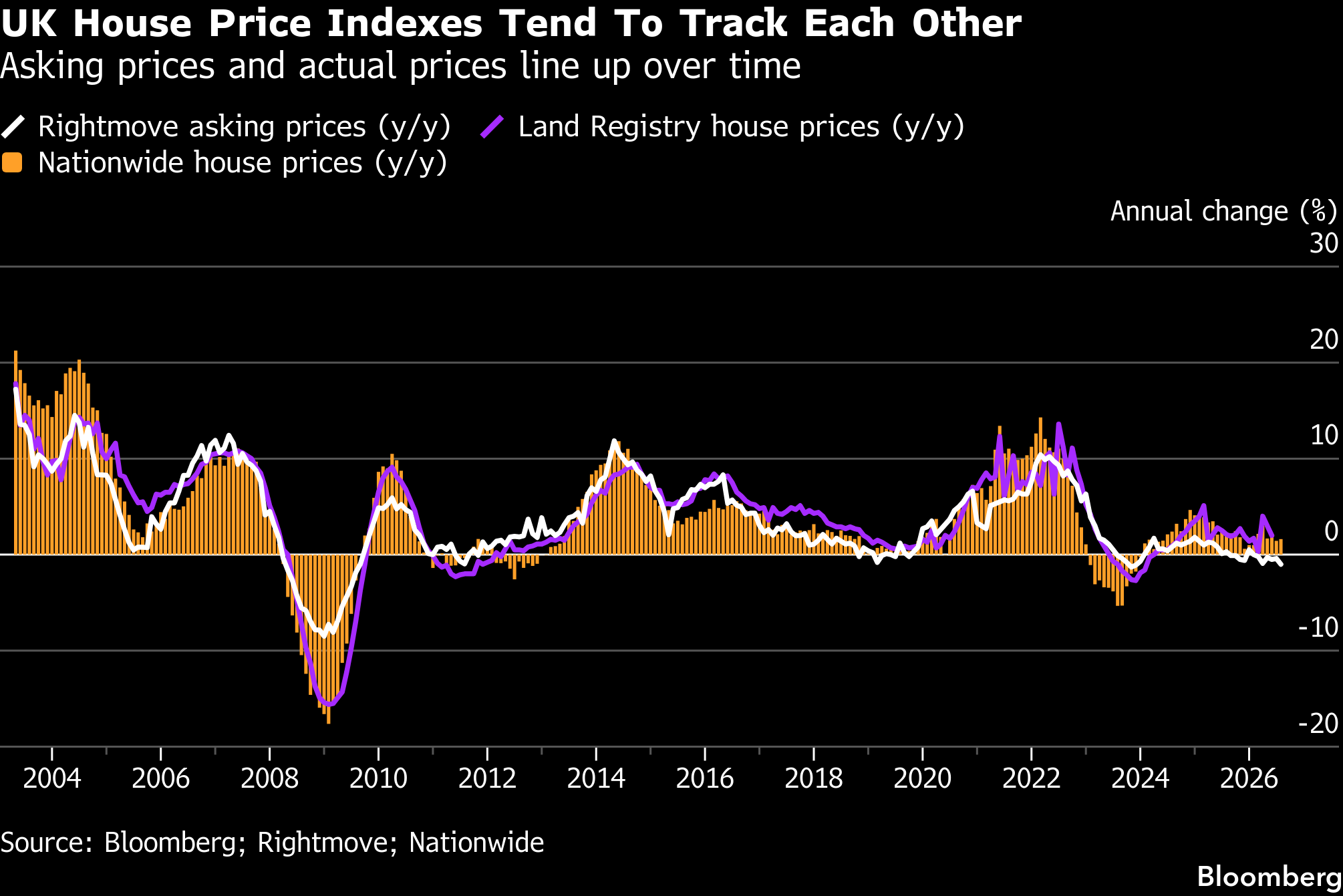
- Annual House Price Growth: Average UK house prices increased by a modest 2.0% over the past 12 months.
- The Rent vs. Buy Divergence: While house price appreciation remains muted, private sector rental costs have climbed sharply by 3.7% annually, underscoring high domestic inflation pressures.
- The Mortgage Reality: The average two-year fixed-rate mortgage deal sits at 5.59%, a substantial increase from the sub-2% rates seen during the pandemic era.
- Market Sentiment Balance: The latest RICS house price balance index printed at -28%. While still negative, this represents a gradual “bottoming out” process from previous cyclical lows, indicating the market is finding a fragile equilibrium.
People Also Ask:
How does the UK housing market affect the GBP?
The UK housing market influences the GBP by reflecting economic health, affecting foreign investment, and responding to interest rate changes set by the Bank of England.
What historical events have impacted the UK housing market?
Key events include the 2008 Financial Crisis, the 2016 Brexit Referendum, and the 2022 Mini-Budget, all of which reshaped the relationship between property values and the GBP.
Why is consumer behavior important for Forex traders?
Consumer behavior indicates economic strength or weakness, affecting spending patterns and housing demand, which in turn impact currency valuation.
What is the “London Discount”?
The “London Discount” refers to the phenomenon where a weaker GBP makes UK real estate cheaper for foreign investors, boosting property demand when the Pound falls.
How do interest rates affect the UK housing market?
Interest rates impact mortgage costs; higher rates can reduce housing demand by increasing monthly payments, thus affecting property prices and consumer spending.